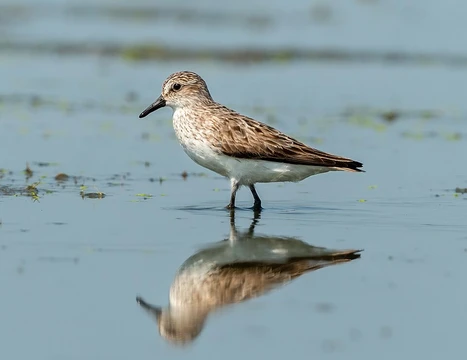
Latham's snipe
A migratory snipe of the East Asian–Australasian Flyway.
Last updated
Latham's snipe, also called the Japanese snipe, is a medium-sized shorebird with a long bill that migrates along the East Asian–Australasian Flyway. Why it bears that name is uncertain; John Latham, an English physician and ornithologist who studied Australasian birds, had no known link to the species.
Scientific classification
- KingdomAnimalia
- PhylumChordata
- ClassAves
- OrderCharadriiformes
- FamilyScolopacidae
- GenusGallinago
- SpeciesGallinago hardwickii
Named by (Gray, JE, 1831)
Close relatives
Other species of Gallinago with a Codexery entry.
- Swinhoe's snipe Gallinago megala
- Pin-tailed snipe Gallinago stenura
- Common snipe Gallinago gallinago
- Great snipe Gallinago media
- Magellanic snipe Gallinago magellanica
- Pantanal snipe Gallinago paraguaiae
Sources: Wikipedia taxobox: Latham's snipe (CC BY-SA 4.0) · order, family and genus agree with WoRMS AphiaID 225952 (CC BY 4.0)
Conservation status
Near Threatened (NT)
- LC
- NT▲ this species
- VU
- EN
- CR
- EW
- EX
Source: IUCN Red List assessment · GBIF copy of the Red List category
How big is it?
Largest length in the source, 0.54 m, next to a 1.8 m person.
Diagram: drawn by Codexery, schematic shapes to scale (not a likeness). Length: Wikipedia: Latham's snipe
Where the latham's snipe has been recorded
Each dot is a place where the species has been observed and reported (79,315 records, half-degree grid) — not a modelled range. 173 inland records left out (institution coordinates).
Map: drawn by Codexery. Data: GBIF occurrence search (records CC0 / CC BY) · Natural Earth basemap (public domain) · place coordinates: Wikipedia (CC BY-SA 4.0)
Distribution and habitat
The Latham's snipe raises its young mainly on the northern Japanese island of Hokkaidō, with smaller breeding populations on Honshū, the Russian mainland, Sakhalin, and formerly the Kurile Islands. Every bird migrates, spending the off-season mostly in eastern Australia, where it is the most common Gallinago snipe.
Migrating individuals have been spotted in Taiwan, the Philippines, and New Guinea, and it occasionally wanders to New Zealand. Its Asian breeding grounds are alpine moorland, grasslands, rough pasture, young tree plantations, and farmland. In Australia, it lives in shallow freshwater wetlands, using bare mud or shallow water to feed and nearby vegetation for cover.
Status and conservation
The global status for Latham's snipe is near-threatened. Australia once allowed hunting of this bird, but it now has full protection and, since a 2020 review, a vulnerable listing under national law.
South Australia’s 1972 act marks it as rare. Japan’s environment ministry also lists it as near-threatened. Although development in Hokkaido has created more breeding grounds, the overall population keeps falling.
Did You Know?
- Courtship consists of display flights and drumming by the males.
- The nest is on the ground, concealed in vegetation, with a clutch of four eggs.
- Its diet includes seeds, plant material, insects, earthworms, spiders, and occasionally molluscs, isopods, and centipedes.
More in Shorebirds
Test yourself
Three questions drawn from this entry’s sources. Pick an answer to check it.
Answers checked against the source article
Sources
Compiled from Wikipedia and the sources listed below. Text from Wikipedia is available under CC BY-SA 4.0; this entry is adapted from it.
- Wikipedia: Latham's snipe (CC BY-SA 4.0).
- Classification: the source article's taxobox; order, family and genus checked against WoRMS, the World Register of Marine Species (CC BY 4.0).
- Conservation status: IUCN Red List assessment.
- Occurrence records: GBIF (CC0 / CC BY). Basemap: Natural Earth (public domain).
Spotted an error? Know more?
Reader corrections go straight into our review queue. Suggest an edit · How this site is sourced