Wa shogi
A large shogi variant with animal-named pieces and unclear historical rules.
Wa shogi (和将棋, wa shōgi, harmony chess) is a large board variant of shogi in which all pieces are named for animals. It is played either with or without drops, though modern players typically use drops. The historical rules are unclear because the surviving sources for large shogi variants are often terse and inconsistent, except for chu shogi and dai shogi.
Quick Facts
- Board size
- 11 ranks by 11 files
- Pieces per player
- 27
- Objective
- Capture the opponent's crane king
Facts from the source article.
Did You Know?
- The outcome of that championship is uncertain; the title could have been disputed between Francis Fahys and game inventor Wayne Schmittberger in the early 2000s.
- A few games from that tournament can be viewed on the heterochess.net website.
Rules of the game
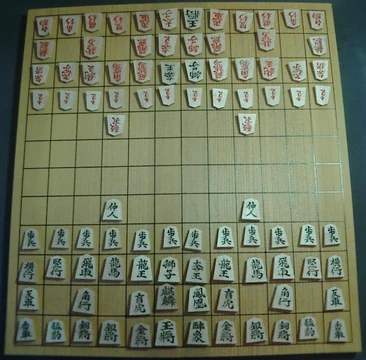
The objective is to capture the opponent's crane king. Two players, Black and White (or sente and gote), play on an 11×11 grid of undifferentiated squares. Each player has 27 wedge-shaped pieces of slightly different sizes. From largest to smallest they are: crane king, cloud eagle, flying falcon, swallow's wings, treacherous fox, running rabbit, violent wolf, violent stag, flying goose, flying cock, strutting crow, swooping owl, blind dog, climbing monkey, liberated horse, oxcart, and 11 sparrow pawns. Each piece has its name in two kanji on its face; the reverse side, turned up to indicate promotion, bears two other characters, often in a different color. Crane kings, cloud eagles, and treacherous foxes lack a reverse side. Pieces are wedge-shaped and face forward toward the opponent. In the rank nearest the player, the crane king is placed in the center file. The violent wolf is to its left, the violent stag to its right. The flying goose is left of the violent wolf, the flying cock right of the violent stag. The strutting crow is left of the flying goose, the swooping owl right of the flying cock. The blind dog is left of the strutting crow, the climbing monkey right of the swooping owl. The oxcart is in the left corner file, the liberated horse in the right corner file. In the second rank, the swallow's wings is in the same file as the crane king, the flying falcon in the same file as the blind dog, and the cloud eagle in the same file as the climbing monkey. In the third rank, the treacherous fox is in the same file as the flying goose, the running rabbit in the same file as the flying cock, and nine sparrow pawns occupy the remaining files. The fourth rank also receives pieces.
Game notation
A typical example is SP-8f. The first letter(s) represent the piece: SP for sparrow pawn, OC for oxcart, LH for liberated horse, CM for climbing monkey, BD for blind dog, SO for swooping owl, SC for strutting crow, FC for flying cock, FG for flying goose, VS for violent stag, VW for violent wolf, RR for running rabbit, TF for treacherous fox, SW for swallow's wings, FF for flying falcon, CE for cloud eagle, and CK for crane king. Promoted pieces have a + added before the letter, e.g., +SP for a golden bird. The piece designation is followed by a symbol: - for an ordinary move or x for a capture. Next is the destination square, consisting of a file number and a rank letter, with 1a being the top right corner from Black's view and 11k the bottom left corner. This follows Japanese convention, which uses Japanese numerals instead of letters (e.g., 2c is 2三). If a move allows promotion, a + at the end indicates promotion was taken, or an = that it was declined, e.g., FFx7c=. When ambiguity arises, the start square is added after the piece designation; this can only apply to golden birds. Moves are commonly numbered as in chess.
More in Shogi Variants
Spotted an error? Know more?
Reader corrections go straight into our review queue. Suggest an edit · How this site is sourced