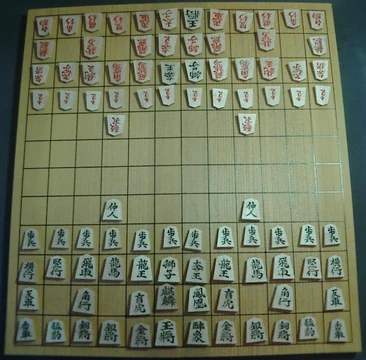
Dai dai shogi
A 17×17 shogi variant with promotion by capture.
Dai dai shōgi (大大将棋 'huge chess') is a large board variant of shogi that dates to the 15th century and is based on the earlier dai shogi. It is the smallest board variant to use a 'promotion by capture' rule. The historical rules are unclear due to contradictory sources, and it is uncertain how much the game was actually played.
Quick Facts
- Board size
- 17 ranks by 17 files (289 squares)
- Pieces per player
- 96
- Piece types per player
- 64
- Earliest known century
- 15th century
- Based on
- dai shogi
Facts from the source article.
Did You Know?
- The kirin's name is sometimes anglicised as 'kylin'.
- The historical sources for dai dai shogi include the Edo-era publications 象戯図式 (Shōgi Zushiki), 諸象戯図式 (Sho Shōgi Zushiki), and 象棋六種之図式 (Shōgi Rokushu no Zushiki).
Rules of the game
The objective is to capture the opponent's king. Unlike standard shogi, captured pieces may not be dropped back into play. Two players, Black and White (or sente and gote), play on a board of 17 ranks by 17 files, totaling 289 undifferentiated squares. Each player has 96 wedge-shaped pieces of 64 different types, with 68 different moves to remember. The pieces vary in size, from largest to smallest (roughly most to least powerful): King, Queen, Rushing bird, Free demon, Free dream-eater, Water buffalo, Dragon king, Dragon horse, Square mover, Racing chariot, Rook, Bishop, Golden bird, Great dragon, Standard bearer, Fragrant elephant, White elephant, Lion, Lion dog, Dove, She-devil, Blue dragon, White tiger, Right chariot, Left chariot, Phoenix, Kirin, Poisonous snake, Old kite, 2 Violent oxen, Flying dragon, Enchanted fox, Old rat, Enchanted badger, Flying horse, Prancing stag, 2 Savage tigers, Hook mover, Long-nosed goblin, Northern barbarian, Southern barbarian, Eastern barbarian, Western barbarian, Neighboring king, Blind monkey, 2 Ferocious leopards, 2 Evil Wolves, 2 Violent bears, Right general, Left general, 2 Gold generals, 2 Silver generals, 2 Copper generals, 2 Iron generals, 2 Wood generals, 2 Stone generals, 2 Angry boars, Cat sword, 2 Reverse chariots, 2 Lances, 2 Side movers, Vertical mover, 2 Howling Dogs, and 17 Pawns. Each piece has its name in two Japanese characters on its face; the reverse side, often in a different color, indicates promotion. Pieces are wedge-shaped and face forward to show ownership. Relatively few pieces promote; some pieces only appear upon promotion.
Game notation
Moves are expressed using a method established by George Hodges in 1976, derived from algebraic chess notation with modifications for dai dai shogi. A typical example is P-8g. The first letter indicates the piece; promoted pieces have a '+' prefix (e.g., +BM for a mountain witch). A '-' denotes an ordinary move, and 'x' denotes a capture. The destination square is given by a file number and a rank letter, with 1a as the top right corner from Black's view and 17q as the bottom left corner, based on Japanese convention. For a lion capturing by 'igūi', the captured piece's square is used with a '!' symbol; double captures are added after the first. If a capture mandates promotion, a '+' is appended (e.g., CSx7c+). When ambiguous, the start square is added after the piece designation. Moves are numbered as in chess.
Strategy
According to the German Chu Shogi Association, average piece values (using interpretations of The Shogi Association, e.g., the lion dog as a three-square range mover without lion power) are normalized so a pawn is worth 1 point. These values exclude the king's royal status. Pieces gain value if they have a good chance of promotion, especially the old kite and poisonous snake, which promote to the two most powerful pieces.
More in Shogi Variants
Spotted an error? Know more?
Reader corrections go straight into our review queue. Suggest an edit · How this site is sourced