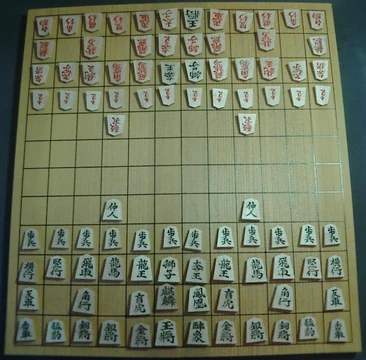
Sho shogi
16th-century predecessor of modern shogi with a drunk elephant piece.
Shō shōgi (小将棋 'small chess') is a 16th-century form of shogi, the immediate predecessor of the modern game. It is notable for including a drunk elephant piece that promotes into a prince, acting as a second king. The drunk elephant was eliminated by the Emperor Go-Nara, and the drop rule is assumed to have been introduced around the same time, giving rise to shogi as known today.
Quick Facts
- Board size
- 9×9
- Pieces per player
- 21
- Piece types
- king
- drunken elephant
- rook
- bishop
- 2 gold generals
- 2 silver generals
- 2 knights
- 2 lances
- 9 pawns
- Objective
- Capture opponent's king and crown prince (if present) or all other pieces
- Eliminated by
- Emperor Go-Nara (reigned 1526–1557)
Facts from the source article.
Rules of the game
The objective is to capture the opponent's king and crown prince (if present) or all other pieces. Two players, Black and White (or sente and gote), play on a board of 9 ranks by 9 files, with undifferentiated squares. Each player has 21 wedge-shaped pieces, sized from largest (most powerful) to smallest: king, drunken elephant, rook, bishop, two gold generals, two silver generals, two knights, two lances, and nine pawns. English names roughly correspond to Western chess equivalents rather than direct translations. Each piece bears two kanji on its face; the reverse side, often in red, indicates promotion. Pieces face forward toward the opponent. Promoted bishops are sometimes called horses, promoted rooks dragons, and promoted pawns tokin; silver and gold generals are commonly called silvers and golds. The reverse characters for pieces promoting to gold generals are cursive versions of 金, becoming more abbreviated as the original piece's value decreases: 全 for promoted silver, 今 for promoted knight, 仝 for promoted lance, and 个 for tokin. Another convention uses 圭 for promoted knight, 杏 for promoted lance, 全 for promoted silver, and と for tokin. Each side places pieces pointing toward the opponent. In the nearest rank, the king goes in the center file, gold generals adjacent to the king, silver generals adjacent to each gold, knights adjacent to each silver, and lances at the corners. The second rank holds the rook in the second file from the left and the bishop in the second file from the right. The third rank is filled with nine pawns.
Game notation
The English-language notation for shogi moves, established by George Hodges in 1976, derives from algebraic chess notation but differs in several ways. A typical example is P-8f. The first letter indicates the piece: P = pawn, L = lance, N = knight, S = silver, G = gold, B = bishop, R = rook, DE = drunken elephant, K = king. Promoted pieces have a + prefix, e.g., +P for tokin. The piece designation is followed by a symbol: - for an ordinary move, x for a capture. Next is the destination square, given as a file number and a rank letter, with 1a as the top right corner from Black's view and 9i as bottom left. This follows Japanese convention, which uses numerals instead of letters (e.g., 2c is 2三). If a move allows promotion, a + appended indicates promotion was taken, an = that it was declined. For example, Nx7c= means a knight captures on 7c without promoting. When ambiguity arises, the start square is added after the piece designation. Moves are numbered as in chess, e.g., 1. P-7f P-3d.
More in Shogi Variants
Spotted an error? Know more?
Reader corrections go straight into our review queue. Suggest an edit · How this site is sourced