Daifugō
Japanese shedding card game with social hierarchy and taxation.
Last updated
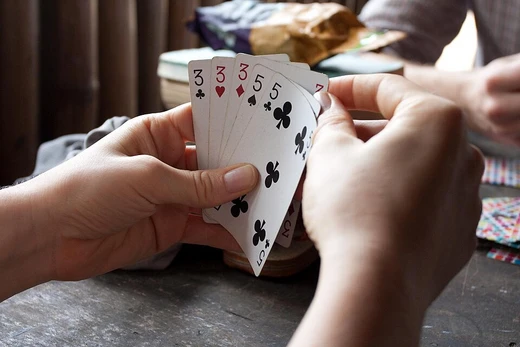
Daifugō, also called Fool or Tycoon, is a Japanese shedding card game for three or more players using a standard 52-card deck. The goal is to be the first to discard all cards by playing increasingly stronger cards than the last player. The first to finish, the daifugō or grand millionaire, earns perks in the next round, while the last player is the daihinmin, or grand pauper. Winners may exchange unwanted cards for better ones from losers in the following round.
Basic rules
The rules described here are based on those popularized in the U.S. by Tokyopop in volume two of the manga Fruits Basket, aiming to condense the game to its core elements. Gameplay varies by region as it is taught and evolves by word of mouth. Five special titles are used: Daifugō (winner of previous round, also President/Tycoon), Fugō (second place, Vice President/Rich), Heimin (average placement, Neutral/Commoner), Hinmin (second-to-last, Dirt/Poor), and Daihinmin (last place, Lowest Dirt/Beggar).
In the first round all players are heimin, with the dealer chosen randomly. Depending on player count, multiple players may be heimin or none; a three-player game has no fugō or hinmin. After each hand, players switch seats so the daihinmin deals and everyone sits clockwise in title order, with daifugō on the dealer's left and hinmin on the right (American variants often skip this). The daihinmin shuffles and deals all cards clockwise; jokers, other wilds, or extra 2s may be used for even dealing, or the deal starts to give richer players fewer cards.
After the first hand, the daihinmin gives their two strongest cards to the daifugō, and the hinmin gives their one strongest to the fugō; the daifugō and fugō then return an equal number of unwanted junk cards, a process called zeikin (taxation). Play is organized into tricks, but each trick can involve multiple cards per player, and players may pass.
Optional rules
House rules are common in Daifugō. Rule No. 420: if the losing player finishes first, the card order 1,2,3,4 reverses to 4,3,2,1. Strict 52-card: uneven hand sizes are allowed, with the benefit of smaller hands going to richer players; the deal starts with the richest heimin (or hinmin in a four-player game) and continues clockwise down wealth rank. Dummy Hand: after the first round, one extra hand is dealt; the daifugō may swap their dealt hand with the dummy hand before taxation, without looking at it first, and cannot change their mind afterward.
Deuce Means Clear: a single 2 beats any other combination and clears the pile, allowing the holder to steal the lead; this is common in Western versions including Asshole. Match Means Clear: if a player matches the current active play (e.g., a 7 on a 7, or two Kings on two Kings), the trick is cleared; this is sometimes called the Grand Palace Rule. Jokers are Wild: can be played almost anytime as any value but cannot beat a 2; a joker alone is one higher than the previous card, and a joker with another card equals that card's value. Jokers are 2s is another variant.
Social aspects
Titles from the game often extend to social interactions. The daihinmin may be required to fetch snacks and drinks, though this task is sometimes given to the hinmin so the daihinmin can shuffle and deal. The daifugō can give an order after each round that must be followed, such as having all heimin bark like dogs or the hinmin give a backrub. The daifugō may also add rules related to the game itself, though limitations such as a maximum number of additional rules or the ability for other players to override by unanimous vote are often set before the game starts.
Popular culture
In Fruits Basket, a popular manga and anime series, characters often play Daifugō, emphasizing its fun social aspects. In 2006, Score Entertainment released a Fruits Basket card game containing a set of Daifugō rules. In volume 6 of Ouran High School Host Club, Haruhi Fujioka and Suoh Tamaki (very poor man and poor man) were made to obey Kyoya Ootori (rich man) after a game. The commercial game The Great Dalmuti is a custom Daifugō deck where lower-numbered cards are strictly better, with copies of each card equal to its value.
Dilbert: Corporate Shuffle is a further variant adding three special effect cards. In the PC game Katawa Shoujo, Misha and Shizune challenge Hisao to play Daifugō. In Germany, a similar game is called Vollarsch or Arschloch (Asshole). In Belgium, the loser is called Stront (shit in Dutch).
In Sweden, the game was once called neger och president (Negro and President), reflecting slave-age USA hierarchy, but newer titles like President have been adopted. A Greek variant called Νίγκα features five ranks (Masta, Half-Masta, Swiss, Half-Nigga, Nigga), uses cards sevens and up with aces strongest, and includes a Swiss card swap option and the Kakumei-Revolution rule.
More in Shedding-type Card Games
Sources
Compiled from Wikipedia and the sources listed below. Text from Wikipedia is available under CC BY-SA 4.0; this entry is adapted from it.
- Wikipedia: Daifugō (CC BY-SA 4.0).
Spotted an error? Know more?
Reader corrections go straight into our review queue. Suggest an edit · How this site is sourced