Dou dizhu
A Chinese shedding game of bidding, bombs, and peasant teamwork.
Last updated
Dou dizhu is a shedding-type card game in the gambling genre, widely regarded as one of the most popular card games in China. It is considered easy to learn but hard to master, requiring mathematical and strategic thinking along with carefully planned execution. Suits are irrelevant in play, and the game can be played with a deck that has no suits printed on the cards.
Game play
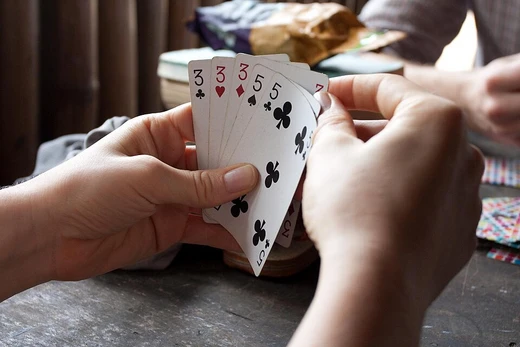
A shuffled pack of 54 cards is dealt to three players, each receiving 17 cards, with the last three cards left face down on the table. Players review their own cards without showing them, then take turns bidding for the landlord position by stating a risk stake of 1, 2, or 3, with higher stakes indicating greater confidence. The first bidder is chosen randomly in most online rooms; in real life, house rules vary, such as the player holding the three of hearts bidding first, or rotating the first bidder each round. A player may pass or outbid the prior player, unless the prior player bet 3.
The highest bidder becomes the landlord, and the remaining two players form the peasant team. The three leftover cards are revealed to all and then given to the landlord. The landlord wins by discarding all their cards first; the peasant team wins if either peasant empties their hand first.
Rules
Individual cards are ranked from highest to lowest: Red Joker, Black Joker, 2, Ace, King, Queen, Jack, 10, 9, 8, 7, 6, 5, 4, 3. Suits are irrelevant. The Rocket and the Bomb are special groups that function differently from other hands. Hands are compared only within the same category, and chains are compared only if they have the same length; the Rocket and Bomb are exceptions that can beat hands of different lengths.
For chains, only the rank of the primal cards matters; the kicker's rank is irrelevant. Jokers and 2 are non-consecutive and cannot appear in the primal cards of chains; for example, 2-3-4-5-6 is illegal. Hand types include: individual card, one pair, chain (five or more consecutive cards), pairs chain (three or more consecutive pairs), trio with single card, trio with pair, and airplane (two or more consecutive trios). The game uses terms such as hook for Jack, circle for Queen, K for King, tip for Ace, and king for joker, with small king for the black joker and big king for the red joker.
Scoring rules
The game uses a betting mechanism where the winner collects money or points from the loser(s). It can be seen as two separate bets, one between each peasant and the landlord. The bidding stake (1, 2, or 3) sets the initial stake.
Two multipliers apply: a spring (if both peasants play no cards, or the landlord plays no cards after their first hand) doubles the score; each bomb or rocket played also doubles the score. For example, if the landlord wins with a base stake of 2 and one bomb and one rocket are played, the stake is doubled twice to 8, so each peasant pays the landlord 8 units. If a peasant goes out first, the landlord pays each peasant the multiplied stake.
Variations
A four-player version, played mainly in Zhejiang and Jiangsu provinces including Shanghai, uses a double deck of 108 cards with two red and two black jokers. Each player takes 25 cards, and 8 cards are left for the landlord, who plays alone with 33 cards against three peasants. Combinations differ: single card attachments are not permitted, nor are four-with-a-kicker categories. Bombs are four- or five-of-a-kind, rockets are six-of-a-kind, missiles are seven-of-a-kind, sky explosions are eight-of-a-kind, and a nuke (four jokers) is the greatest hand, which can beat anything; if the landlord holds all four jokers, they may claim them and choose to win without playing.
Another variation uses wild cards: after the landlord is determined, four-of-a-kind are randomly selected as wild cards that can stand for any card except jokers. Some games feature two sets of wild cards, one drawn before bidding and another after.
Did You Know?
- The name dou dizhu derives from the class struggle during land reform in the 1950s after the Chinese Communist Party took over China, encouraging peasants to take up arms against landlords.
- China's Generation Y, among the most enthusiastic player groups, has no personal experience of this specific overt class struggle.
- In 2005, 117,931 people participated in a dou dizhu online tournament held by GICQ.
More in Shedding-type Card Games
Sources
Compiled from Wikipedia and the sources listed below. Text from Wikipedia is available under CC BY-SA 4.0; this entry is adapted from it.
- Wikipedia: Dou dizhu (CC BY-SA 4.0).
Spotted an error? Know more?
Reader corrections go straight into our review queue. Suggest an edit · How this site is sourced