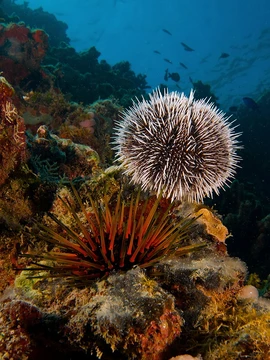
Loxechinus
Monotypic genus of sea urchin native to southern South America.
Last updated

ゆうき315 · via Wikipedia: Loxechinus · CC BY-SA 4.0
Loxechinus albus is the sole species in the genus Loxechinus, a sea urchin native to coastal southern South America and the Falkland Islands.[1] It is a fast-growing, large urchin with a test diameter up to 11 cm, though southern populations grow slower and smaller.[2] In Chile, this species is called 'Erizo rojo' and is both fished commercially and used in local dishes.[3]
Scientific classification
- KingdomAnimalia
- PhylumEchinodermata
- ClassEchinoidea
- OrderCamarodonta
- FamilyParechinidae
- GenusLoxechinus
- SpeciesLoxechinus albus
Named by Molina, 1782
Sources: Wikipedia taxobox: Loxechinus (CC BY-SA 4.0) · order, family and genus agree with WoRMS AphiaID 160809 (CC BY 4.0)
Where the loxechinus has been recorded
Each dot is a place where the species has been observed and reported (30,744 records, half-degree grid) — not a modelled range. 32 inland records left out (institution coordinates).
Map: drawn by Codexery. Data: GBIF occurrence search (records CC0 / CC BY) · Natural Earth basemap (public domain) · place coordinates: Wikipedia (CC BY-SA 4.0)
Quick Facts
- Species
- albus
Facts from the source article.
Key facts and history
The species ranges from Ecuador along Peru and Chile to Argentina, including the Falkland Islands.[1] The echinopluteus larvae spend about thirty days as zooplankton before settling in the rocky intertidal zone.[4] This urchin lives on rocky seafloors and along shorelines, from the intertidal zone down to 340 meters deep.[5] The body is flattened from top to bottom and thickly covered with short spines; live animals usually look a dull reddish color with some pale green spines.[2]
Because of too much harvesting and insufficient management, this urchin has become uncommon in certain areas.[3] Eight years are needed for this urchin to grow large enough to be harvested.[3]
What the cited sources add
A 2010 study on growth and reproduction at the southern edge of the species' range reports that those far-south populations develop more slowly and end up smaller.[2] The same 2010 study is one of the sources for the maximum test diameter of 11 cm.[2] Details on spawning periods at different latitudes and the eight-year growth to harvest size come from the Species Fact Sheets published by the Fisheries and Aquaculture Department.[3]
References
- Wikipedia, "Loxechinus" (CC BY-SA 4.0), which cites: "Growth and reproduction of Loxechinus albus (Echinodermata: Echinoidea) at the southerly peripheries of their species range, Falkland Islands (South Atlantic)", Mar Biol, 2010, p. 1837–1847; "Loxechinus Desor, 1856", 2022 (original not read by us) en.wikipedia.org
- Wikipedia, "Loxechinus" (CC BY-SA 4.0), which cites: "Growth and reproduction of Loxechinus albus (Echinodermata: Echinoidea) at the southerly peripheries of their species range, Falkland Islands (South Atlantic)", Mar Biol, 2010, p. 1837–1847; Species Fact Sheets: Loxechinus albus (Molina, 1782) Fisheries and Aquaculture Department. Retrieved 2011-08-26.; Carolina J. Zagal and Consuelo Hermosilla C. (2007). Guía de Invertebrados marinos del sur de Chile. Editorial Fantástico Sur, Punta Arenas, Chile; Species Fact Sheets: Loxechinus albus (Molina, 1782) Fisheries and Aquaculture Department. Re en.wikipedia.org
- Wikipedia, "Loxechinus" (CC BY-SA 4.0), which cites: Species Fact Sheets: Loxechinus albus (Molina, 1782) Fisheries and Aquaculture Department. Retrieved 2011-08-26. (original not read by us) en.wikipedia.org
- Wikipedia, "Loxechinus" (CC BY-SA 4.0), which cites: Ecology of Loxechinus albus Retrieved 2011-08-26. (original not read by us) en.wikipedia.org
- Wikipedia, "Loxechinus" (CC BY-SA 4.0), which cites: Carolina J. Zagal and Consuelo Hermosilla C. (2007). Guía de Invertebrados marinos del sur de Chile. Editorial Fantástico Sur, Punta Arenas, Chile (original not read by us) en.wikipedia.org
Each numbered sentence above was checked against the source it cites before publication. Sentences citing Wikipedia adapt text from the English Wikipedia article Loxechinus (contributors), used under CC BY-SA 4.0; this entry is available under the same licence. Other sources were used for facts only; no text or images are copied from them.
More in Sea Urchins
Sources
Compiled from Wikipedia and the sources listed below. Text from Wikipedia is available under CC BY-SA 4.0; this entry is adapted from it.
- Wikipedia: Loxechinus (CC BY-SA 4.0).
- Classification: the source article's taxobox; order, family and genus checked against WoRMS, the World Register of Marine Species (CC BY 4.0).
- Occurrence records: GBIF (CC0 / CC BY). Basemap: Natural Earth (public domain).
- Word definitions: the Codexery glossary, each quoted from its Wikipedia article.
Spotted an error? Know more?
Reader corrections go straight into our review queue. Suggest an edit · How this site is sourced