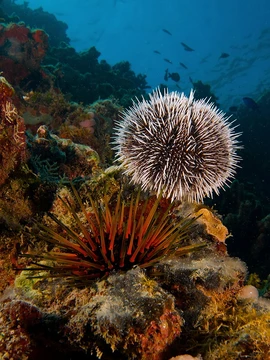
Heliophora
A morphologically variable sand dollar from West African waters.
Last updated
It has an endoskeleton of calcareous ossicles covered in ciliated tissue, and moves using spines rather than tube feet.[1]
Scientific classification
- KingdomAnimalia
- PhylumEchinodermata
- ClassEchinoidea
- OrderClypeasteroida
- FamilyRotulidae
- GenusHeliophora
- SpeciesHeliophora orbicularis
Named by Agassiz 1840
Sources: Wikipedia taxobox: Heliophora (CC BY-SA 4.0) · differs from this box at order: WoRMS AphiaID 534502 (CC BY 4.0)
Last updated 2026-10-08 from the source article.
Quick Facts
- Family
- Rotulidae
- Only species
- Heliophora orbicularis
- Earliest occurrence
- Late Miocene
- Geographic range
- western coast of Sahara and Senegal to Angola
- Habitat
- very shallow water of lagoons and estuaries, lightly buried in mud
Facts from the source article.
Key facts and history
Its tube feet are used for gas exchange, not locomotion.[1] In the center of its test is a feeding device called Aristotle's lantern, capable of suspension feeding, herbivory, detritivory, and occasional predation.[1] Its low, domed profile acts as a hydrofoil, generating lift that lunules help reduce.[2][3] Lunules also relieve excess pressure on the oral surface via drainage channels.[3]
The sand dollar can delay metamorphosis for a limited time.[4] The West African Sand Dollar possesses a low, domed shape with a slender margin, a form well-suited for burrowing.[2]
What the cited sources add
A study by Raymond C. Highsmith and Richard B. Emlet found that spontaneous metamorphosis in sand dollar relatives peaked in the fourth week of competence.[4] Their evidence showed juveniles grew more rapidly when sand was present.[4] The evidence indicates that higher growth rates in sand dollars are linked to higher mortality rates, which implies that delayed metamorphosis may not rely heavily on lipid energy reserves for larval survival.[5] Tube-building predators like Leptochelia dubia pose a significant threat to sand dollars that have just undergone metamorphosis.[5]
References
- Wikipedia, "Heliophora" (CC BY-SA 4.0), which cites: Mooi, "Paedomorphosis, Aristotle's lantern, and the origin of the sand dollars (Echinodermata: Clypeasteroida)", Paleobiology, 1990, p. 25–48 (original not read by us) en.wikipedia.org
- Wikipedia, "Heliophora" (CC BY-SA 4.0), which cites: Telford, "A Hydrodynamic Interpretation of Sand Dollar Morphology", www.ingentaconnect.com, July 1981; Telford, "A Hydrodynamic Interpretation of Sand Dollar Morphology", www.ingentaconnect.com, July 1981 (original not read by us) en.wikipedia.org
- Wikipedia, "Heliophora" (CC BY-SA 4.0), which cites: Telford, "A Hydrodynamic Interpretation of Sand Dollar Morphology", www.ingentaconnect.com, July 1981; Telford, "A Hydrodynamic Interpretation of Sand Dollar Morphology", www.ingentaconnect.com, July 1981; Telford, "A Hydrodynamic Interpretation of Sand Dollar Morphology", www.ingentaconnect.com, July 1981; Seilacher, "Constructional Morphology of Sand Dollars", Paleobiology, 1979, p. 191–221; Seilacher, "Constructional Morphology of Sand Dollars", Paleobiology, 1979, p. 191–221; Seilacher, "Constructional Morphology of Sand Dollars", Paleob en.wikipedia.org
- Wikipedia, "Heliophora" (CC BY-SA 4.0), which cites: Highsmith, "DELAYED METAMORPHOSIS: EFFECT ON GROWTH AND SURVIVAL OF JUVENILE SAND DOLLARS (ECHINOIDEA: CLYPEASTEROIDA)", Ingenta Connect, 1986; Highsmith, "DELAYED METAMORPHOSIS: EFFECT ON GROWTH AND SURVIVAL OF JUVENILE SAND DOLLARS (ECHINOIDEA: CLYPEASTEROIDA)", Ingenta Connect, 1986 (original not read by us) en.wikipedia.org
- Wikipedia, "Heliophora" (CC BY-SA 4.0), which cites: Highsmith, "Induced Settlement and Metamorphosis of Sand Dollar (Dendraster Ecentricus) Larvae in Predator-Free sites: Adult Sand Dollar Beds", Ecology, 1982, p. 329–337 (original not read by us) en.wikipedia.org
Each numbered sentence above was checked against the source it cites before publication. Sentences citing Wikipedia adapt text from the English Wikipedia article Heliophora (contributors), used under CC BY-SA 4.0; this entry is available under the same licence. Other sources were used for facts only; no text or images are copied from them.
More in Sea Urchins
Sources
Compiled from Wikipedia and the sources listed below. Text from Wikipedia is available under CC BY-SA 4.0; this entry is adapted from it.
- Wikipedia: Heliophora (CC BY-SA 4.0).
- Classification: the source article's taxobox; compare WoRMS, the World Register of Marine Species (CC BY 4.0).
- Word definitions: the Codexery glossary, each quoted from its Wikipedia article.
Spotted an error? Know more?
Reader corrections go straight into our review queue. Suggest an edit · How this site is sourced