
Carole Landis
The Ping Girl who lit up the screen and served her country.
Carole Landis (born Frances Lillian Mary Ridste; January 1, 1919 – July 5, 1948) was an American actress. She worked as a contract player for [[20th Century Fox]] in the 1940s. Her breakout role was as the female lead in the 1940 film One Million B.C. from United Artists. She was known as "The Ping Girl", a nickname given to her by Frank Seltzer that she disliked and tried to disassociate herself from.
- born
- January 1, 1919, Fairchild, Wisconsin
- died
- July 5, 1948
- field
- Actress
- nationality
- American
- known_for
- Breakout role in One Million B.C., USO tours during World War II, pin-up popularity
Lore & Background
Landis was born on January 1, 1919, in Fairchild, Wisconsin, the youngest of five children of Clara (née Sentek), a Polish farmer's daughter, and Norwegian-American Alfred Ridste, a drifting railroad mechanic who abandoned the family after Landis's birth. In 1923, Landis's family moved to San Bernardino, California. At age 15, she dropped out of San Bernardino High School and started as a hula dancer in a San Francisco nightclub. After saving $100, she moved to Hollywood in 1937. She bleached her hair blonde and adopted the screen name "Carole Landis" in honor of Carole Lombard and Kenesaw Mountain Landis, legally changing her name on April 23, 1942. She was signed by Warner Bros. in late 1936, later moved to Republic Pictures, and was signed by Hal Roach in June 1940. She landed a contract with Twentieth Century-Fox and began a sexual relationship with studio chief Darryl F. Zanuck. When she ended the relationship, Zanuck stopped furthering her career. She traveled over 100,000 miles for USO tours during World War II. She was married four times and had no children. She died by suicide on July 5, 1948, at her Pacific Palisades home by taking an overdose of Seconal.
Reader's Guide
Landis's breakout role was as the female lead in One Million B.C. (1940). She appeared in films such as Turnabout (1940), Moon Over Miami (1941), and I Wake Up Screaming (1941). Her final two films, Noose and Brass Monkey, were made in Great Britain. On March 20, 1943, the Fashion Academy named her the best-dressed woman for 1943 in its screen classification category. In 1945 she starred on Broadway in the musical A Lady Says Yes. She wrote the 1944 book Four Jills in a Jeep, later made into a movie, and the foreword to Vic Herman's cartoon book Winnie the WAC.
Did You Know?
- Landis was known as "The Ping Girl", a nickname she disliked.
- She legally changed her name to Carole Landis on April 23, 1942.
- She was named the best-dressed woman for 1943 by the Fashion Academy.
- She wrote the book Four Jills in a Jeep about her wartime experiences.
- She died by suicide on July 5, 1948, after an affair with actor Rex Harrison.
From Wisconsin to the Silver Screen
Carole Landis entered the world as Frances Lillian Mary Ridste on January 1, 1919, in the small town of Fairchild, Wisconsin. She was the youngest of five siblings, born to Clara Sentek, a Polish farmer's daughter, and Alfred Ridste, a railroad mechanic of Norwegian descent who departed the family shortly after her birth. Biographer E. J. Fleming noted circumstantial evidence suggesting her biological father may have been her mother's second husband, Charles Fenner, who himself left in 1921. By 1923, the family had relocated to San Bernardino, California, where her mother scraped by on menial labor. At fifteen, Landis abandoned her education at San Bernardino High School and threw herself into the entertainment world, beginning as a hula dancer at a San Francisco nightclub. Her employer reportedly hired her out of pity, describing her as a nervous, low-paid blonde performing a pathetic hula. After saving a modest $100, she made her way to Hollywood in 1937, bleached her hair blonde, and crafted the stage name Carole Landis—blending her admiration for actress Carole Lombard with baseball commissioner Kenesaw Mountain Landis. She formalized the name legally in April 1942.
The Road to Stardom and the Studio Machine
Landis's early film years were defined by obscurity. Signed by Warner Bros. in late 1936, she appeared in roughly two dozen features, most of them low-budget B-movies for Bryan Foy's unit, including incremental roles in Torchy Blane comedies. Even when she landed uncredited bits in major pictures like The Adventures of Robin Hood and Boy Meets Girl by 1938, the studio showed little interest in advancing her. Frustrated, she moved to Republic Pictures, where she earned ingenue leads in Three Mesquiteers westerns and a serial. Her true breakthrough came when Hal Roach, preparing the prehistoric drama One Million B.C., brought in D. W. Griffith to cast the female lead. Griffith's unconventional method—having candidates sprint to a telephone post and back—single-handedly identified Landis as the only girl who ran with the grace of an athlete. Roach signed her in June 1940 and gave her three more starring roles, including the role-reversal farce Turnabout. Yet her most consequential career move was signing with Twentieth Century-Fox, where she began a sexual relationship with studio head Darryl F. Zanuck. When she ended that relationship, Zanuck effectively froze her career; she was relegated to lesser films and loaned out to other studios. Her final two pictures, Noose and Brass Monkey, were shot in Britain.
Wartime Service and the 'Ping Girl' Controversy
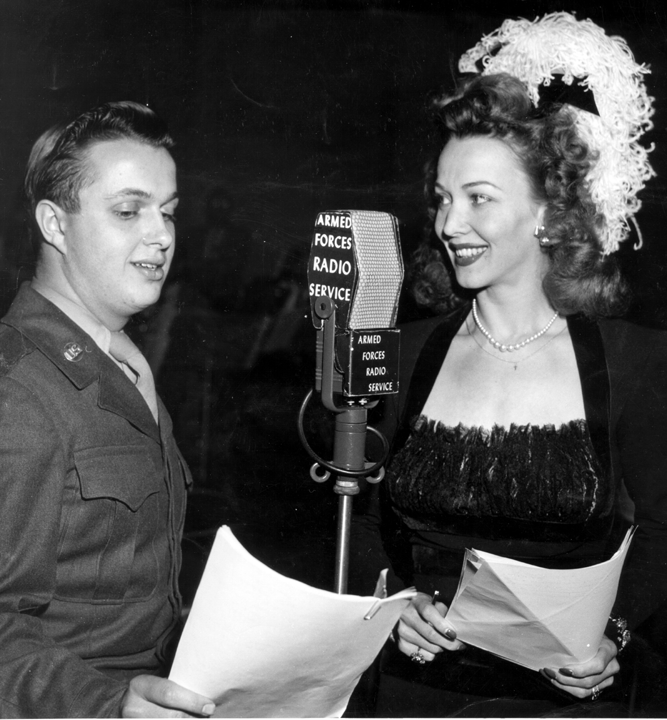
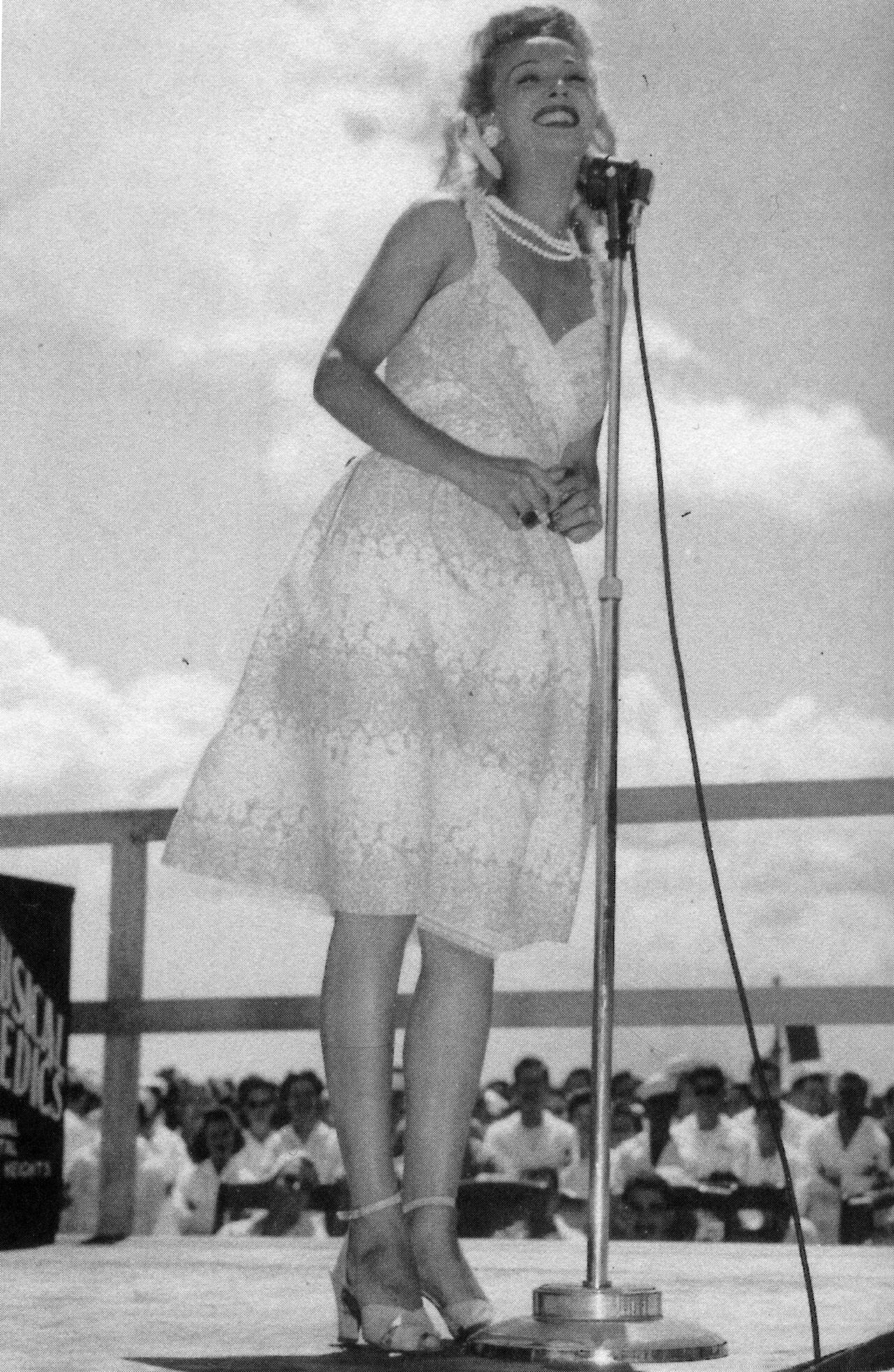
During World War II, Landis became one of the most recognizable faces among American servicemen, a status cemented by the nickname 'The Ping Girl,' a label bestowed by Frank Seltzer that she deeply resented and spent considerable effort trying to shed. Beyond her screen presence, she committed herself extensively to the USO. In 1942, she traveled to England and North Africa alongside comedian Martha Raye, dancer Mitzi Mayfair, and actress Kay Francis. Two years later, she entertained troops in the South Pacific with Jack Benny. Over the course of the war, she logged more than 100,000 miles of travel, making her the actress who spent the greatest amount of time in frontline entertainment. The physical toll was severe: she contracted amoebic dysentery and malaria during her deployments. She channeled these experiences into print, writing newspaper and magazine articles and co-authoring the 1944 book Four Jills in a Jeep, which was later adapted into a film featuring her USO companions. She also contributed the foreword to Vic Herman's cartoon book Winnie the WAC. In 1943, the Fashion Academy named her the best-dressed woman in the screen category, reflecting her enduring public appeal beyond the battlefield.
Personal Struggles and a Brief Afterlife in Culture
Landis's private life was marked by instability and heartbreak. She married four times and never had children; endometriosis made conception impossible. Her first marriage, at just fifteen to nineteen-year-old Irving Wheeler in January 1934, was annulled by her mother within a month. Beyond the screen, she made a notable Broadway appearance in 1945, starring in the musical A Lady Says Yes, in which future novelist Jacqueline Susann held a small role. Susann later acknowledged that the character Jennifer North in her best-selling novel Valley of the Dolls was partly inspired by Landis. Her life was cut short on July 5, 1948, at the age of twenty-nine. The trajectory of her existence—from a neglected child in a Wisconsin farming community to a wartime icon who crisscrossed the globe for troops, to a woman whose career was stymied by the very studio system that initially elevated her—remains a poignant example of the personal costs embedded in Hollywood's golden age. Her story endures not only through her films but through the literary and cultural echoes she left behind.
Gallery



More in Screen Legends 1-24
Spotted an error? Know more?
This is a living reference — every entry is fact-audited, and reader corrections feed straight into our audit queue. Suggest an edit · See this site's audit record