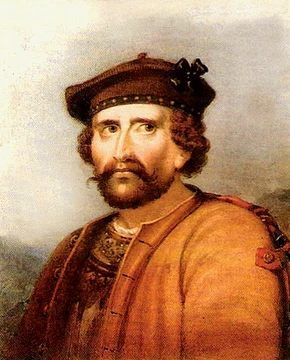
Sir Gilbert Eliott, 3rd Baronet, of Stobs
Whig MP outlawed for killing a fellow MP in a duel.
Last updated
A Scottish Whig, Sir Gilbert Eliott, 3rd Baronet of Stobs, sat in Parliament from 1708 to 1727. Following a fatal after-dinner brawl with an opponent, he was declared an outlaw but later received a pardon. He died in 1764, born around 1680.
Career
The Eliotts of Stobs dominated the politics of Roxburghshire. Three generations of Eliott's ancestors had represented the county in the Parliament of Scotland. At the 1708 British general election, Eliott was returned in a contest to serve in the new Parliament of Great Britain at Westminster as the Member of Parliament for Roxburghshire. On an election case on 16 December 1708, he upset his Scottish colleagues by sticking to the Whigs rather than joining with the Tories against a member who expressed anti-Scottish sentiments.
He voted for the impeachment of Dr Sacheverell in 1710. At the 1710 British general election, he was returned as a Whig, again in a contest, and initially voted with the Whigs. However he began to act independently, and took part in an attempt to dissolve the Union in May 1713 and voted against the French commerce bill in June 1713. He was returned unopposed at the 1713 British general election and voted against the expulsion of Richard Steele on 18 March 1714.
He told in support of the Whigs, but was willing to work with Tories on some matters of Scottish interest. Eliott stood down at the 1715 election in favour of William Douglas, son of the county's hereditary sheriff. At the 1722 election he let the seat be taken by his relative Sir Gilbert Elliot, 2nd Baronet, of Minto. Minto was appointed in 1726 as a judge of the Court of Session, and at the resulting by-election Sir Gilbert was elected to replace him.
However, at a dinner shortly after the election, he fell into an argument with Colonel John Stewart (a former MP for Kirkcudbright Stewartry). The dispute escalated into a fight, and Sir Gilbert killed the Colonel with his sword. He was declared an outlaw, and fled to Holland. Due to lobbying on his behalf during the next year by his friends Lord Minto and Lord Ilay, Eliott received a royal pardon, and returned to Scotland.
Did You Know?
- He succeeded to the baronetcy on the death of his father in 1699.
- On 23 April 1702 at St Bride's Church, London, he married Eleanora or Eleanor Elliot, daughter of William 'the laceman' Elliot.
- His mother was Margaret, daughter of Charles Murray of Hadden, Roxburghshire.
More in Scottish Outlaws
Sources
Compiled from Wikipedia and the sources listed below. Text from Wikipedia is available under CC BY-SA 4.0; this entry is adapted from it.
- Wikipedia: Sir Gilbert Eliott, 3rd Baronet, of Stobs (CC BY-SA 4.0).
Spotted an error? Know more?
Reader corrections go straight into our review queue. Suggest an edit · How this site is sourced