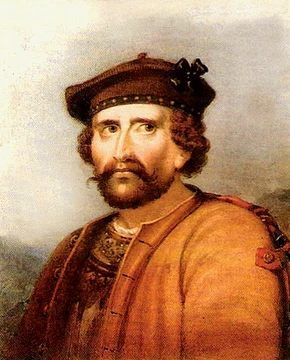
Little Jock Elliot
Border reiver and subject of a lost ballad.
Last updated
Little Jock Elliot is a Border ballad of indeterminate age, sometimes called the 'lost ballad' because only the famous verse 'Wha daur meddle wi me?' survives with certainty. A version was written by James Smail under the pseudonym Matthew Gotterson in The Scotsman in 1872, with a second part added in 1892.
Quick Facts
- Subject
- John Elliot of Park
- Pseudonym of james smail
- Matthew Gotterson
- Year of second part
- 1892
- Date of elliot's death
- 7 October 1566
Facts from the source article.
History
The events occurred in fact, with both Elliot and Bothwell at least wounding each other. Accounts agree that Bothwell wounded Elliot first, but Elliot, despite his wounds, wounded Bothwell so severely that he was near death. This wounding led to Mary, Queen of Scots life being endangered; on her way to see Bothwell she almost perished in a mire, and after a strenuous ride of fifty miles in a single day she became extremely ill, apparently with pneumonia.
The Scottish chronicle Diurnal of Occurrents records that Elliot was captured and then shot by Bothwell outside Hermitage Castle as he tried to escape, dying of his wounds on 7 October 1566. An English border warden wrote that Bothwell shot him through the thigh with a dag, and Robert Birrel's diary states Elliot's head was sent to Edinburgh. Sir Richard Maitland's poem mentions Elliot as a Liddesdale reiver, while George Buchanan's Detectio notes only that Bothwell was wounded by a nameless thief.
Synopsis
John Elliot of Park was a Scottish border reiver and plunderer from the powerful Elliot family along the lawless Scottish border with England in the mid 16th Century. The ballad 'Little Jock Elliot' asserts his prowess in battle and contains the refrain 'My name is Little Jock Elliot, and wha daur meddle wi' me!', which has been offered as a possible source for the Latin motto of the Order of the Thistle, 'Nemo me impune lacessit'. The ballad ends by referencing Elliot's wounding of James Hepburn, 4th Earl of Bothwell in the summer of 1566 when Bothwell attempted to arrest him. Another ballad called 'Bothwell', attributed to Robert Aytoun, presents the story from Bothwell's perspective, stating that the earl, though suffering life-threatening wounds, managed to kill Elliot.
More in Scottish Outlaws
Sources
Compiled from Wikipedia and the sources listed below. Text from Wikipedia is available under CC BY-SA 4.0; this entry is adapted from it.
- Wikipedia: Little Jock Elliot (CC BY-SA 4.0).
- Word definitions: the Codexery glossary, each quoted from its Wikipedia article.
Spotted an error? Know more?
Reader corrections go straight into our review queue. Suggest an edit · How this site is sourced