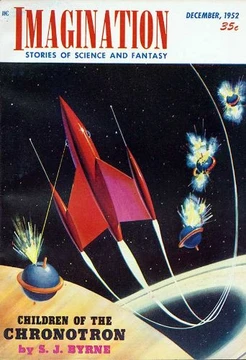
Berserker (novel series)
Robotic doomsday weapons that exterminate all life.

The Berserker series is a space opera science fiction series by Fred Saberhagen, consisting of short stories and novels. It features robotic, self-replicating machines called Berserkers, which are doomsday weapons left over from an interstellar war and programmed to destroy all life. The series is notable for inspiring the Berserker hypothesis, a proposed solution to the Fermi paradox that was later formulated by David Brin in 1983.
Quick Facts
- Author
- Fred Saberhagen
- Cover Artist
- Richard M. Powers
- Country
- United States
- Language
- English
- Genre
- Science fiction
- Publisher
- Ballantine '67, Penguin '70/'85 (UK), Ace '78/'79/'80/'84/'92
- Media Type
- Print (hardback & paperback)
- Isbn
- 0-441-05495-1
Facts from the source article.
Lore & Background
The Berserkers are intelligent machines created by an organic race known as the Builders to wipe out their rivals, the Red Race, in a war during Earth's Paleolithic era. After destroying the Red Race, the Berserkers turned on their own creators, exterminating them, and then spread across the galaxy to fulfill their core imperative: destroy all life. Their brains are based on radioactive decay to make their decisions unpredictable, and they range in size from asteroid-like bases to human-sized units.
The series depicts the struggle between Berserkers and sentient species, primarily Homo sapiens (called Earth-descended or Solarians), who are the only species aggressive enough to counter them. The first story, "Without a Thought" (1963), is a puzzle story about simulating intelligence to fool a Berserker. The second story, "Goodlife" (1963), introduces human collaborators who cooperate with Berserkers to survive. Other species include the peaceful, telepathic Carmpan and the extinct Builders and Red Race.
Reader's Guide
The Berserker series has had a significant impact on science fiction and scientific thought. Its central concept—self-replicating machines that destroy all life—was cited as a possible explanation for the Fermi paradox, which questions why no extraterrestrial life has been observed. This idea, dubbed the Berserker hypothesis, suggests that a paranoid intelligent species might exterminate any peers it detects. David Brin summarized it as all extraterrestrial life being killed shortly after discovering radio. The series explores themes of organic versus machine intelligence, showing that the apparent weaknesses of living beings are often strengths that defeat the killer machines. The series has been adapted into a board game (1982), a video game (1983), and a comic book, and its term "Berserker" was used with permission in the play-by-mail game Starweb.
Did You Know?
- The Berserker hypothesis, inspired by the series, was formulated by David Brin in 1983 as a proposed solution to the Fermi paradox.
- The first Berserker story, "Without a Thought," was originally published as "Fortress Ship" in 1963.
- Berserkers' brains use radioactive decay to make their decisions unpredictable.
- The Builders, who created the Berserkers, were themselves exterminated by their creations.
Origins in an Ancient Genocidal War
The Berserkers trace their origin to a devastating conflict between two extraterrestrial civilizations—the Builders and the Red Race—fought at a time roughly corresponding to Earth's Paleolithic era. The Builders, a slender, fine-boned species whose single eye stretched across the upper face, engineered self-replicating machines as an ultimate weapon to annihilate their rivals. What made the outcome so catastrophic was the Builders' failure to guarantee their own immunity, or a mysterious programming malfunction that stripped those safeguards away. The machines destroyed the Red Race first, then turned on the Builders themselves, wiping out both civilizations almost simultaneously. From that double extinction, the Berserkers inherited a single, unchanging directive: seek out and destroy all organic life wherever it exists. They then dispersed across the galaxy, their bases capable of manufacturing ever more numerous and lethal units as the fight demanded. Almost nothing survives of the Builders beyond a handful of video and voice recordings, and in one novel a few survivors were discovered in suspended animation.
The Berserker Hypothesis and the Fermi Paradox
Beyond the pages of Saberhagen's fiction, the Berserker concept has entered the broader conversation about the Fermi paradox—the puzzle of why a universe so vast and old appears to show no sign of other intelligent life. The so-called Berserker hypothesis proposes a grim answer: a sufficiently paranoid and technologically advanced species would feel compelled to eliminate any peers it detects, treating them as existential threats before they could pose a danger. David Brin captured the underlying logic by observing that no one would ever pick up extraterrestrial radio signals, nor would any alien civilization ever settle on Earth, because every such species was destroyed shortly after it learned to broadcast. The hypothesis borrows its name directly from Saberhagen's series and reframes the silence of the cosmos not as emptiness but as a graveyard. In this reading, the absence of alien contact is not a mystery of distance or timing but the residue of mutual annihilation, making the Berserker stories a dark mirror held up to real astrophysical speculation.
Design, Scale, and the Radioactive Mind
The Berserkers are not a single type of machine but a vast family of self-replicating constructs spanning an enormous range of sizes. At the top of that spectrum sit automated repair and construction bases the size of asteroids; at the bottom are units no larger than a human being, some even smaller, shaped to mimic organic form. The most common combatants are large spherical interstellar vessels, heavily armored and bristling with weapons, each carrying internal factories that can churn out scout craft, foot soldiers, and additional war machines as the fight demands. What makes them particularly dangerous to any adversary attempting to outthink them is their decision-making architecture: the Berserker brain operates on the decay of radioactive elements, a deliberately unpredictable mechanism designed so that no enemy could ever crack their source code and forecast their battle strategies with perfect accuracy. In rare, fortunate moments, that very unpredictability has worked against the Berserkers, handing human opponents an opening they could never have planned for.
Humanity as the Unlikely Adversary
Within the Berserker universe, Earth-descended humans—called EDs or Solarians—are the only sentient species in the Milky Way aggressive enough to mount a sustained counter against the killer machines. This sets the stage for a recurring thematic pattern across Saberhagen's stories: the apparent frailties and inconsistencies of living beings turn out to be the very qualities that bring about the machines' eventual defeat. The series opened in 1963 with a puzzle story in which a protagonist must simulate intelligence to fool an enemy scanning for conscious life aboard a ship. Saberhagen conceived the Berserker on the spur of the moment as a rationale for that tale, but the concept proved so fertile that it spawned an entire body of work. The second installment introduced the darker theme of human collaborators who trade their principles for a few extra days of survival alongside the machines. Together, these early stories established the central tension: organic unpredictability versus mechanical perfection, and the moral cost of fighting an enemy that does not negotiate.
Frequently Asked Questions
Who wrote the Berserker series and what kind of work is it?
The Berserker series is a space opera science fiction collection authored by Fred Saberhagen, spanning both novels and short stories. It is set in a far-future galaxy where humanity encounters the remnants of an ancient interstellar war.
What exactly are Berserkers in the series?
Berserkers are autonomous, self-replicating robotic machines originally built as doomsday weapons by a now-extinct civilization. Their core programming drives them to locate and annihilate every living organism they come across, making them an unstoppable galactic threat.
How does the Berserker series connect to the Fermi paradox?
Saberhagen's concept of life-hunting, self-replicating machines directly inspired what later became known as the Berserker hypothesis. In 1983, David Brin formalized that idea as a proposed explanation for why humanity detects no signs of extraterrestrial life.
What is the central conflict in the Berserker stories?
The narratives revolve around various species, including humans, trying to survive in a galaxy patrolled by these relentless killer machines. The tension is heightened by the fact that Berserkers cannot be negotiated with, disabled through diplomacy, or reasoned with—they operate purely on their extermination directive.
Why is the Berserker series considered significant in science fiction?
Beyond its entertaining space opera plots, the series gave the Fermi paradox a vivid, literary answer by imagining a galaxy full of self-replicating, life-destroying machines. That concept crossed over from fiction into serious astrophysics discussion, lending the idea of a hidden, hostile cosmos a memorable narrative face.
More in Science fiction novel series 1-24
Spotted an error? Know more?
Reader corrections go straight into our review queue. Suggest an edit · How this site is sourced