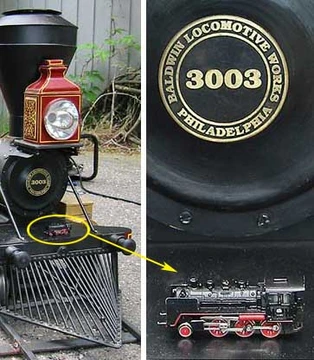
Toy train
Toy trains prioritize playability and durability over precise scale modeling.
Last updated
A toy train is a plaything designed to look like a train. Unlike a model train, which prioritizes accurate scale representation, a toy train focuses on being inexpensive and durable.
It can be a simple item that rolls along a track, or it might be powered by electricity, a clockwork mechanism, or live steam. Common materials include wood, plastic, or metal. Many modern model trains could also be classified as toy trains if they are not built to a precise scale or if they sacrifice detail for sturdiness, making them suitable for children or cheaper to produce.
Definitions
The term "toy train" generally refers to a scaled-down train for children to play with. Larger, rideable vehicles that resemble trains, often found in parks and playgrounds and usually running on tires rather than tracks, are also called toy trains. In India, full-sized trains operating on meter-gauge tracks, such as those on the Darjeeling Himalayan Railway, are referred to as toy trains. For highly accurate models intended for serious hobbyists and collectors, the term "model train" is used instead.
USA classification
The first widely accepted standards for toy trains that run on tracks were introduced in Leipzig, Germany, in 1891 by Märklin. In the United States, common toy train gauges include Z (1:220), N (1:160), HO (1:87), S (1:64), O (1:43 to 1:48, varying), and G (1:20). Märklin measured gauge as the distance between the centers of the two outer rails, rather than the outer edges.
Lionel's standard gauge reportedly resulted from a misreading of these standards, which also explains the differences in O gauge between the United States and Europe. Many of these larger standards never became popular due to their size, which made them impractical for indoor use, and their high manufacturing costs. Wide gauge trains, similar in size to 2 gauge, are still produced in limited numbers, along with 1 gauge and O gauge trains, with O gauge being the most common. Modern standards also include S gauge, HO scale, N scale, and Z scale, listed from largest to smallest.
HO and N scale are the most popular model railway standards today, though inexpensive sets sold in toy stores are less realistic than those for hobbyists. O gauge remains arguably the most popular toy train standard. Another growing interest among hobbyists is building and operating trains from Lego, known as L gauge, which is roughly 1/38 scale.
Quick Facts
- First widely adopted standards
- Leipzig
- Germany
- 1891 by Märklin
- Common gauges
- Z (1:220)
- N (1:160)
- HO (1:87)
- S (1:64)
- O (1:43 to 1:48)
- G (1:20)
- Earliest electric trains
- 1897, produced by U.S. firm Carlisle & Finch
- Earliest toy trains material
- lead, with no moving parts
Facts from the source article.
Lore & Background
The earliest toy trains were made of lead and had no moving parts; some early 19th-century push toys were made of tinplate, including large, stylized locomotive toys in the U.S. painted red and gold and decorated with hearts and flowers. Around 1875, advancements in materials and manufacturing allowed tin to be stamped, cut, rolled, and lithographed faster than ever before. Toy trains were revolutionized when Märklin, a German firm specializing in doll house accessories, sought to create an equivalent toy for boys with a constant revenue stream from add-on accessories; they offered boxed sets with train and track, plus extra track, rolling stock, and buildings sold separately, creating the predecessor to the modern model train layout.
Electric trains first appeared in 1897, produced by the U.S. firm Carlisle & Finch. As residential electricity became more common in the early 20th century, electric trains gained popularity and grew in sophistication, gaining lighting, direction change, whistling sounds, smoke, remote coupling and uncoupling, and cargo loading.
Toy trains from the first half of the 20th century were often made of lithographed tin; later trains were often mostly plastic. Prior to the 1950s, there was little distinction between toy trains and model railroads—model railroads were toys by definition. Consumer interest in trains as toys waned in the late 1950s but has experienced resurgence since the late 1990s due largely to the popularity of Thomas the Tank Engine.
Reader's Guide
Toy trains hold significance as both playthings and collectibles, with a history that spans from simple lead push toys to sophisticated electric systems. The introduction of standardized track gauges by Märklin in 1891 established a framework that allowed for expansion and compatibility, influencing generations of toy train production. The distinction between toy trains and model trains emerged primarily in the 1950s, when realism in model railroading began to be emphasized; prior to that, all model railroads were considered toys. Today, O gauge remains the most popular toy train standard, while S gauge and O gauge railroads are still considered toy trains even by their adherents and are often accessorized with semi-scale model buildings.
Some adult fans operate their trains, while others only collect; layouts range from highly realistic with scale models to those accessorized with toy buildings, cars, and figures. The legacy of toy trains includes not only the major manufacturers like Märklin, Lionel, American Flyer, and Marx, but also modern systems such as wooden train sets compatible with Brio or Thomas, and Playmobil's railway play worlds. The resurgence of interest since the late 1990s, driven by Thomas the Tank Engine, has introduced toy trains to new generations, ensuring their continued cultural and recreational relevance.
Did You Know?
- O gauge track is 1/45 the size of real-world standard gauge track, but U.S. manufacturers rounded it down to 1:48 scale.
- The term 'Vario System' introduced by Eichhorn refers to a variant of the connecting system used by some modern wooden track producers.
More in Scale Models and Railroads
Sources
Compiled from Wikipedia and the sources listed below. Text from Wikipedia is available under CC BY-SA 4.0; this entry is adapted from it.
- Wikipedia: Toy train (CC BY-SA 4.0).
Spotted an error? Know more?
Reader corrections go straight into our review queue. Suggest an edit · How this site is sourced