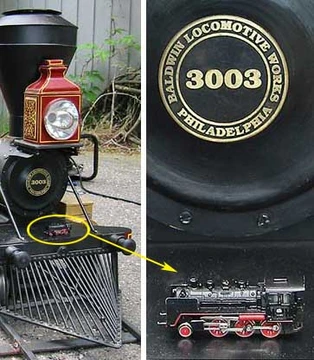
O scale
O scale is a model railroad scale introduced by Märklin around 1900.
Last updated
O scale, also known as O gauge, is a model railway scale that originated with the German company Märklin around 1900. By the 1930s, the three-rail alternating current version of O gauge had become the dominant model railroad scale in the United States, a position it held until the early 1960s. In Europe, its popularity waned before World War II as smaller scales entered the market. The scale’s peak came when model railroads were still seen primarily as toys, where cost, durability, and ease of use for children mattered more than fine detail or realism.
Today, O scale remains a favorite among hobbyists who prioritize running trains over other modeling activities, though recent innovations have also attracted fine-scale modelers who appreciate the level of detail possible at this size. Because O scale is larger than OO or HO, the space required for a layout is a key factor in deciding whether to build one. Collecting vintage O gauge trains is another popular pursuit, with a market for both original and reproduction models.
Lore & Background
The name for O gauge and O scale is derived from '0 [zero] gauge' or 'Gauge 0' being smaller than Gauge 1 and the other then-existing standards. It was created in part because manufacturers realized their best selling trains were those built in the smaller scales.
In the United States, manufacturers such as the Ives Manufacturing Company, American Flyer, and Lionel Corporation used O gauge for their budget line, marketing either Gauge 1 or 'Wide gauge' (also known as 'standard gauge') as their premium trains. One of the Lionel Corporation's most popular trains, the 203 Armoured Locomotive, was O gauge and ran on tracks with rails spaced 1.25 inches apart. The Great Depression wiped out demand for the expensive larger trains, and by 1932, O gauge was the standard, almost by default.
Because of the emphasis on play value, the scale of pre–World War II O gauge trains varied. The Märklin specifications called for 1:43.5 scale. However, many designs were 1:48 scale or 1:64 scale. Early Marx Trains and entry-level trains, usually made of lithographed tin plate, were not scaled at all, made to whimsical proportions about the same length of an HO scale ('half O') piece, but about the same width and height of an O scale piece.
Yet all of these designs ran on the same track, and, depending on the manufacturer(s) of the cars, could sometimes be coupled together and run as part of the same train. After World War II, manufacturers started paying more attention to scale, and post-war locomotives and rolling stock tended to be larger and more realistic than their earlier counterparts. This has been reflected in the change of name from O gauge to O scale: gauge describes merely the distance between the rails, while scale describes the size ratio of a model as it relates to its real-world prototype.
Reader's Guide
O scale's significance lies in its long history as a dominant model railroad scale, particularly in the United States from the 1930s through the early 1960s. Its origins as a toy-oriented gauge shaped its early characteristics: cost, durability, and ease of handling were prioritized over detail and realism. The Great Depression cemented O gauge's position when demand for larger, more expensive trains collapsed. The scale's legacy includes a strong collecting market for vintage O gauge trains, with both reproduction and vintage models available.
Since the early 1990s, O scale has experienced a resurgence in popularity as manufacturers such as Lionel, MTH, Atlas, and Williams by Bachmann have placed more emphasis on realism, producing O gauge model trains at 1:48 scale. This has made O scale popular among fine-scale modellers who value the detail that can be achieved, while it also remains a choice for hobbyists who enjoy running trains. The size of O is larger than OO/HO layouts, which is a factor in the decision to build an O gauge layout. The differences in various O gauge and O scale standards can be confusing, with regional manufacturers using different scales (1:43.5 in the UK, 1:45 in continental Europe, 1:48 in the USA) and track gauges, but the NMRA and MOROP maintain detailed standards to help model makers create interoperable models.
More in Scale Models and Railroads
Sources
Compiled from Wikipedia and the sources listed below. Text from Wikipedia is available under CC BY-SA 4.0; this entry is adapted from it.
- Wikipedia: O scale (CC BY-SA 4.0).
Spotted an error? Know more?
Reader corrections go straight into our review queue. Suggest an edit · How this site is sourced