Lichfield War Memorial
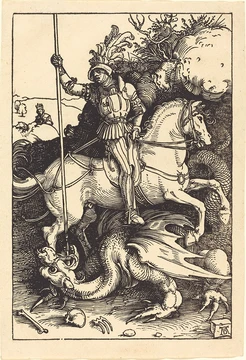
War memorial with Saint George and dragon sculpture.
The Lichfield War Memorial, also called the Men of Lichfield Memorial, is a grade II listed structure in Lichfield, Staffordshire. It stands in the Garden of Remembrance near the city's cathedral and Minster Pool. Designed by Charles Bateman and built between 1919 and 1920, it commemorates local residents killed in the First World War, with a central life-size sculpture of Saint George atop a dragon.
Quick Facts
- Location
- Lichfield, Staffordshire, England
- Designer
- Charles Bateman
- Construction period
- 1919–1920
- Height
- 7.25 m / 23 ft 9 in
- Width
- 9.25 m / 30 ft 4 in
- Depth
- 0.8 m / 2 ft 7 in
- Material
- Limestone from Guiting Power, Gloucestershire; Portland stone for the sculpture
Facts from the source article.
Description
The Lichfield War Memorial is found in the Garden of Remembrance, positioned to the northwest of Minster Pool and to the southwest of Lichfield Cathedral. High brick walls enclose the site on its northern and eastern sides. A balustrade with a gate opens onto Bird Street to the west, and another balustrade runs along the southern boundary with Minster Pool. Two pairs of decorative urns sit on the balustrades at the south and west edges. The wrought-iron gate carries the word "PAX–1919," a reference to the 1919 Treaty of Versailles that formally concluded the First World War, though actual fighting stopped with the armistice on 11 November 1918. The gate piers are made of brick with stone caps, and on top sit lion sculptures bearing the city’s coat of arms. The memorial itself stands against the eastern wall. It is a slab-like structure, 7.25 metres tall, 9.25 metres wide, and 0.8 metres deep. Built from limestone sourced from Guiting Power in Gloucestershire, its design is English Renaissance and resembles the front of a classical basilica. At each end, panelled piers are topped with balls and foliage. Swept parapets rise from these piers to the central bay, which is the tallest part. The parapet faces show relief carvings of wreaths with crowns above them, and the parapet is finished with scroll details. Two Ionic-style pilasters, reeded and fluted, frame the centre. Inside this frame is a niche holding a life-sized Portland stone statue of Saint George. George stands on the slain dragon, holding a bronze Christian cross in his right hand, his left hand resting on a shield bearing the same cross. His pose is similar to that of Giulio Angolo del Moro’s statue on the San Giorgio Maggiore church in Venice. George is depicted as proud and youthful, with armour inspired by Donatello’s St George at the Orsanmichele church in Florence. The niche has a semi-circular top with a shell detail. Between the niche and each pilaster, a lion’s head relief appears above the years 1914–1919, marking the First World War, and these are interspersed with inverted bouquets in relief. The central bay is topped by a tympanum carved with a scallop shell and leaves.
History
Before the First World War, Lichfield housed the depot for the four reserve battalions of the South Staffordshire Regiment and the North Staffordshire Regiment. During the war, each regiment raised three additional New Army battalions in the city, which served in France and Italy; the South Staffordshire Regiment also raised a garrison battalion for service in India. After the war, a War Memorial Committee chaired by Major Longstaff was formed to commemorate the city's fallen. Architect Charles Bateman was appointed to design the works on a site already owned by Lichfield Corporation. Construction began in 1919 under the supervision of city surveyor P. A. Benn. The site was laid out as a garden within existing 18th-century walls. According to Historic England, the balustrade and urns were relocated from Shenstone Court in Staffordshire, but George T. Noszlopy and Fiona Waterhouse stated in 2005 that they came from Moxhull Hall in Warwickshire. The right-hand gate pier incorporates an ancient boundary stone. The gates were made by J. C. Culwick of Lichfield. Bateman designed the memorial, and Messrs Robert Bridgeman and Sons of Lichfield built it. The garden and memorial were opened on 20 October 1920 by mayor H. G. Hall and dedicated the same day by the Bishop of Lichfield, John Kempthorne. The ceremony included buglers of the 6th Battalion of the North Staffordshire Regiment, the band of the 2nd Battalion of the Oxfordshire and Buckinghamshire Light Infantry, and choirs from the cathedral and local churches. Additional plaques for Second World War dead were added shortly after 1945. The memorial received grade II listed status on 5 February 1952, covering the walls, gate piers, and balustrade, with the memorial as the primary object. The gardens and memorial were restored between 2009 and 2012 in a £60,000 project partly funded by the Heritage Lottery Fund and the War Memorials Trust, earning a British Association of Landscape Industries award in 2012. The listing was raised to grade II on 24 June 2016 as part of the centenary of the Battle of the Somme.
More in Saint George and the Dragon
Spotted an error? Know more?
Reader corrections go straight into our review queue. Suggest an edit · How this site is sourced