Guild Day
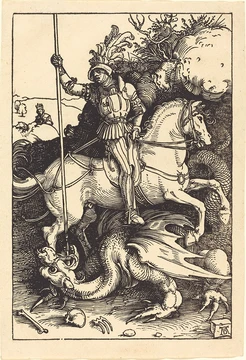
Annual Norwich festival featuring Saint George and the dragon.

via Wikipedia: Guild Day · see source
Guild Day was an annual ceremony and festival held in the city of Norwich, England from its establishment by its namesake the Guild of Saint George in 1385 to its abolition in 1835. There are extensive records of the event's history, though the rituals associated with it changed over time. From its establishment in 1385 it was largely a civic religious parade that took place on Saint George's Day from the St Peter Mancroft church to Norwich Cathedral, usually featuring a dramatisation of the legendary fight between Saint George and a dragon figure, as well as a representation of Lady Margaret from 1530. During and after the Reformation, it began to take on a secular purpose, surviving the Chantries Act 1547, and eventually became a celebration of the yearly inauguration of the new Mayor of Norwich.
Quick Facts
- Genre
- Parade and ceremony
- Frequency
- Annual
- Location
- Norwich
- Country
- England
- Years active
- 1385–1835
- Founder name
- Guild of Saint George
Facts from the source article.
Did You Know?
- Guild Day was established in 1385 by the Guild of Saint George and abolished in 1835 under the Municipal Corporations Act 1835.
- In 1559, the Guild removed Saint George and Margaret from the parade but kept the dragon 'for pastime'.
- Drawings of Guild Day events are held by the US Library of Congress.
History
The religious Guild of Saint George in Norwich founded the ceremony in 1385, honouring the saint, venerating God, and praying for members and men in the King's service. Douglas Ezzy, Gary Easthope and Victor Morgan have suggested that Norwich may have drawn ideas from the mayor's pageant in London. The religious rituals varied over time. Early ceremonies began with evensong in Norwich Cathedral on 22 April, with the main event on 23 April, Saint George's Day, or in May if the date fell during Holy Week or Easter Week. The procession went from St Peter Mancroft church to Norwich Cathedral, led by a man carrying a wooden sword with a dragon's head handle, followed by a standard bearer, musicians, torch bearers, holy water bearers, the City Waits, cantors from the Cathedral, and officials. From the early 15th century, the centrepiece was a representation of Saint George on horseback in full armour with a dragon figure. A dramatised battle occurred, after which the dragon was not permitted to enter the cathedral, some scholars say remaining on a dragon stone. Guild members heard mass at the Saint George altar or chapel, then joined a feast. They returned to pray for dead members and benefactors. The next morning, additional services were held and guild officers were elected.
Norwich Snapdragon
From the early 1400s, dragon figures were part of the Guild Day parade, walking alongside a depiction of Saint George to collect money from the crowd. These Norwich dragons were worn like backpacks, with operators using straps and working the puppet from inside. A skirt painted with dragon legs hid the operator’s own legs. No pictures of these early dragons survive, but old payment records hint at their details. After Saint George was dropped from the parade in 1559, historian Gervasse Rosser suggests the dragon came to represent both threat and safety. By the early 1600s, the dragon was called Snap, marking a shift to a more playful image and a loss of its old religious meaning. A later 19th-century rhyme went: “Snap, snap, steal a boy’s cap, give him a penny and he’ll give it back.” Snap was last used in 1835, when Guild Day was ended.
Legacy
The Norfolk Museums Service now holds many surviving ceremonial objects from Guild Day, such as emblematic trenchers, speech-boys' cardboard shields, staves, processional banners, a figure of Snap the dragon, and civic regalia. Versions of the dragon have appeared at Norwich Castle Museum, including Old Snap in the 1963 exhibition The Growth of a City, plus mock dragons from Pockthorpe and Costessey. One dragon, made in 1795, is 4.5 meters from nose to tail. The Library of Congress also keeps a compendium of drawings by people who witnessed the Norwich Guild Days.
Historical analysis
Benjamin McRee detailed that the re-enactment of the legend of Saint George was initially a unifying display of pride after England's military victories in France in the 15th century. Muriel C. McClendon stated that Guild Day combined veneration of a popular saint with an impressive display of civic leadership, and that use of the Cathedral highlighted the close connection between secular government and religion. Ezzy, Easthope and Morgan argued that after the Reformation, Guild Day was a way for Norwich city officials to retain power, as the Reformation weakened sacred ritual and the secular elite lacked physical force to justify authority. They argued that civic ritual maintained control by creating a liminal state with loud noise, decorations, and transgression of the town/country boundary.
More in Saint George and the Dragon
Spotted an error? Know more?
Reader corrections go straight into our review queue. Suggest an edit · How this site is sourced