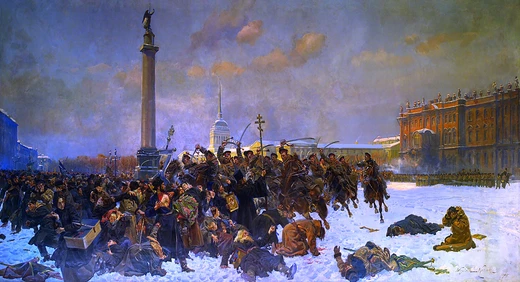
Bloody Sunday (1905)
Massacre that sparked the 1905 Revolution in Russia.
Bloody Sunday, also known as Red Sunday, refers to the events of 22 January 1905 in St Petersburg, when demonstrators led by Father Georgy Gapon were fired upon by soldiers of the Imperial Guard while marching toward the Winter Palace to present a petition to Tsar Nicholas II. The massacre is considered the start of the active phase of the Revolution of 1905 and is viewed by some historians as a key event leading to the Russian Revolution of 1917.
Quick Facts
- Part of
- the 1905 Russian Revolution
- Date
- 22 January, 1905, 9 January
- Location
- St. Petersburg, Russian Empire
- Methods
- Demonstration march
- Result
- Dispersal of the workers' procession; beginning of the 1905 Russian Revolution
Facts from the source article.
Did You Know?
- Soviet actor, film director and screenwriter Vyacheslav Viskovsky told the story of Bloody Sunday in his 1925 silent feature film Devyatoe yanvarya.
- Dmitri Shostakovich's 1957 11th Symphony, subtitled The Year 1905, includes a second movement entitled 'The Ninth of January' depicting the massacre.
- Maxim Gorky's novel The Life of a Useless Man (1908) portrays the effects of Bloody Sunday on the Russian working class.
Background
After the emancipation of the serfs in 1861 by Tsar Alexander II, a new peasant working class emerged in Russia's industrializing cities. Prior to emancipation, serfs working in cities retained ties to the land and their masters, and were employed only for short periods. Emancipation led to a permanent urban working class, straining traditional society. Peasants faced unfamiliar social relationships, factory discipline, and distressing urban conditions.
Generally unskilled, they received low wages, worked up to fifteen hours a day in unsafe environments, and were subject to abusive and arbitrary treatment by factory employers, who were more present than noble landowners had been. Strikes became common, though the Russian term for strike, stachka, derived from an old word meaning to conspire for a criminal act, and strikes were viewed as criminal conspiracies. The tsarist authorities often intervened with harsh punishment for strike leaders, but frequently reviewed strikers' complaints as justified and required employers to correct abuses.
Prelude
In December 1904, six workers at the Putilov Ironworks in St Petersburg were fired because of their membership in the Assembly, though the plant manager asserted they were fired for unrelated reasons. When the manager refused to rehire them, virtually the entire workforce went on strike. Sympathy strikes raised the number of strikers to 150,000 workers in 382 factories. By 21 January [O.S. 8 January] 1905, the city had no electricity, no newspapers, and all public areas were closed.
The decision to prepare a petition was made on the evening of 19 January [O.S. 6 January] at the headquarters of Gapon's movement. The petition, drafted by Gapon in respectful terms, called for improved working conditions, fairer wages, an eight-hour day, and universal suffrage. The idea resonated with traditionally minded workers, as individual or collective petitions had been an established means of bringing grievances to the tsar's administration from the 15th to the early 18th centuries.
Events of Sunday 22 January
In the pre-dawn darkness of Sunday, 22 January [O.S. 9 January] 1905, striking workers and their families gathered at six points in the industrial outskirts of St Petersburg. Holding religious icons and singing hymns and patriotic songs, a crowd of more than 3,000 proceeded without police interference toward the Winter Palace, unaware that the tsar was not in residence. The intention was for columns to converge at about 2 pm. Estimates of total numbers range from police figures of 3,000 to organizers' claims of 50,000.
Initially women, children, and elderly workers were to lead, but younger men moved to the front. Substantial military forces, including units of the Imperial Guard, Cossacks, and infantry regiments brought in by rail, had been deployed, numbering about 10,000 troops ordered to halt the marchers. Reaction was inconsistent: some policemen saluted religious banners, while army officers variously allowed smaller groups, called for dispersal, or ordered troops to fire without warning.
Cossacks and regular cavalry charged with sabres or trampled people. The first shooting occurred between 10 and 11 am near the Narva Gate, where about forty people were killed or wounded; Gapon was not injured.
Consequences
The immediate consequence was a strike movement that spread throughout the country, erupting in Moscow, Warsaw, Riga, Vilna, Kovno, Reval, Tiflis, Baku, and Batum. About 414,000 people participated in work stoppages during January 1905. Tsar Nicholas II attempted to appease the people with a duma, but the autocracy resorted to brute force, and between October 1905 and April 1906 an estimated 15,000 peasants and workers were hanged or shot, 20,000 injured, and 45,000 sent into exile. The most significant effect was a drastic change in attitude: previously the tsar had been seen as the champion of the people, but after Bloody Sunday he was held personally responsible for the tragedy. The killing resulted in a surge of bitterness, captured in the reaction 'we no longer have a Tsar'.
More in Russian Revolution of 1905
Spotted an error? Know more?
Reader corrections go straight into our review queue. Suggest an edit · How this site is sourced