Yekaterinburg
The third capital of Russia, a cultural and industrial powerhouse on the Iset River.
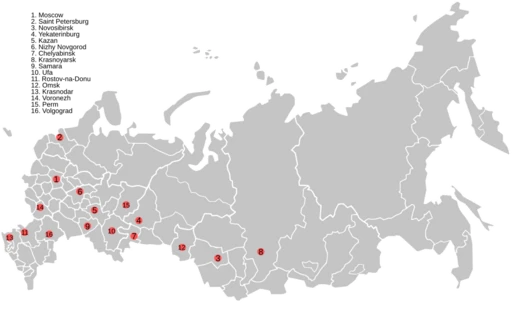
Yekaterinburg, alternatively romanized as Ekaterinburg and formerly known as Sverdlovsk (1924–1991), is a city and the administrative centre of Sverdlovsk Oblast and the Ural Federal District, Russia. The city is located on the Iset River between the Volga-Ural region and Siberia, with a population of roughly 1.5 million residents, up to 2.2 million residents in the urban agglomeration. Yekaterinburg is the fourth most populous city in Russia, the largest city in the Ural Federal District, and one of Russia's main cultural and industrial centres. Yekaterinburg has been dubbed the "third capital of Russia", as it is ranked third by the size of its economy, culture, transportation and tourism, behind Moscow and Saint Petersburg.
- Founded
- 18 November 1723
- Founders
- Vasily Tatishchev and Georg Wilhelm de Gennin
- Named after
- Catherine I (wife of Peter the Great)
- Former name
- Sverdlovsk (1924–1991)
- Population
- Roughly 1.5 million residents (up to 2.2 million in urban agglomeration)
- Region
- Sverdlovsk Oblast, Ural Federal District, Russia
- Known for
- Mining capital of the Russian Empire; site of the murder of the Romanov family; host city of the 2018 FIFA World Cup
Quick Facts
- En Name
- Yekaterinburg
- Coa Caption
- Coat of arms
- Holiday
- 3rd Saturday of August
- Federal Subject
- Sverdlovsk Oblast
- Adm Inhabloc Jur
- City of Yekaterinburg
- Inhabloc Cat
- City
- Urban Okrug Jur
- Yekaterinburg Urban Okrug
- Leader Title
- Heads of Yekaterinburg · lt=Head · ru · Глава Екатеринбурга
- Leader Name
- Alexey Orlov (mayor) · lt=Alexey Orlov · ru · Орлов, Алексей Валерьевич
- Representative Body
- City Duma
- Area Km2
- 1111
- Pop 2010Census
- 1349772
Facts from the source article.
Lore & Background
Yekaterinburg was founded on 18 November 1723 and named after the Orthodox name of Catherine I (born Marta Helena Skowrońska), the wife of Russian Emperor Peter the Great. The city served as the mining capital of the Russian Empire as well as a strategic connection between Europe and Asia. In 1781, Catherine the Great gave Yekaterinburg the status of a district town of Perm Province. Yekaterinburg became a key city to Siberia, which had rich resources. In the late 19th century, Yekaterinburg became one of the centres of revolutionary movements in the Urals. During the Russian Civil War, it was the site of the murder of the Romanov family. In 1924, after the Russian SFSR founded the Soviet Union, the city was renamed Sverdlovsk after the Bolshevik leader Yakov Sverdlov. During the Soviet era, a tram network was completed in 1929 and Sverdlovsk and its surroundings were turned into a heavy industry powerhouse. The Sverdlovsk Metro opened in April 1991, and in September 1991 the city returned to its historical name.
Reader's Guide
Yekaterinburg is one of Russia's most important economic centres and was one of the host cities of the 2018 FIFA World Cup. In the 21st century, the city has experienced an economic and population boom, which resulted in some of the tallest skyscrapers of Russia being located in the city. Yekaterinburg is home to the headquarters of the Central Military District of the Russian Armed Forces, as well as the presidium of the Ural Branch of the Russian Academy of Sciences. Yekaterinburg is famous for its constructivist architecture, and is also considered the "Russian capital of street art".
Did You Know?
- The earliest settlements in the area date to 8000–7000 BC, in the Mesolithic period.
- The city was founded by Russian historian Vasily Tatishchev and Russian engineer Georg Wilhelm de Gennin under a decree of Peter the Great.
- Yekaterinburg was renamed Sverdlovsk from 1924 to 1991.
- The Sverdlovsk Metro opened in April 1991.
More in Russian Cities 1-17
Spotted an error? Know more?
This is a living reference — every entry is fact-audited, and reader corrections feed straight into our audit queue. Suggest an edit · See this site's audit record