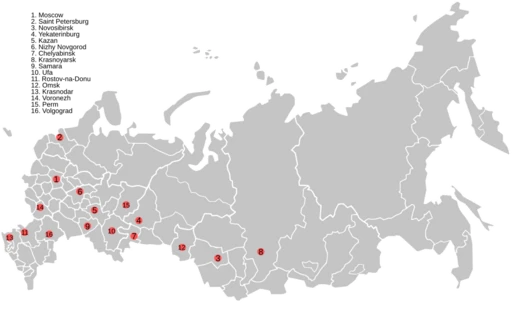
Irkutsk
The Paris of Siberia
Irkutsk is the largest city and administrative center of Irkutsk Oblast, Russia. With a population of 587,891, Irkutsk is the 25th-largest city in Russia by population, the fifth-largest in the Siberian Federal District, and one of the largest cities in Siberia. Located in the south of the eponymous oblast, the city proper lies on the Angara River, a tributary of the Yenisei, about 850 kilometres to the south-east of Krasnoyarsk and about 520 kilometres north of Ulaanbaatar. The Trans-Siberian Highway and Trans-Siberian Railway connect Irkutsk to other regions in Russia and Mongolia.
- Founded
- 1661 (as an ostrog)
- City status
- 1686
- Population (2010 Census)
- 587,891
- Location
- Southern Irkutsk Oblast, on the Angara River
- Known for
- Decembrist exile center, 'Paris of Siberia', aircraft manufacture, historic wooden houses
Lore & Background
Irkutsk was named after the Irkut River. Its name was derived from the Buryat word for 'spinning,' and was used as an ethnonym among local tribes, who were known as Yrkhu, Irkit, Irgit, and Irgyt. The old spelling of the city's name was 'Иркутскъ'. Before the revolution, the city was called 'East Paris', 'Siberian Petersburg', 'Siberian Athens'. In 1652, Ivan Pokhabov built a zimovye (winter quarters) near the site of Irkutsk for collecting fur taxes from the Buryats. In 1661, Yakov Pokhabov built an ostrog (a small fort) nearby. The ostrog gained official town rights from the government in 1686. Many distinguished Russians were sent into exile in Irkutsk for their part in the Decembrist revolt of 1825, and the city became an exile-post for the rest of the century. Some historic wooden houses still survive. When the railway reached Irkutsk, it had earned the nickname of 'The Paris of Siberia.' The city was the center of bitter fighting in the Russian Civil War of 1918–20. Afterward, in the Soviet period, its architecture was dominated by the mandatory squared-up style. The city became a major centre of aircraft manufacture. The historic centre of Irkutsk is included in UNESCO's tentative list of World Heritage Sites.
Reader's Guide
Irkutsk is located about 850 km to the south-east of Krasnoyarsk, and about 520 km north of Ulaanbaatar. The city proper lies on the Angara River. The Trans-Siberian Highway and Trans-Siberian Railway connect Irkutsk to other regions in Russia and Mongolia. Notable sites include the Epiphany Cathedral (built in 1718–1746), the Aleksandr Kolchak monument (unveiled in 2004), and surviving historic wooden houses from the Decembrist era. The Irkutsk Synagogue (1881) was gutted by a fire on July 27, 2004.
Did You Know?
- Irkutsk was named after the Irkut River, whose name comes from a Buryat word for 'spinning'.
- The city was formerly known as 'East Paris', 'Siberian Petersburg', and 'Siberian Athens' before the revolution.
- In 1879, a fire destroyed three-quarters of the city, including approximately 4,000 houses.
- The first train arrived in Irkutsk on August 16, 1898.
Frequently Asked Questions
What is Irkutsk and where is it located?
Irkutsk is the administrative capital of Irkutsk Oblast in southern Siberia, built along the Angara River. It stands roughly 850 km southeast of Krasnoyarsk and about 520 km north of Ulaanbaatar, making it a key urban hub deep in the Siberian Federal District.
When was Irkutsk founded and how did it grow?
The settlement originated in 1661 as a small wooden fortress (ostrog) and was officially granted town status in 1686. Over the following centuries it expanded into the largest city in the oblast and the fifth-biggest in the Siberian Federal District.
Why is Irkutsk historically significant?
The city became a well-known exile destination for the Decembrists after their failed 1825 uprising, and its rich cultural life earned it the nickname 'Paris of Siberia.' It is also recognized for its remarkable collection of historic wooden houses and its long tradition of aircraft manufacturing.
How large is Irkutsk's population?
The 2010 Census recorded approximately 587,900 residents, placing Irkutsk as the 25th most populous city in all of Russia. Within the Siberian Federal District it ranks fifth by population.
How do people travel to and from Irkutsk?
The city sits on both the Trans-Siberian Railway and the Trans-Siberian Highway, providing direct overland links to Moscow, other Siberian centers, and onward to Mongolia. These two corridors make Irkutsk a major transit node between European Russia and East Asia.
More in Russian Cities 1-17
Spotted an error? Know more?
This is a living reference — every entry is fact-audited, and reader corrections feed straight into our audit queue. Suggest an edit · See this site's audit record