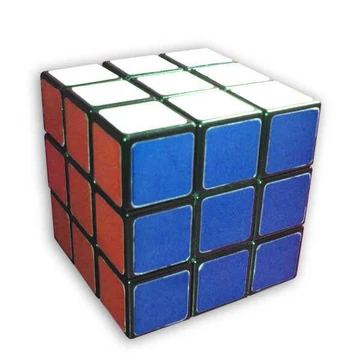
Rubik's family cubes of varying sizes
Cubes of all sizes, from hardware to software.
Rubik's family cubes are mechanical or software puzzles that extend the original 3×3×3 cube invented in 1974 by Ernő Rubik. They include cubes of various sizes, from the size 2 Pocket Cube to the size 49 hardware cube, as well as software emulators that can handle arbitrarily large sizes. The mathematical properties of these cubes, which depend on the cube size variable, are the main focus of this article.
Quick Facts
- Inventor
- Ernő Rubik
- Year of invention
- 1974
- Original cube size
- 3×3×3
- Largest hardware cube made
- size 49
- Largest mass-produced hardware cube
- size 21
- Smallest cube size
- size 2 (Pocket Cube)
Facts from the source article.
Cube types
Hardware cubes are physical puzzles based on the original size 3 cube invented by Ernő Rubik in 1974, typically using coloured stickers on facelets for cubie identification. The size 3 standard Rubik’s Cube peaked in interest during the 1980s, soon followed by the size 4 Rubik's Revenge. Other hardware cubes include size 2 (Pocket Cube), size 5 (Professor's Cube), size 6 (V-Cube 6), and size 7 (V-Cube 7), with larger sizes also produced; the largest hardware cube ever made is size 49, and the largest mass-produced is size 21.
Software cube emulators follow the same rules as hardware cubes but are not limited by physical constraints, so only software forms offer truly large cubes. A single program can accommodate a range of cube sizes, and design features vary, such as allowing users to save a partially unscrambled state. Software cubes existed in the 1980s when monochrome monitors were common, requiring alternative face identification; a 1991 program provided monochrome capability (using numerals 1 to 6) for sizes 2 to 11 and colour capability for sizes 2 to 15. Modern software cubes typically use coloured facelets like hardware cubes. Most emulators present a three-dimensional display resembling a real cube, though this view hides parts of the cube without extra enhancements.
Rules for Rubik’s family cubes
A cube is solvable if its current state has existed at some previous time and no tampering (such as rearranging stickers) has occurred. Rules documented for the standard size 3 cube and the entire family limit which arrangements are possible, making unreachable states far outnumber reachable ones. All cubes have three mutually perpendicular axes about which one or more layers can be rotated, and every move can be considered a sequence of quarter-turn rotations.
Each quarter turn moves cubies in separate four-cubicle trajectories (4-cycles), which can be represented by three swaps. The parity of a permutation—whether it is even or odd—depends on the number of swaps; an odd number of 4-cycles yields an odd overall parity for the quarter turn. For odd-size cubes, all permutations have even overall parity. For even-size cubes where half the cube size is an odd number, every individual quarter turn has odd overall parity.
Cube solving
Solving a cube means applying layer rotations to a scrambled cube until it reaches a solved state. For cubes with unmarked centres, all faces must appear in uniform colour; for cubes with marked centres, a unique arrangement of all centre cubies is also required. Because the starting point always differs, no single set of rotations works for every cube. Solvers typically use algorithms, especially in later stages, and it is theoretically possible to write a computer program that solves the cube without human intervention.
Most software cube emulators let users interact with the program to solve the cube similarly to a hardware cube. Efficient rotation sequences can be developed using group theory, and references exist for solving size 3, 4, and 5 cubes. There is no wrong way to solve a cube, and steps for cubes larger than size 4 are straightforward extensions of those for size 3 and 4 cubes, though generalized instructions for all sizes are limited. Anyone who can solve a size 4 cube can solve larger cubes with increased time. Software features unavailable in hardware cubes can simplify solving. The complexity of solving increases with the number of reachable states, which is strongly influenced by cube size because the number of cubies grows quadratically.
Reachable and unreachable states for cubes of all sizes
A reachable state is any state that can arise from legal moves if the cube has previously occupied the solved state. For small cubes (size 2, 3, or 4), an unreachable state is one that cannot be reached by legal moves; for larger cubes, notional movement between 24-cubie orbits for edge and centre cubies is excluded. If m represents the number of reachable states, u the number of unreachable states, and t their sum, then t = m × k, where k is a positive integer. Both m and k are functions of cube size.
The number of reachable states is based on standard permutation and combination mathematics, reduced by factors reflecting movement restrictions specific to Rubik's family cubes. These numbers for any size can be related to those for size 3 and size 4 cubes. Hofstadter's 1981 paper derived the number of states for the standard size 3 cube, and other sources justify figures for size 3 and size 4 cubes. For cubes with unmarked centres, positive integer constants P, Q, R, and S apply, agreeing with frequently quoted figures for size 3 and size 4 cubes.
More in Rubik's Cube
Spotted an error? Know more?
Reader corrections go straight into our review queue. Suggest an edit · How this site is sourced