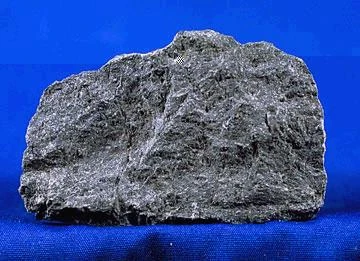
Greywacke
A dark, hard sandstone formed by ancient submarine avalanches.
Greywacke is an immature, generally indurated, dark grey sandstone with poorly sorted angular to subangular sand-sized grains.[1] Greywackes are characterized by a gritty texture and a mixture of many different minerals.[2]
Quick Facts
- Type
- Sedimentary rock (sandstone variety)
- Hardness
- 6–7 on Mohs scale
- Composition
- Quartz
- feldspar
- lithic fragments
- clay-fine matrix
- Matrix proportion
- More than 15% by volume
Facts from the source article.
Key facts and history
Greywackes are very frequent among Silurian and Cambrian rocks but less common in Mesozoic or Cenozoic strata.[2] Greywackes are abundant in Wales, southern Scotland, the Longford-Down Massif in Ireland, the Lake District of England, and compose most of the Southern Alps of New Zealand.[3] The grains in greywacke are often angular and not well-rounded, and the rock is frequently hardened by recrystallization, including the addition of silica between grains.[2] While some greywacke deposits show cleavage, this feature is less developed in them than it is in slates.[2]
In the Ecca Group of South Africa, researchers have identified both feldspathic and lithic varieties of greywacke.[4] In Britain, greywackes were among the first rocks studied by geologists after the Geological Society was founded in 1807, and their distribution across the country helped reveal the sequence of geological strata.[5]
What the research sources say
The Ancient Egyptian Materials account states that greywacke is a term referring to an immature sandstone, generally indurated, dark grey, and consisting of poorly sorted angular to subangular sand-sized grains.[1] The account explains that the metamorphism of greywacke increases the cohesiveness of its mineral grains and rock hardness, making it less susceptible to fracture during carving.[1] It also reports that the metagreywacke of Wadi Hammamat was called bhn (bekhen) by the ancient Egyptians, and some stone artifacts were inscribed with this name.[1] The source adds that the origin of the modern word "basalt" is from these words for greywacke.[1]
References
- "Ancient Egyptian Materials: Greywacke (schist)", www.hallofmaat.com. facts only, no text reused. hallofmaat.com
- Wikipedia, "Greywacke" (CC BY-SA 4.0), which cites: Flett 1911 (original not read by us) en.wikipedia.org
- Wikipedia, "Greywacke" (CC BY-SA 4.0), which cites: "The Geological Heritage of County Longford", The County Longford Geological Heritage Project (original not read by us) en.wikipedia.org
- Wikipedia, "Greywacke" (CC BY-SA 4.0), which cites: Baiyegunhi, "Modal composition and tectonic provenance of the sandstones of Ecca Group, Karoo Supergroup in the Eastern Cape Province, South Africa", Open Geosciences, 2017-10-28, p. 491–508 (original not read by us) en.wikipedia.org
- Wikipedia, "Greywacke" (CC BY-SA 4.0), which cites: Bryson, "A Short History of Nearly Everything", Crown, October 27, 2009, p. 80; Bryson, "Short History of Nearly Everything", Crown, p. 85; Davidson, "The greywacke: how a priest, a soldier and a schoolteacher uncovered 300 million years of history", Profile Books, 2021 (we also read that source) en.wikipedia.org
Each numbered sentence above was checked against the source it cites before publication. Sentences citing Wikipedia adapt text from the English Wikipedia article Greywacke (contributors), used under CC BY-SA 4.0; this entry is available under the same licence. Other sources were used for facts only; no text or images are copied from them.
More in Rocks And Minerals
Spotted an error? Know more?
Reader corrections go straight into our review queue. Suggest an edit · How this site is sourced