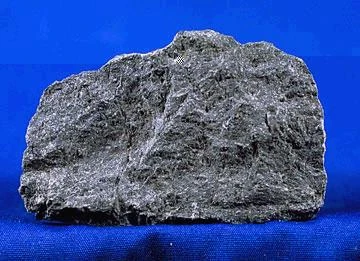
Enstatite
Magnesium-rich pyroxene mineral found in rocks, meteorites, and space.
Enstatite is the magnesium-rich endmember of the pyroxene mineral series that runs from enstatite (MgSiO₃) to ferrosilite (FeSiO₃). Members of this solid-solution series that are rich in magnesium are common rock-forming minerals in igneous and metamorphic rocks. The intermediate composition, (Mg,Fe)SiO₃, was once called hypersthene, but that name is now abandoned in favor of orthopyroxene. When the composition is determined petrographically or chemically, it is expressed as relative proportions of enstatite (En) and ferrosilite (Fs), for example En₈₀Fs₂₀. Most natural enstatite crystals are orthorhombic (space group Pbca), but three polymorphs exist. The high-temperature, low-pressure forms are protoenstatite and protoferrosilite (also orthorhombic, space group Pbcn), while the low-temperature forms, clinoenstatite and clinoferrosilite, are monoclinic (space group P2₁/c). When enstatite containing a small amount of iron weathers, it develops a submetallic luster and a bronze-like color; this material is called bronzite, though it is more accurately described as altered enstatite. An emerald-green variety known as chrome-enstatite is cut as a gemstone, its color coming from traces of chromium. Black, chatoyant hypersthene and brownish bronzite are also used as semi-precious gemstones. Enstatite and other orthorhombic pyroxenes are distinguished from monoclinic pyroxenes by optical characteristics: straight extinction, much weaker double refraction, and stronger pleochroism. They also have perfect prismatic cleavage in two directions at 90 degrees. Enstatite is white, gray, greenish, or brown, with a hardness of 5–6 on the Mohs scale and a specific gravity of 3.2–3.3. This prismatic form is used in gemstones and for academic study. Isolated enstatite crystals are rare, but orthopyroxene is an essential component of many igneous and metamorphic rocks. Magnesian orthopyroxene occurs in plutonic rocks like gabbro (norite) and diorite, and it can form small idiomorphic phenocrysts or groundmass grains in volcanic rocks such as basalt, andesite, and dacite. Enstatite near En₉₀Fs₁₀ in composition is an essential mineral in typical peridotite and pyroxenite of Earth’s mantle.
Quick Facts
- Category
- Inosilicate minerals (single chain)
- Group
- Pyroxene group, orthopyroxene subgroup
- Formula
- MgSiO; 3
- Strunz classification
- 9.DA.05
- System
- Orthorhombic
- Class
- Dipyramidal (mmm); H-M symbol: (2/m 2/m 2/m)
- Symmetry
- Pbca
- Habit
- Prismatic crystals
- commonly lamellar
- fibrous
- or massive
Facts from the source article.
Frequently Asked Questions
What is Enstatite?
Enstatite is the magnesium-rich endmember of the pyroxene mineral series, defined by the formula MgSiO₃. It marks one extreme of a solid-solution spectrum that runs all the way to the iron-rich ferrosilite.
What does Enstatite look like and how hard is it?
Natural crystals typically show up as white, gray, greenish, or brown, and they register around 5–6 on the Mohs hardness scale. With a specific gravity of roughly 3.2–3.3, it sits in the moderately dense range for silicate minerals.
More in Rocks And Minerals
Spotted an error? Know more?
Reader corrections go straight into our review queue. Suggest an edit · How this site is sourced