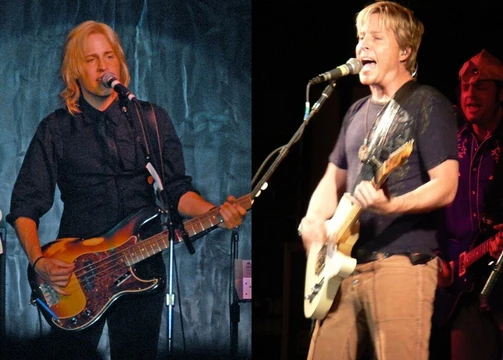
Death from Above 1979
Canadian dance-punk duo known for loud, minimal rock.

Death from Above 1979, also referred to as Death from Above or DFA 1979, is a Canadian rock duo from Toronto, Ontario. The group was founded in 2001 by bassist Jesse F. Keeler and drummer and vocalist Sebastien Grainger. Their first album, *You're a Woman, I'm a Machine*, came out in 2004, and the band split up in 2006. They got back together in 2011 and released a second album, *The Physical World*, in 2014. Two more albums followed: *Outrage! Is Now* in 2017 and *Is 4 Lovers* in 2021.
Grainger and Keeler first met at a Sonic Youth concert, though they sometimes joked about meeting in prison, on a pirate ship, or in a gay bar, which some journalists and fans took seriously. Keeler also said he was looking for a drummer for his hardcore punk band Femme Fatale when he met Grainger, adding that this was how Death from Above started. In a 2021 interview with Anthony Fantano, Keeler gave the real story. In 2001, he was drumming for the local Toronto band Black Cat #13 and had bass gear stored at his house for a planned Detroit show opening for The Blood Brothers. That concert was canceled because of the September 11 attacks, so Keeler asked Grainger to jam and use the equipment, which inspired them to form their own band. Their first release, the EP *Heads Up*, came out on November 5, 2002.
Recording for their debut album, *You're a Woman, I'm a Machine*, took place from February to April 2004 at The Chemical Sound in Toronto, with additional work at Studio Plateau in Montreal. Al-P engineered and produced the album, except for the Montreal sessions, which were engineered by Drew Malamud. The album was released in October 2004. Three singles promoted it: "Romantic Rights" on November 4, 2004, "Blood on Our Hands" on February 17, 2005, and "Black History Month" on June 13, 2005. In 2005, the video for "Blood on Our Hands" won a VideoFACT award at the MuchMusic Video Awards. In 2004, the band changed its name from "Death from Above" to "Death from Above 1979" after a cease and desist letter from James Murphy's label Death From Above Records. The band responded by adding the minimum number of numerals legally required to keep the first part of the name. On MuchMusic's *The New Music*, Keeler explained the band split was due to disagreements with Grainger over creative differences and musical style.
- Formed
- 2001
- Origin
- Toronto, Ontario, Canada
- Genre
- dance-punk, noise punk, punk rock
- Members
- Jesse F. Keeler (bass, synthesizer, keyboards, backing vocals), Sebastien Grainger (drums, vocals)
- Debut album
- You're a Woman, I'm a Machine (2004)
- Notable singles
- Romantic Rights, Blood on Our Hands, Black History Month
Lore & Background
Grainger and Keeler reportedly met at a Sonic Youth concert, though they sometimes jokingly claimed to have met in prison, on a pirate ship, or in a gay bar, leading some journalists and fans to believe these stories. Keeler has also said to have met Grainger when looking for a drummer to play in his hardcore punk band Femme Fatale. In a 2021 interview with Anthony Fantano, Keeler revealed the actual formation: in 2001, Keeler was playing drums in local Toronto band Black Cat #13 and was storing bass gear for a cancelled concert due to the September 11 attacks; he invited Grainger to jam, and they formed the band. The band released their debut EP Heads Up on November 5, 2002.
The band reunited in 2011, and their reunion was documented in a short film called 'The Physical World'.
Reader's Guide
Death from Above 1979 emerged from the Toronto underground in the early 2000s, quickly becoming a defining act of the dance-punk movement. Their stripped-down lineup—only bass, drums, and vocals—created a powerful, minimalist sound that combined noisy hardcore, gritty synths, and earnest screams. Their debut album, You're a Woman, I'm a Machine, became a cult classic, and their energetic live shows built a devoted following. The band's breakup in 2006 was followed by a successful reunion in 2011, leading to three more studio albums that continued their evolution while maintaining their core aesthetic. Their influence is seen in the resurgence of dance-punk and the DIY ethos they embodied. The band's name changes and playful origin stories added to their mystique, while their music remained consistently loud and direct. Their legacy is that of a duo that proved a two-piece could create a massive, genre-blurring sound.
Did You Know?
- The band changed their name to 'Death from Above 1979' in 2004 after a cease and desist letter from James Murphy's label Death From Above Records.
- Keeler and Grainger sometimes jokingly claimed to have met in prison, on a pirate ship, or in a gay bar, though they actually met at a Sonic Youth concert or through Keeler's search for a drummer.
- The band's debut album was engineered and produced by Al-P, with Montreal sessions engineered by Drew Malamud.
- The band's 2014 documentary Life After Death from Above 1979 was directed by Grainger's wife, Eva Michon.
More in Rock music duos 1-24
Spotted an error? Know more?
Reader corrections go straight into our review queue. Suggest an edit · How this site is sourced