Kabul River
Major river of eastern Afghanistan and Khyber Pakhtunkhwa, Pakistan.

via Wikipedia: Kabul River · see source
The Kabul River flows for 700 kilometers, starting in the Sanglakh Range of the Hindu Kush within northeastern Maidan Wardak Province, Afghanistan. It is separated from the Helmand River's drainage basin by the Unai Pass. This river ends at the Indus River near Attock, Pakistan, and is the primary waterway for eastern Afghanistan and Pakistan's Khyber Pakhtunkhwa province.
Quick Facts
- Length (km)
- 700
- Source location
- Near Maidan Shar, Maidan Wardak, Afghanistan
- Source elevation
- 2,400 m / 7,874 ft
- Mouth
- Indus River
- Mouth location
- Near Kund Park, Attock, Punjab, Pakistan
- Tributaries left
- Panjshir River
- Alingar River
- Chitral River
- Swat River
- Tributaries right
- Logar River
- Surkhab River
- Bara River
Facts from the source article.
Course
The Kabul River rises in the Sanglākh Range at Sar Čašma, 14,000 feet above sea level in the Kōh-e Bābā mountains northwest of Kabul. It flows through Kabul and Jalalabad in Afghanistan, then enters Khyber Pakhtunkhwa, Pakistan, about 25 km north of the Durand Line crossing at Torkham. In Pakistan it passes through Peshawar, Charsadda, and Nowshera. Its drainage basin covers the eastern provinces of Nangarhār, Kunar, Laghmān, Lōgar, Kabul, Kāpisā, Parwān, Panjshēr, and Bāmyān.
Hydrology
For most of the year the Kabul River is a trickle, but it swells in summer from melting snows in the Hindu Kush Range. Its largest tributary is the Chitral River, which begins as the Mastuj River from the Chiantar Glacier in Brughil Valley, Chitral, Pakistan, and meets the Kabul near Jalalabad. Despite the Chitral carrying more water, the river retains the name Kabul for political and historical reasons. Annual mean discharge near Nowshehra is 800 m³/s, with the Chitral contributing over 288 m³/s and the Swat over 280 m³/s. Dams include Surobi (built 1957 with German assistance), Naghlu and Darunta (built by Soviet scientists in the 1960s), and Warsak Dam in Pakistan.
History
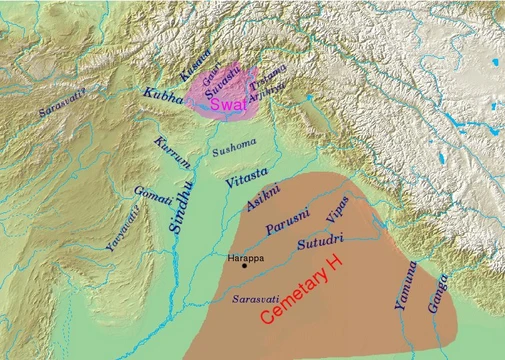
In ancient times, the Kabul River was known as the Kubha (कुभा) and Cophen (Κωφήν). The word Kubhā is both a Sanskrit and Avestan word, later changing to Kābul. Al-Biruni called it 'the River of Ghorwand'. The river gave its name to the region and to the settlement of Kabul. In Arrian's The Campaigns of Alexander, the river is referred to as Κωφήν Kōphēn. Philostratus wrote that Apollonius forded the Cophen on his way from crossing the Caucasus to the Indus Valley. Since the 1990s, the river has experienced substantial droughts in summer. In approximately March 2019, tens of thousands of gallons of untreated sewage from the Makroyan Waste Water Treatment Plant were dumped into the Kabul River each month, reportedly causing gastrointestinal issues among the 3,000 families living along the river.
More in Rigvedic Rivers
Spotted an error? Know more?
Reader corrections go straight into our review queue. Suggest an edit · How this site is sourced