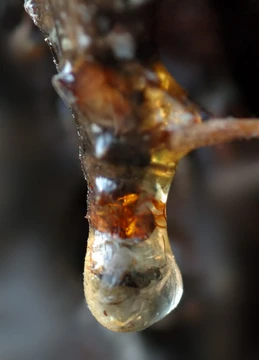
Furfural
An organic aldehyde derived from agricultural biomass.
Furfural is an organic compound with the formula C4H3OCHO, a colorless liquid that often appears brown in commercial samples. It is produced by dehydrating sugars found in agricultural byproducts such as corncobs, oat, wheat bran, and sawdust. Notable as one of the oldest organic chemicals readily purified from natural precursors, its name derives from the Latin word for bran.
Quick Facts
- First isolated
- 1821 (published 1832)
- Isolated by
- Johann Wolfgang Döbereiner
- Empirical formula determined by
- John Stenhouse (1840)
- Empirical formula
- C5H4O2
- Permissible exposure limit (osha)
- 5 ppm over eight-hour TWA
Facts from the source article.
Did You Know?
- Furfural dissolves readily in most polar organic solvents but is only slightly soluble in water or alkanes.
- When heated in the presence of acids, furfural irreversibly polymerizes, acting as a thermosetting polymer.
- Furfural exhibits less aromatic character than benzene, as seen by its ready hydrogenation to tetrahydrofurfuryl alcohol.
History
Furfural was first isolated in 1821 by the German chemist Johann Wolfgang Döbereiner, who obtained a small sample as a byproduct of formic acid synthesis; the work was published in 1832. In 1840, the Scottish chemist John Stenhouse produced the same chemical by distilling crop materials such as corn, oats, bran, and sawdust with aqueous sulfuric acid, and he determined its empirical formula as C5H4O2. George Fownes named the oil "furfurol" in 1845, combining furfur (bran) and oleum (oil).
Auguste Cahours identified furfural as an aldehyde in 1848. The structure proved difficult to establish because the furan ring tends to open under harsh reagents. Adolf von Baeyer speculated on the structure of furan and 2-furoic acid in 1870, and Heinrich Limpricht supported this idea. By 1877, Baeyer had confirmed his earlier belief on furfural's structure.
The name "furfural" (short for furfuraldehyde) came into use by 1886, and the correct structure was proposed that year. Willy Marckwald inferred in 1887 that some furfural derivatives contain a furan nucleus. Carl Harries determined furan's structure in 1901 through work with succindialdehyde and 2-methylfuran, confirming furfural's proposed structure. Furfural remained obscure until 1922, when the Quaker Oats Company began mass-producing it from oat hulls.
Today, it is still produced from agricultural byproducts such as sugarcane bagasse and corn cobs, with major producing countries including the Dominican Republic, South Africa, and China.
Production
Furfural is made by using an acid to trigger the dehydration of five-carbon sugars, primarily xylose. These sugars come from pentosans, which are part of the hemicellulose found in lignocellulosic biomass. Depending on the crop residue used, between 3% and 10% of its mass can be turned into furfural. During production, furfural and water leave the reaction mixture as vapor and then separate when they condense.
As of 2012, global production capacity was around 800,000 tons, with China being the largest producer. The other two main commercial producers are Illovo Sugar in South Africa and Central Romana in the Dominican Republic. In a lab, furfural can be made by heating plant material with sulfuric acid or other acids. To avoid toxic waste, researchers have looked into replacing sulfuric acid with solid acid catalysts that are easy to separate and reuse.
Adjusting factors like acid concentration, temperature, and time can favor the formation and extraction of xylose and furfural over other sugars. In industrial settings, the leftover lignocellulosic residue is dried and burned to generate steam for the plant. Newer, more efficient plants produce extra residue, which can be used for co-generating electricity, making cattle feed, activated carbon, or mulch and fertilizer.
Uses and occurrence
Furfural is commonly found in cooked or heated foods, such as coffee at 55–255 mg/kg and whole grain bread at 26 mg/kg. In the petrochemical industry, it serves as a specialized solvent for diene extraction. As a renewable, non-petroleum chemical feedstock, furfural can be converted into solvents, polymers, fuels, and other chemicals via catalytic reduction. Hydrogenation yields furfuryl alcohol, used to produce furan resins for thermoset polymer matrix composites, cements, adhesives, casting resins, and coatings.
Further hydrogenation gives tetrahydrofurfuryl alcohol, a solvent in agricultural formulations and an adjuvant for herbicide penetration. Palladium-catalyzed decarbonylation produces furan industrially. Another solvent made from furfural is methyltetrahydrofuran. Furfural also yields furoic acid via oxidation. A method to directly produce gamma-butyrolactone using electrolytic catalysts was recently developed.
Safety
Furfural is known to cause cancer in lab animals and mutations in single-celled organisms, though its effects on humans remain unstudied. Because of this lack of human data and insufficient animal testing to meet stricter criteria, the IARC places it in Group 3. The substance is toxic to the liver. Its oral median lethal dose in dogs is high, ranging from 650 to 900 mg per kg, which aligns with its common presence in foods. OSHA limits workplace exposure to 5 ppm over an eight-hour average and warns that furfural can be absorbed through the skin.
More in Resins
Spotted an error? Know more?
Reader corrections go straight into our review queue. Suggest an edit · How this site is sourced