
Ancient Celtic religion
Polytheistic religion of ancient Celtic peoples, known from fragmentary evidence.

Pious Shy Boi · CC0
Ancient Celtic religion—also called Celtic polytheism or Celtic paganism—was the faith of the ancient Celtic peoples across Europe. Since no written records from the Celts themselves survive, what we know comes from archaeology, Greek and Roman writings (some of which were hostile and probably not well-informed), and literature from the early Christian period. This belief system was part of a larger family of polytheistic Indo-European religions that flourished in Iron Age Europe.
The specific gods and goddesses worshipped varied by region and changed over time, but there were broad similarities and a basic religious unity among Celtic peoples. Widely venerated deities included Lugus, Toutatis, Taranis, Cernunnos, Epona, Maponos, Belenos, and Sucellos. Sacred springs were often linked to healing gods. The number three appears frequently, with many deities depicted as triple figures—for instance, the Three Mothers.
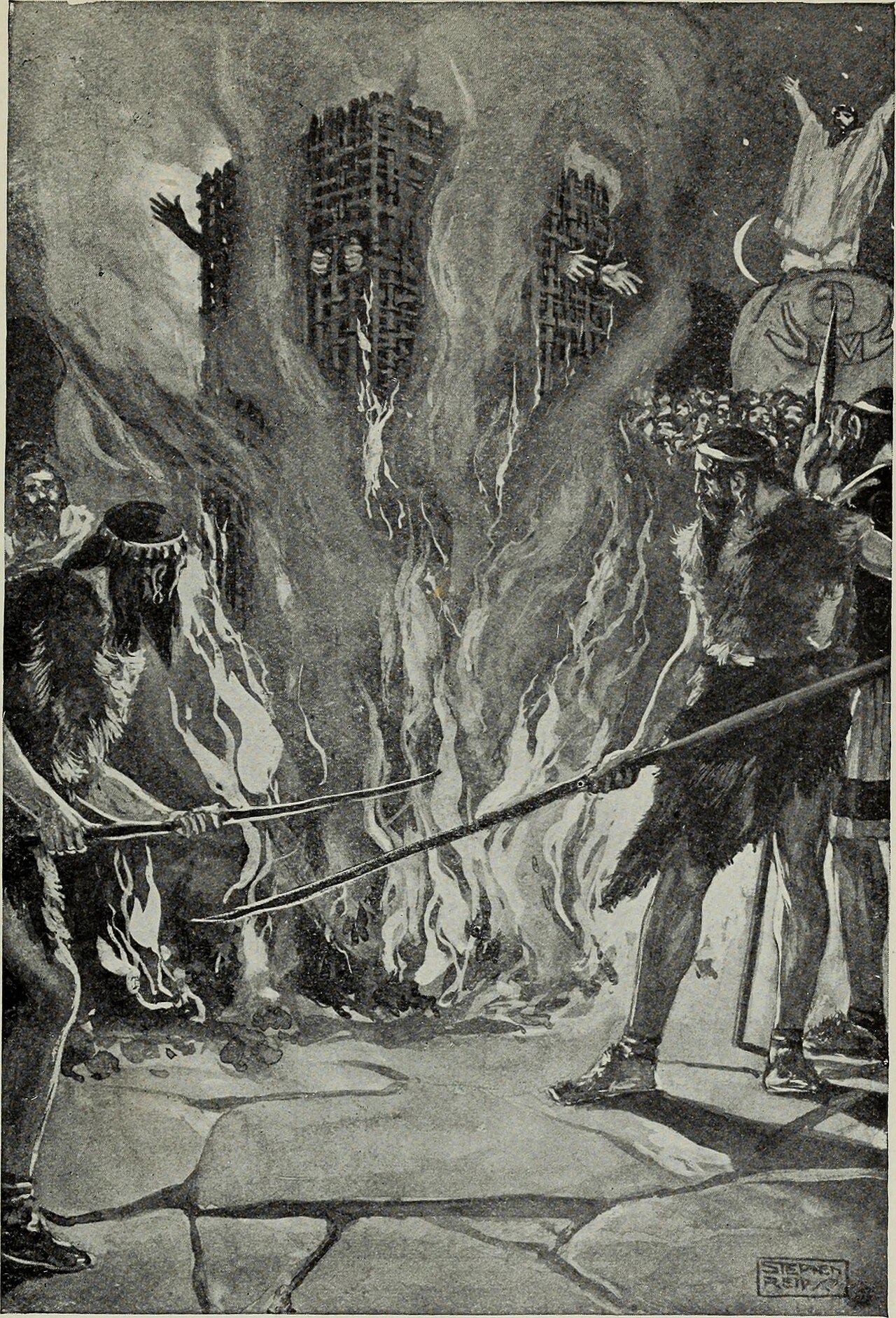
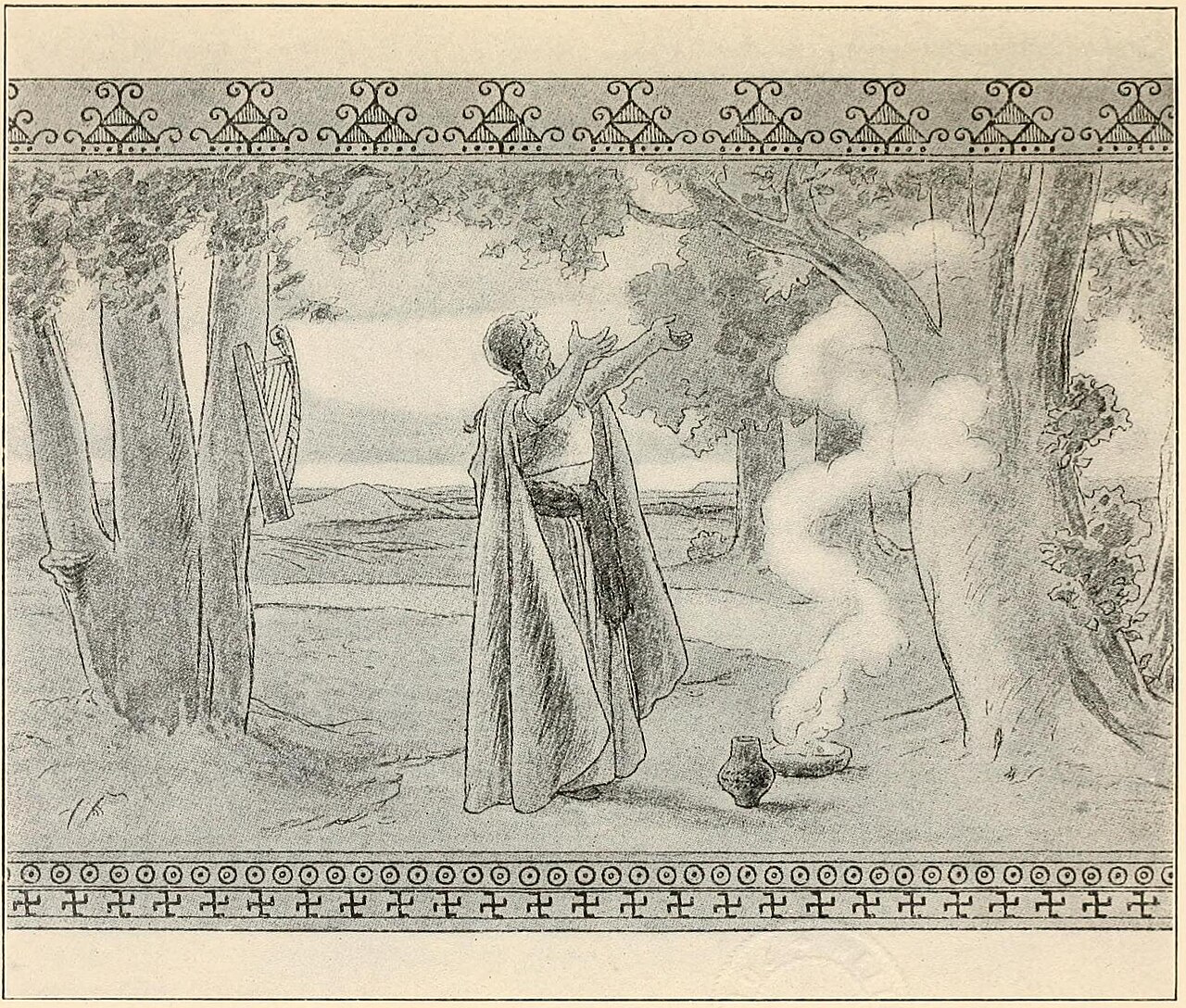
The druids served as the priests of Celtic religion, though little is known for certain about them. According to Greco-Roman writers, the Celts held ceremonies in sacred groves and other natural shrines called nemetons, while some groups also built temples or ritual enclosures. Votive offerings were commonly placed in water, wetlands, ritual shafts, and wells. Evidence shows that animals—almost always livestock or working animals—were sacrificed. There is also some evidence of human sacrifice; Julius Caesar, in his account of the Gallic Wars, claimed the Gauls burned criminals alive inside a wicker man.
**History**
**Origins**
Celtic paganism, as practiced by the ancient Celts, descended from Proto-Celtic paganism, which itself came from Proto-Indo-European paganism. Many Celtic deities have counterparts in other Indo-European mythologies. For example, the Celtic goddess Brigantia shares traits with the Roman Aurora, the Vedic Ushas, and the Norse Aurvandill; the Welsh Arianrhod corresponds to the Greek Selene, the Baltic Mėnuo, and the Slavic Myesyats; and the Irish Danu is linked to the Hindu Danu and gives her name to rivers such as the Danube, Don, and Dnieper.
**Legacy**
After the Roman Empire conquered Gaul (58–51 BCE) and southern Britain (43 CE), Celtic religion in those areas underwent Romanization, creating a syncretic Gallo-Roman faith with deities like Lenus Mars, Apollo Grannus, and Telesphorus. The Gauls gradually converted to Christianity from the third century onward. Following the end of Roman rule in Britain around 410 CE, Celtic paganism was largely replaced by Anglo-Saxon paganism in what became England. The Celtic populations of Britain and Ireland converted to Christianity from the fifth century onward. Still, Celtic paganism left a lasting legacy in many Celtic nations, influencing mythology and, in the 20th century, forming the basis for a new religious movement known as Celtic neopaganism.
Some figures from medieval Irish mythology are thought to be versions of earlier deities. According to scholar Miranda Aldhouse-Green, the Celts were also animists, believing that every part of the natural world had a spirit.
**Revival**
Various Neopagan groups today claim a connection to Celtic paganism. These range from Reconstructionists, who strive to practice ancient Celtic religion as accurately as possible, to New Age, eclectic groups that draw inspiration from Celtic mythology and iconography—the most notable of which is Neo-Druidry.
**Sources**
Relatively little is known about Celtic paganism because the evidence is fragmentary, largely because the Celts who practiced it left no written records. What we have comes from early Christian literature, classical Greek and Roman commentaries, and archaeological finds. Archaeologist Barry Cunliffe described the sources for Celtic religion as a "fertile chaos," borrowing the term from Irish scholar Proinsias MacCana. He added that there is more varied evidence for Celtic religion than for any other aspect of Celtic life, but the challenge is to assemble it systematically without oversimplifying its intricate details.
**Archaeological sources**
Archaeological evidence lacks the bias found in literary sources, but its interpretation can still be shaped by modern perspectives. Many discoveries have helped us understand Celtic religion. Most surviving Celtic art is not figurative; some art historians suggest that the complex decorative motifs of certain periods had religious meaning, though that meaning now seems lost. Surviving figurative stone sculpture comes almost entirely from Romano-Celtic contexts and follows provincial Roman styles, though figures likely representing deities often wear torcs, and inscriptions in Roman letters sometimes include Romanized Celtic names. The Pillar of the Boatmen from Paris, which features many deity figures and is dated by a dedication to Emperor Tiberius (reigned from 14 AD), is the most comprehensive example.
Monumental stone sculptures from before the Roman conquest are much rarer, and it is unclear whether they depict deities. Notable examples include the Warrior of Hirschlanden and the "Glauberg Prince" (6th and 5th centuries BC, from Germany), the Mšecké Žehrovice Head (probably 2nd century BC, Czech Republic), and sanctuaries at the southern French oppida of Roquepertuse and Entremont. There are also Celtiberian standing "warrior" figures and several other stone heads from various areas. In general, early monumental sculpture is found in regions with greater contact with the classical world.
- field
- Polytheistic Indo-European religion
- known_for
- Worship of deities such as Lugus, Toutatis, Taranis, Cernunnos, Epona, Maponos, Belenos, and Sucellos; sacred springs; triplicity; druids as priests; votive offerings in water and wetlands; animal and
Lore & Background
Celtic paganism descended from Proto-Celtic paganism, itself derived from Proto-Indo-European paganism. Many Celtic deities have cognates in other Indo-European mythologies, such as Brigantia with the Roman goddess Victoria or Minerva, though some speculative connections to Vedic Ushas or Norse Aurvandill are not widely accepted in mainstream scholarship. The druids were the priests, but little is definitively known about them. Greco-Roman writers stated that ceremonies were held in sacred groves and natural shrines called nemetons, while some Celtic peoples also built temples or ritual enclosures. Votive offerings were deposited in water, wetlands, ritual shafts, and wells. Animal sacrifice—almost always livestock or working animals—is evidenced; Julius Caesar claimed Gauls sacrificed criminals by burning them in a wicker man, though human sacrifice is debated.
Reader's Guide
After the Roman conquest of Gaul (58–51 BCE) and southern Britain (43 CE), Celtic religion underwent Romanization, producing a syncretic Gallo-Roman religion with deities such as Lenus Mars, Apollo Grannus, and Telesphorus. The Gauls gradually converted to Christianity from the third century onward. After the end of Roman rule in Britain (c. Celtic populations of Britain and Ireland gradually converted to Christianity from the fifth century onward. Celtic paganism left a legacy in many Celtic nations, influenced mythology, and in the 20th century served as the basis for Celtic neopaganism. Some figures from medieval Irish mythology are believed to be versions of earlier deities. According to Miranda Aldhouse-Green, the Celts were animists, believing every part of the natural world had a spirit. Neopagan groups today range from Reconstructionists aiming for historical accuracy to eclectic New Age groups inspired by Celtic mythology and iconography, most notably Neo-Druidry.
Did You Know?
- No native written records of Celtic religious beliefs survive; evidence comes from archaeology, Greco-Roman accounts, and early Christian literature.
- Widely worshipped Celtic gods included Lugus, Toutatis, Taranis, Cernunnos, Epona, Maponos, Belenos, and Sucellos.
- The druids were the priests of Celtic religion, but little is definitively known about them.
- Celtic coinage from the late 4th century BC until conquest clearly copies Greek and Roman examples, and heads and horses on them may have local religious significance.
Survival and Loss of the Mythological Record
The fate of Celtic mythological knowledge is one of the most dramatic stories of cultural preservation and destruction in European history. The continental Celtic peoples—Gauls, Celtiberians, and others—saw their rich mythological traditions effectively erased by a double blow: the military conquest by Rome and the subsequent loss of their native languages, compounded later by conversion to Christianity. What remains of their stories is fragmentary, preserved only in passing references within Greco-Roman literary sources and in archaeological evidence such as votive inscriptions. By stark contrast, the Insular Celtic peoples—the Gaels of Ireland and Scotland, and the Celtic Britons of western Britain and Brittany—managed to carry their myths forward through centuries of oral tradition. These tales were eventually committed to writing by Christian monks in the medieval period, though the scribes inevitably filtered the material through a religious lens, stripping away much of its original sacred context. Irish mythology emerged as the most extensive written corpus, with Welsh mythology following as the second-largest body of surviving Celtic myth.
The Cycles of Irish Myth
Irish mythology, the largest surviving branch of the Celtic mythological tradition, is organized into distinct narrative cycles that together paint a vast picture of a mythic past. The Mythological Cycle, sometimes called the Cycle of the Gods, centers on the Tuatha Dé Danann—a supernatural race widely understood to represent the principal Irish deities recast as kings, queens, druids, bards, warriors, healers, and craftsmen. Among their most prominent members are the Dagda, often regarded as the chief god; the Morrígan, a triple goddess linked to war, fate, and sovereignty; Lugh; Nuada; Aengus; Brigid; Manannán; and the craft-triad that includes Dian Cecht the healer and Goibniu the smith. Their great adversaries are the Fomorians, defeated in the Battle of Moytura. The Ulster Cycle turns to heroic legend, spotlighting Cú Chulainn and the epic Cattle Raid of Cooley. The Fianna Cycle follows the warrior band of Fionn, while the Kings' Cycle weaves together semi-historical royal narratives and dynastic origin tales.
Pan-Celtic Parallels and Shared Motifs
Despite the political fragmentation of the Celtic world, which produced enormous local variation in religious practice, certain mythological threads stretch across the entire Celtic-speaking sphere. A striking example is the family of warrior-gods: the Irish Lugh and the Welsh Lleu are linguistic and mythological cognates of the continental Lugus, whose cult was widespread. Similarly, the Irish smith Goibniu and the Welsh Gofannon both descend from the same ancestral figure as the Roman-era Gobannos, while the Irish Macán and the Welsh Mabon parallel the continental Maponos. A particularly unifying motif is the sovereignty goddess, a figure who embodies the land itself and confers royal authority by taking a king as her consort. The Otherworld, a parallel supernatural realm inhabited by the divine races and visited by mortal heroes, appears as a shared imaginative space across traditions. These commonalities suggest a deeper, more unified pantheon than the scattered local inscriptions alone might indicate, and they also seeded the later Arthurian legend that would shape European storytelling.
The Landscape of Worship and the Role of the Druids
Celtic religion was polytheistic, yet it was never centralized under a single priesthood or a unified state cult. At its height the Celtic world spanned much of western and central Europe, but it lacked political unity and any single dominant cultural authority, so local religious practice varied enormously. More than three hundred deities appear in surviving inscriptions, many of them equated with Roman counterparts, yet the vast majority were genii locorum—local or tribal spirits rather than widely venerated national gods. The nature and roles of these figures can be reconstructed from their names, the geographic context of their inscriptions, their iconography, and the Roman gods they were paired with. The druids, the priestly class, occupied a complex position: Julius Caesar noted that they were forbidden from committing certain sacred verses to writing, even though the Gauls themselves were literate and used Greek, Latin, and Old Italic alphabets for votive inscriptions and documents like the Coligny calendar. Rome's conquest broke druidic power and introduced a new culture of public inscription, meaning that most surviving deity inscriptions actually post-date the Roman takeover.
Gallery

Frequently Asked Questions
What is Ancient Celtic religion?
It was the polytheistic faith of Celtic peoples across Iron Age Europe, part of the broader Indo-European religious family. Its core features included worship of multiple gods, reverence for sacred springs, and a priestly class of druids.
Who are the most recognized deities in Ancient Celtic religion?
Commonly cited figures include Lugus, Toutatis, Taranis, Cernunnos, Epona, Maponos, Belenos, and Sucellos, though the full pantheon is only partially known. These gods were typically linked to specific natural elements, crafts, or human activities.
What role did druids play in Ancient Celtic religion?
Druids functioned as the ritual specialists and priestly intermediaries of Celtic communities, overseeing ceremonies and maintaining oral tradition. They were also associated with legal knowledge and the performance of sacred rites.
How do scholars reconstruct Ancient Celtic religion when no native writings survive?
Because no indigenous texts remain, researchers piece together beliefs from archaeological finds, Greco-Roman accounts (sometimes hostile or poorly informed), and early Christian-era literature. This patchwork approach means many details stay debated or uncertain.
Why is Ancient Celtic religion still studied today?
It illuminates how Iron Age European communities understood nature, structured social life, and expressed devotion through practices like votive offerings in wetlands. Its fragmentary survival also makes it a compelling case study in reconstructing a lost belief system.
More in Religious Traditions 1-24
Spotted an error? Know more?
This is a living reference — every entry is fact-audited, and reader corrections feed straight into our audit queue. Suggest an edit · See this site's audit record