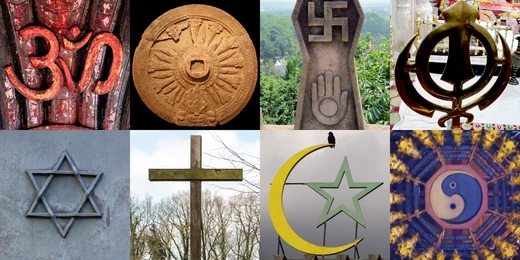
Prayer
Prayer is deliberate communication with a deity or deified ancestor.

Prayer is a deliberate act of communication intended to establish or deepen a connection with a divine being or object of worship. In a specific sense, it involves asking for something or interceding on behalf of others before a god or a deified ancestor. More broadly, prayer can express gratitude or adoration, and in the study of world religions, it is often linked to meditation, charms, and spells. Written records of prayer date back roughly five thousand years, and it is now a practice found in nearly all major religions.
The English word "prayer" comes from the Medieval Latin *precaria*, meaning "petition" or "prayer." The Latin term used in the Vulgate is *oratio*, which translates the Greek *proseuchē*, itself a rendering of the Biblical Hebrew *tĕphillah*.
Prayer takes many forms. It can be part of a fixed liturgy or ritual, performed alone or in a group. It may be a hymn, an incantation, a formal statement of belief, or a spontaneous utterance. Some traditions require strict sequences of actions or limit who may pray, while others allow anyone to pray at any time. Physical gestures vary widely: Christians may bow their heads and fold their hands; some Native Americans consider dancing a form of prayer; Hindus chant mantras; Jewish prayer can involve swaying and bowing; Muslims bow, kneel, and prostrate; and some Sufis whirl. Other outward acts include anointing with oil, ringing a bell, burning incense or paper, lighting candles, facing a specific direction (such as Mecca or the East), and making the sign of the cross. Fasting is a less visible practice associated with prayer. Body postures—standing, sitting, kneeling, prostrating, with eyes open or closed, hands folded, raised, or clasped with others—often convey respect or adoration. Prayers may be recited from memory, read from a book, or composed on the spot. They can be spoken, chanted, or sung, with or without music, and sometimes are offered in silence. Specific prayers exist for occasions like meals, births, deaths, or religious holidays.
Friedrich Heiler’s typology lists six types of prayer: primitive, ritual, Greek cultural, philosophical, mystical, and prophetic. Some forms require prior purification, such as *ghusl* or *wudhu* in Islam. Prayer can be private (affective prayer) or collective, led on behalf of a faith community or a broader group. It may be integrated into a daily "thought life" of constant communication with a god, a practice required in some Christian denominations. Answers to prayer are interpreted in many ways, and there may be no answer at all. In Catholic tradition, contemplation differs from meditation: meditation uses reason to understand divine revelation, while contemplation uses imagination for the same purpose.
Anthropologically, prayer is linked to surrender and supplication. In medieval Europe, the typical posture was kneeling or lying supine with clasped hands, but in antiquity, raised hands were more common. Early Christians prayed standing, looking upward with arms outstretched and heads bare—a pre-Christian, pagan posture (though Roman pagans covered their heads). Late Bronze Age figures from Crete and Cyprus with raised arms are interpreted as worshippers, their pose resembling a "hands up" gesture of surrender. The kneeling, clasped-hands posture appeared in the early high medieval period, likely borrowed from feudal homage. In animism, literal prayer is absent, but communication with spirits is vital, often through a shaman who enters a trance to relay the spirits’ thoughts. Other methods include astrology or consulting fortune tellers and healers.
Scientific studies on prayer have mostly examined its effect on healing the sick or injured. Results are contradictory: many well-controlled trials found no effect, and some even suggested negative outcomes.
- forms
- hymn, incantation, creedal statement, spontaneous utterance
- associated_practices
- meditation, charms, spells
- common_postures
- standing, sitting, kneeling, prostrate, hands clasped or upraised
- scientific_study_focus
- healing of sick or injured people
Lore & Background
Prayer can take a variety of forms: it can be part of a set liturgy or ritual, and it can be performed alone or in groups. Prayer may take the form of a hymn, incantation, formal creedal statement, or a spontaneous utterance in the praying person. Some traditions distinguish between contemplative and meditative prayer; contemplation is foundational in the Catholic faith, while meditation uses the reasoning faculty to understand revelation. Outward acts that may accompany prayer include anointing with oil, ringing a bell, burning incense or paper, lighting a candle, facing a specific direction, and making the sign of the cross. Fasting is a less noticeable act related to prayer.
Reader's Guide
Prayer has been a central practice across human cultures for at least five thousand years, with written records from ancient Mesopotamia and Egypt. Its forms range from highly ritualized liturgies to spontaneous individual utterances. The efficacy of prayer in faith healing has been evaluated in numerous studies, with contradictory results; many well-controlled trials have found no effect, and some even suggest negative outcomes. Anthropologically, prayer is closely related to surrender and supplication, and in animist traditions, communication with the spirit world is often mediated by shamans. The English term derives from Medieval Latin 'precaria,' meaning petition or prayer. Prayer remains a universal human cultural phenomenon, adapted to the beliefs and practices of each tradition.
Did You Know?
- The English term 'prayer' comes from Medieval Latin 'precaria,' meaning 'petition, prayer.'
- Some of the oldest extant literature, such as the Kesh temple hymn (c. 26th century BC), is liturgy addressed to deities and thus technically 'prayer.'
- Scientific studies on prayer have mostly concentrated on its effect on healing, with contradictory results; many well-controlled trials found no effect.
- In Shinto, prayers frequently consist of wishes or favors asked of the kami, rather than lengthy praises or devotions.
More in Religious Practices And Symbols 1-17
Spotted an error? Know more?
This is a living reference — every entry is fact-audited, and reader corrections feed straight into our audit queue. Suggest an edit · See this site's audit record