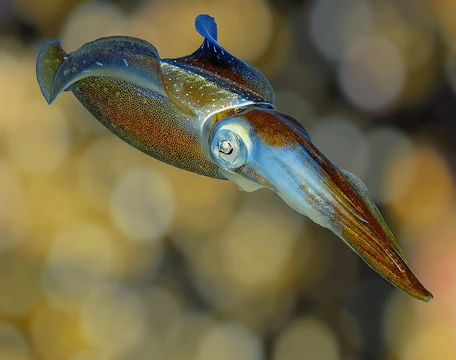
Pinnoctopus cordiformis
A common New Zealand reef octopus with disputed taxonomy.
Last updated

Brian Gratwicke · via Wikipedia: Pinnoctopus cordiformis · CC BY 2.0
This reef-dwelling octopus has a primary distribution in New Zealand waters, with additional documented occurrences near South Australia.[1][2] Distinguishing features include an orange-brown or purple-grey body, plus iridescent white spots located on the arms and web, while the mantle lacks such spots.[3]
Scientific classification
- OrderOctopoda
- FamilyOctopodidae
- GenusPinnoctopus
- SpeciesPinnoctopus cordiformis
Named by (Quoy & Gaimard, 1832)
Close relatives
Other species of Pinnoctopus with a Codexery entry.
- Pinnoctopus bunurong Pinnoctopus bunurong
- Pinnoctopus macropus Pinnoctopus macropus
- Pinnoctopus ornatus Pinnoctopus ornatus
Sources: Wikipedia taxobox: Pinnoctopus cordiformis (CC BY-SA 4.0) · order, family and genus agree with WoRMS AphiaID 342381 (CC BY 4.0)
How big is it?
Largest length in the source, 1 m, next to a 1.8 m person.
Diagram: drawn by Codexery, schematic shapes to scale (not a likeness). Length: Wikipedia: Pinnoctopus cordiformis
Where the pinnoctopus cordiformis has been recorded
Each dot is a place where the species has been observed and reported (1,469 records, half-degree grid) — not a modelled range. 6 inland records left out (institution coordinates).
Map: drawn by Codexery. Data: GBIF occurrence search (records CC0 / CC BY) · Natural Earth basemap (public domain)
Last updated 2026-10-10 from the source article.
Key facts and history
The eggs are of intermediate size, pear-shaped, with the yolk representing about 57% of the egg size.[4] Early Maori used to catch octopus by hand, using one hand as bait while the other picked it up and killed it.[5] French naturalists Jean René Constant Quoy and Joseph Paul Gaimard provided the first formal description of this species in 1832, naming it Octopus cordiformis.[6] Alcide d'Orbigny introduced the genus Pinnoctopus in 1845, selecting O. cordiformis as its type species.[6]
Taxonomic opinions differ: some consider Pinnoctopus a valid genus and treat P. cordiformis as conspecific with Macroctopus maorum (with the latter as the junior synonym), while others reject this synonymy and instead regard P. cordiformis as a synonym of Enteroctopus zealandicus.[6] A close relationship exists between Pinnoctopus cordiformis and Robsonella huttoni, but the two differ because P. cordiformis reaches a larger size and possesses two rows of suckers.[7] This octopus occupies a broad depth range, from tidal rock pools and shallow coastal waters down to 300 m.[4] The species has a brief lifespan: males perish following mating, and females incubate eggs inside a den for roughly 80 days without eating.[4]
References
- Wikipedia, "Pinnoctopus cordiformis" (CC BY-SA 4.0), which cites: O'Shea S 1999. The marine fauna of New Zealand: Octopoda (Mollusca: Cephalopoda). NIWA Biodiversity Memoir 112, 280 pp.; O'Shea S, Jackson GD 2010. Class Cephalopoda. In: Cook S de C ed. New Zealand Coastal Marine Invertebrates, volume 1. Christchurch, Canterbury University Press. (original not read by us) en.wikipedia.org
- Wikipedia, "Pinnoctopus cordiformis" (CC BY-SA 4.0), which cites: O'Shea S 1999. The marine fauna of New Zealand: Octopoda (Mollusca: Cephalopoda). NIWA Biodiversity Memoir 112, 280 pp.; O'Shea S, Jackson GD 2010. Class Cephalopoda. In: Cook S de C ed. New Zealand Coastal Marine Invertebrates, volume 1. Christchurch, Canterbury University Press.; (original not read by us) en.wikipedia.org
- Wikipedia, "Pinnoctopus cordiformis" (CC BY-SA 4.0), which cites: Anderson TJ 1994. Taxonomy and ecology of shallow benthic octopuses in north-eastern New Zealand. MSc thesis. Auckland, New Zealand, University of Auckland. (original not read by us) en.wikipedia.org
- Wikipedia, "Pinnoctopus cordiformis" (CC BY-SA 4.0), which cites: "The early life history of two sympatric New Zealand octopuses: eggs and paralarvae of Octopus huttoni and Pinnoctopus cordiformis", New Zealand Journal of Zoology, 2014, p. 32–45 (original not read by us) en.wikipedia.org
- Wikipedia, "Pinnoctopus cordiformis" (CC BY-SA 4.0), which cites: Maggy Wassilieff and Steve O'Shea. 'Octopus and squid - Octopus in New Zealand', Te Ara - the Encyclopedia of New Zealand, updated 13-Jul-12 URL: http://www.TeA (original not read by us) en.wikipedia.org
- Wikipedia, "Pinnoctopus cordiformis" (CC BY-SA 4.0), which cites: Steve O'Shea, "The Marine Fauna of New Zealand:Octopoda (Mollusca: Cephalopoda)", National Institute of Water and Atmospheric Research Ltd (NIWA), 1999, p. 134-145; "Pinnoctopus A. d'Orbigny, 1845.", MolluscaBase, 2025; Heather E. Braid, "Cephalopod biodiversity of the Kermadec Islands: implications for conservation and some future taxonomic priorities", Invertebrate Systematics, 2019, p. 402-425; Steve O'Shea, "The Marine Fauna of New Zealand:Octopoda (Mollusca: Cephalopoda)", National Institute of Water and Atmospheric Researc en.wikipedia.org
- Wikipedia, "Pinnoctopus cordiformis" (CC BY-SA 4.0), which cites: Sweeney MJ, Roper CFE, Mangold KM, Clarke MR, Boletzky Sv 1992. Larval and juvenile cephalopods: a manual for their identification. Washington, DC, Smithsonian ; Villanueva R, Norman MD 2008. Biology of the plank‐ tonic stages of benthic octopuses. Oceanography and Marine Biology: an annual review 46: 105–202.; Jackson GD, Meekan MG, Wotherspoon S, Jackson CH 2008. Distributions of young cephalopods in the tropical waters of Western Australia over two consecutive summe (original not read by us) en.wikipedia.org
Each numbered sentence above was checked against the source it cites before publication. Sentences citing Wikipedia adapt text from the English Wikipedia article Pinnoctopus cordiformis (contributors), used under CC BY-SA 4.0; this entry is available under the same licence. Other sources were used for facts only; no text or images are copied from them.
More in Reef Cephalopods
Test yourself
Three questions drawn from this entry’s sources. Pick an answer to check it.
Answers checked against the source article
Sources
Compiled from Wikipedia and the sources listed below. Text from Wikipedia is available under CC BY-SA 4.0; this entry is adapted from it.
- Wikipedia: Pinnoctopus cordiformis (CC BY-SA 4.0).
- Classification: the source article's taxobox; order, family and genus checked against WoRMS, the World Register of Marine Species (CC BY 4.0).
- Occurrence records: GBIF (CC0 / CC BY). Basemap: Natural Earth (public domain).
- Word definitions: the Codexery glossary, each quoted from its Wikipedia article.
Spotted an error? Know more?
Reader corrections go straight into our review queue. Suggest an edit · How this site is sourced