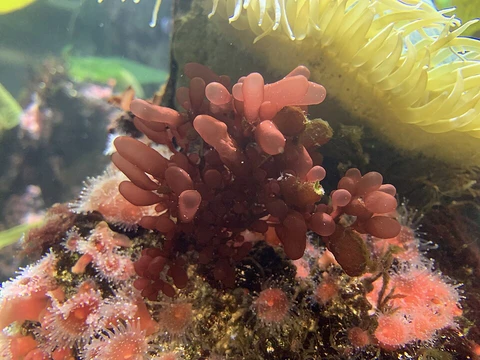
Lithophyllum
A genus of crustose red algae with a long fossil record.
Last updated

Diego Delso · via Wikipedia: Lithophyllum · CC BY-SA 4.0
Lithophyllum is a genus of crust-forming red algae in the family Corallinaceae. Its thalli are monomerous and crustose, built from a single system of filaments that grow tightly against the underlying surface. The alga reproduces through conceptacles, and its outer layer, the epithallus, is periodically shed to prevent other organisms from settling on it.
The genus has a rich fossil record, spanning from the Silurian period to the Quaternary (roughly 418.7 million years ago to the present). Fossils assigned to Lithophyllum have been recovered across Europe, the United States, South America, Egypt, Iran, Iraq, India, Japan, and Australia.
Scientific classification
- CladeEukaryota
- CladeArchaeplastida
- ClassFlorideophyceae
- OrderCorallinales
- FamilyCorallinaceae
- GenusLithophyllum
Named by Philippi, 1837
Sources: Wikipedia taxobox: Lithophyllum (CC BY-SA 4.0)
Quick Facts
- Family
- Corallinaceae
- Fossil range
- Silurian to Quaternary (about 418.7 to 0.0 million years ago)
- Fossil locations
- Europe, United States, South America, Egypt, Iran, Iraq, India, Japan, Australia
- First described by
- Philippi, R.A. (1837)
Facts from the source article.
More in Red Macroalgae and Coralline Algae
Sources
Compiled from Wikipedia and the sources listed below. Text from Wikipedia is available under CC BY-SA 4.0; this entry is adapted from it.
- Wikipedia: Lithophyllum (CC BY-SA 4.0).
- Word definitions: the Codexery glossary, each quoted from its Wikipedia article.
Spotted an error? Know more?
Reader corrections go straight into our review queue. Suggest an edit · How this site is sourced