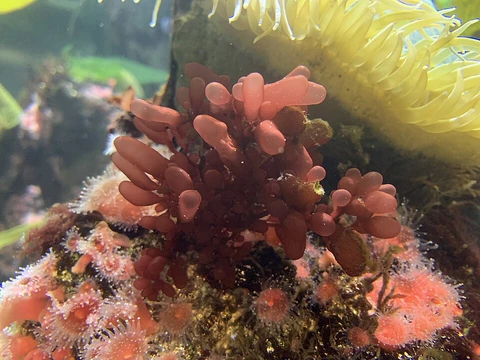
Amphiroa
A calcified red algal genus with alternating jointed branches.

Amphiroa is a genus of red algae with a thallus (body) that grows upright, belonging to the family Corallinaceae. Its mature branches are made up of alternating segments: calcified intergenicula and uncalcified genicula, the latter consisting of more than one cell layer and lacking any dimerous flange-like branches. The algae attach to surfaces via a small, crust-like base. Specimens can reach about 30 cm in size. The thallus is crustose and forms dichotomous branches. Secondary pit connections are present. Reproduction occurs through conceptacles, which produce tetraspores. The pore canals of these conceptacles are lined with parallel filaments, and the shape of the pore canal is a key feature for distinguishing species within the genus.
The genus was first described by Jean Vincent Félix Lamouroux in 1812, with the type species *Amphiroa tribulus*. The name comes from Amphiro, a sea nymph in Hesiod’s *Theogony*. Currently, 72 species are accepted.
Amphiroa has a cosmopolitan distribution, found from tropical to temperate regions. It lives from the intertidal zone down to subtidal reef areas. Its life cycle is triphasic: tetraspores (N) are produced by the tetrasporophyte (2N) and develop into male or female gametophytes (N). Spermatia from the male are captured by the trichogyne of the female, leading to fusion and the formation of a carposporophyte (2N). The cycle completes when carpospores (2N) are released and grow into new tetrasporophytes.
Because its thallus is heavily calcified, Amphiroa is unpalatable and not cultivated or used commercially. However, it contains bioactive compounds: ellagic acid, gallic acid, and phenolics from *A. anceps* show potential as antifungal agents, and polysaccharides from *A. fragilissima* have been found to improve gut health in farmed shrimp. Currently, there is no large-scale utilization or management due to a lack of culture technology.
Quick Facts
- Taxon
- Amphiroa
Facts from the source article.
Lore & Background
Amphiroa was first described by Jean Vincent Félix Lamouroux in 1812, with the type species Amphiroa tribulus. The genus was named after Amphiro, a sea nymph in the epic poem Theogony by the Greek poet Hesiod. There are currently 72 accepted species names for this genus. Morphologically, Amphiroa is composed of an erect thallus attached to the substrate by an inconspicuous crustose base. Its mature branches are differentiated into alternating areas of calcified intergenicula and uncalcified genicula, the latter composed of more than one cell layer and lacking dimerous flange-like branches. Specimens can reach around 30 cm in size. The thalli take a crustose form with dichotomous branches, and the organisms possess secondary pit connections. Reproduction occurs via conceptacles, which produce tetraspores; the pore canals are lined with parallel filaments, and the morphology of the pore canal is a key trait used to delineate species within the genus.
Reader's Guide
Amphiroa exhibits a triphasic life cycle, with tetrasporangia, spermatangia, and carposporangia borne in specialized organs called conceptacles. The cycle involves tetraspores (N) produced by the tetrasporophyte (2N), which develop into male or female gametophytes (N). Spermatia from the male are trapped by the trichogyne of the female, leading to fusion and development of the carposporophyte (2N); carpospores (2N) are released and develop into the next tetrasporophytes. Ecologically, the genus is found from the intertidal down to subtidal reef areas. Despite containing bioactive compounds—such as ellagic acid, gallic acid, and phenolic compounds in A. anceps showing potential anti-fungal activity, and polysaccharides from A. fragilissima improving gut health in farmed shrimp—Amphiroa species are unpalatable due to their highly calcified thallus. Consequently, there is no immediate cultivation or commercial use, and the genus is not currently utilized or managed on a commercial scale due to a lack of culture technology.
Did You Know?
- The genus has 72 accepted species names.
- Its pore canal morphology is a key trait used to delineate species.
More in Red Macroalgae and Coralline Algae 1-24
Spotted an error? Know more?
Reader corrections go straight into our review queue. Suggest an edit · How this site is sourced