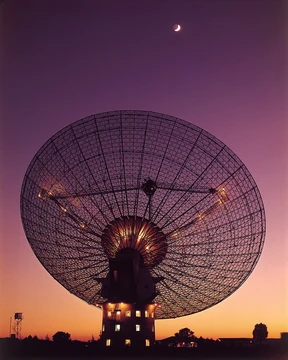
Parkes Observatory
Home of Murriyang, the 64 m dish that relayed Apollo 11 TV.
About 20 kilometres north of the town of Parkes in New South Wales, the Parkes Observatory is a radio astronomy site run by CSIRO. Its main feature is Murriyang, a 64-metre dish known as "The Dish," alongside two smaller telescopes. This dish helped receive live TV from the Apollo 11 Moon landing. The observatory is part of the Australia Telescope National Facility and often works with other radio telescopes across Australia and abroad for very long baseline interferometry. It was added to the Australian National Heritage List in August 2020.
Quick Facts
- Location
- Parkes, New South Wales, Australia
Facts from the source article.
Did You Know?
- In 1995 the radio telescope was declared a National Engineering Landmark by Engineers Australia.
- The telescope is featured on the cover of Steve Hillage's 1977 album Motivation Radio.
- In November 2020, the main telescope was given the Wiradjuri name Murriyang, meaning the home in the stars of Biyaami, the creator spirit.
Design and construction
The Parkes Radio Telescope, completed in 1961, was conceived by E. G. "Taffy" Bowen, chief of the CSIRO's Radiophysics Laboratory. During the Second World War he had worked on radar development in the United States and used his connections to persuade the Carnegie Corporation and the Rockefeller Foundation to fund half the cost. This support persuaded Australian prime minister Robert Menzies to fund the rest. The site was chosen in 1956 for its accessibility and clear skies, with enthusiastic support from mayor Ces Moon and landowner James Helm. NASA later copied features of the design for its Deep Space Network. As of 2018 the telescope is 10,000 times more sensitive than its initial configuration.
Radio telescope
The primary instrument is a 64 m movable dish, the second largest in the Southern Hemisphere and one of the first large movable dishes in the world. The inner part of the dish is solid aluminium and the outer area a fine aluminium mesh, giving a distinctive two-tone appearance. In the early 1970s the outer mesh panels were replaced by perforated aluminium panels, and the inner smooth plated surface was upgraded in 1975 to focus centimetre- and millimetre-length microwaves. The inner aluminium plating was expanded to a 55 m diameter in 2003, improving signals by 1 dB. The telescope has an altazimuth mount, guided by a small mock-telescope with an equatorial mount; the two are dynamically locked by a laser guiding system, a design by Barnes Wallis. The focus cabin, supported by three struts 27 m above the dish, contains multiple detectors including the Multibeam Receiver cooled to -200 °C for the 21 cm Hydrogen line, and the Ultra Wideband Low (UWL) receiver installed in 2018, which covers 700 MHz to 4 GHz and is cooled to -255 °C.
Astronomy research
The telescope became fully operational by 1963. In 1962, lunar occultations of 3C 273 observed at Parkes located its exact position, allowing astronomers to find its optical counterpart and identify the first quasar. An all-sky survey at 408 MHz from 1964 to 1966 produced the first Parkes Catalogue of Radio Sources, finding over 2000 sources including many new quasars. A second all-sky survey at 2,700 MHz began in 1968 and was completed in 1980. In 1990, Parkes collaborated with MIT and NRAO on the Parkes-MIT-NRAO (PMN) Surveys at 5 GHz. Between 1997 and 2002 it conducted the H I Parkes All Sky Survey (HIPASS), the largest blind survey for galaxies in the hydrogen line to that date. More than half of currently known pulsars were discovered by Parkes. It is a vital component of the International Pulsar Timing Array (IPTA) programme to detect gravity waves. Fast radio bursts were discovered in 2007 when archival data from 2001 was analysed, revealing a 30-jansky burst less than 5 milliseconds in duration.
Historical non-astronomy research
During the Apollo missions, Parkes relayed communication and telemetry signals to NASA, providing coverage when the Moon was on the Australian side of the Earth. It also relayed data from the NASA Galileo mission to Jupiter. The observatory has tracked numerous space missions including Mariner 2, Mariner 4, the Voyager missions (though only the 70 m dish at CDSCC can still communicate with the two Voyager probes), Giotto (as primary control and downlink for the mission to Halley's Comet), Galileo, Cassini-Huygens (until 2017), and Artemis II in April 2026 as part of the ground station network organized by Intuitive Machines. From late 2003 to early 2004, the Canberra Deep Space Communication Complex (CDSCC) incorporated the Parkes dish, with NASA upgrading the antenna through CDSCC. When research time allows, Parkes can act as a spare ear for CDSCC and is designated DSS-49. During the Apollo 11 Moon landing, three antennas received signals: the 64 m Goldstone antenna, the 26 m antenna at Honeysuckle Creek, and the 64 m dish at Parkes. Because the spacewalk started early, the Moon was below the main Parkes receiver's visibility, so the international broadcast alternated between Goldstone and Honeysuckle Creek, which broadcast Neil Armstrong's first steps. Nine minutes in, the Moon rose enough for the main antenna, and the broadcast switched to Parkes; the quality was so superior that NASA stayed with Parkes for the remainder of the 2.5-hour broadcast.
More in Radio Telescopes
Spotted an error? Know more?
Reader corrections go straight into our review queue. Suggest an edit · How this site is sourced