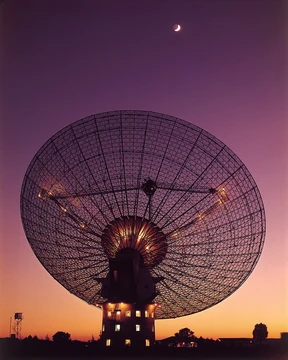
South Pole Telescope
A 10 m telescope studying the cosmic microwave background from Antarctica.
The South Pole Telescope (SPT) is a 10 m diameter telescope at the Amundsen–Scott South Pole Station, Antarctica, designed for microwave, millimeter-wave, and submillimeter-wave observations of the cosmic microwave background (CMB). Its notable achievements include the first detection of B-mode polarization in the CMB, the discovery of over 1000 galaxy clusters via the Sunyaev–Zel'dovich effect, and highly sensitive measurements of CMB power spectra at small angular scales.
Quick Facts
- Diameter
- 10 m / 32 ft 10 in
- Location
- Amundsen–Scott South Pole Station, Antarctica
- First light
- 2007
- Primary funding agencies
- National Science Foundation and United States Department of Energy
- Project director
- John Carlstrom
- Lead institution
- University of Chicago
Facts from the source article.
Did You Know?
- The South Pole's high altitude of 2.8 km and extreme cold keep atmospheric water vapor low, crucial for millimeter-wavelength observations.
- The telescope is a 394-inch diameter off-axis Gregorian in an altazimuth mount, with a mirror surface smooth to about 25 µm.
- The first camera, SPT-SZ, contained a 960-element TES bolometer array split into six pie-shaped wedges observing at 95, 150, and 220 GHz.
The SPTpol camera
The second camera on the SPT, SPTpol, used superconducting TES arrays with 780 polarization-sensitive pixels, each containing two TES bolometers sensitive to one linear polarization direction. Pixels were divided between 90 GHz and 150 GHz, with different detector architectures: 150 GHz pixels were corrugated-feedhorn-coupled TES polarimeters fabricated at the National Institute of Standards and Technology, while 90 GHz pixels were individually packaged dual-polarization absorber-coupled polarimeters developed at Argonne National Laboratory. The first year surveyed a 100-square-degree field centered at R.A. 23h30m declination −55d; the next four years surveyed a 500-square-degree region containing that field.
The SPT-3G camera
Installed in January 2017, the SPT-3G camera combined improvements to the optical system—providing a larger diffraction-limited field of view—with new detector technology enabling multiple observing bands per pixel. Its detector array contains over 16,000 sensors, split evenly between 90, 150, and 220 GHz, more than ten times the number in SPTpol, yielding roughly a tenfold increase in mapping speed. Since 2019, SPT-3G has surveyed nearly 10,000 square degrees of the Southern Sky. The main 1500-square-degree Winter Field overlaps with the BICEP Array observing field for joint analyses of primordial gravitational waves. As of end of 2025, this field has been observed eight months per year for six years; the remaining observing time has covered about 8500 additional square degrees.
Science goals and results
The first key project, a 2500-square-degree survey completed in October 2011, used the Sunyaev–Zel'dovich effect to find hundreds of galaxy clusters over a wide redshift range, aiming to constrain the dark energy equation of state. SPT-SZ survey data also produced the most sensitive measurements of the CMB power spectrum at angular scales smaller than about 5 arcminutes and discovered a population of distant, gravitationally lensed dusty, star-forming galaxies. SPTpol data yielded the first detection of the B-mode component of polarized CMB, generated at small scales by gravitational lensing of E-mode polarization and at large scales by gravitational waves from inflation. SPTpol demonstrated B-mode delensing—using E-mode and lensing potential measurements to clean large-scale B-mode data—and produced the most precise measurements of the E-mode power spectrum and temperature-E-mode correlation spectrum, as well as high-signal-to-noise maps of projected matter density via CMB lensing reconstructions.
Operations
The South Pole Telescope achieved first light in 2007, with formal science observations beginning in March 2007. Commissioning and an initial small survey were completed during austral winter 2007 by winter-overs Stephen Padin and Zak Staniszewski. Larger survey fields followed in 2008 (Keith Vanderlinde and Dana Hrubes) and 2009 (Erik Shirokoff and Ross Williamson). The camera was upgraded in December 2009 for the 2010 season, and the full 2500-square-degree SPT-SZ survey was completed during 2010 and 2011 by winter-overs Dana Hrubes and Daniel Luong-Van. SPTpol first light occurred on January 27, 2012; subsequent winter-overs included Cynthia Chiang, Nicholas Huang, Dana Hrubes, Jason Gallicchio, Robert Citron, Charlie Sievers, Todd Veach, Christine Corbett Moran, and Amy Lowitz. The first SPT-3G winter was conducted by Daniel Michalik and Andrew Nadolski, followed by winter-overs through 2026.
More in Radio Telescopes
Spotted an error? Know more?
Reader corrections go straight into our review queue. Suggest an edit · How this site is sourced