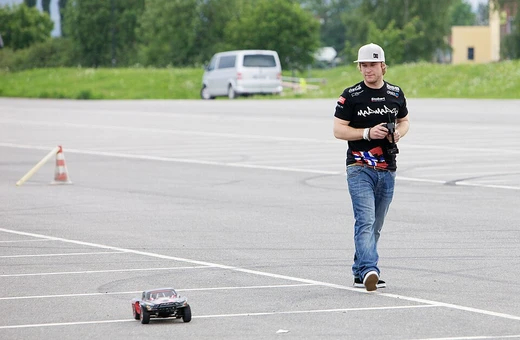
Radio-controlled car
Miniature vehicles controlled via radio since the 1940s.

Radio-controlled cars, often called RC cars, are small vehicles operated by radio signals. The first such cars appeared in the 1940s. In 1954, a streamlined radio-controlled vehicle took third prize in Ford Motor Company’s Industrial Arts Awards. David Swinder, from Warren, Ohio, demonstrated the six-foot-long car using a large control console for Ford’s chief test driver, Al Esper.
Car manufacturers used scale models to speed up new design development and cut costs. Ford created radio-controlled versions of two dream cars: the LaTosca, a futuristic bubble-top design, and the Mexico, an aerodynamic reworking of the 1955 Thunderbird aimed at exceeding 200 mph. For these models, designers built radio control systems from full-size Ford parts, including six-volt car batteries and convertible top motors. The system controlled not only movement, braking, and steering but also headlights, brake lights, and turn signals.
In the 1970s, Tamiya released its first RC car, a model of the Porsche 934. During the 1980s, under Shunsaku Tamiya, the company rode a wave of popularity in competitive RC car racing. In 1982, Tamiya introduced its first Mini 4WD models, which became a hit in Japan and remain popular across Asia.
RC cars come in several types for different uses. On-road models are built for smooth surfaces like floors or pavement, while off-road versions handle uneven, rocky terrain. Ready-to-run cars come fully assembled and require little setup, whereas almost-ready-to-run cars allow for customization and reassembly. Electrically powered cars use electronic speed controllers to manage power to the motor. Non-electric models may run on nitromethane (nitro) engines. Electric motors offer cleaner operation and simpler use; nitro engines provide a more realistic internal-combustion experience.
- First known rc car prize
- 1954 Ford Motor Company Industrial Arts Awards third prize
- Early rc car creator
- David Swinder of Warren, Ohio
- Early rc car length
- six feet
- Early rc car control
- large control console
- First tamiya rc car release decade
- 1970s
- First tamiya rc car model
- Porsche 934
- Tamiya mini 4wd development year
- 1982
Lore & Background
Radio-controlled cars have existed since the 1940s. A streamlined radio-controlled vehicle won a third prize in Ford Motor Company's 1954 Industrial Arts Awards program. David Swinder of Warren, Ohio used a large control console to demonstrate the operation of the six-foot vehicle to Al Esper, Ford's chief test driver. Automobile manufacturer studios used scale models to reduce new design development lead times and save money. Among Ford designs executed were the LaTosca, a futuristic bubble-top dream car, and the Mexico, an aerodynamic reskin of the 1955 Thunderbird that was designed to top 200 mph. For these two models the designers constructed radio control systems, adapting six-volt car batteries, convertible top motors, and other full-size components from the Ford parts bins. Along with motive power, braking, and turning, the radio control system also reportedly operated the headlights, brake lights, and turn signals.
In the 1970s, Tamiya released its first radio-controlled car, a model of the Porsche 934. In the 1980s, Shunsaku Tamiya led the company through a surge in the popularity of radio-controlled car racing as a competitive motorsport. In 1982, the company developed its first Mini 4WD models, which became very popular in Japan. Tamiya's Mini 4WD models continue to be popular throughout Asia.
There are multiple types of radio-controlled cars that are suited for different purposes. On-road RC cars are designed for flattened ground, such as floors or paved concrete, while off-road RC cars can be used on uneven and rocky terrain. Ready-to-run RC cars are sold pre-assembled and are able to be used with minimum complications, while almost-ready-to-run RC cars can be customized and reassembled. Electrically powered models utilize electronic speed controllers (ESCs) to adjust the amount of power delivered to the electric motor. Non-electric RC cars may be powered by a nitromethane (a.k.a. nitro) engine. Electric motors provide cleaner operation and ease of use, while nitro engines offer more true-to-life internal combustion.
Reader's Guide
Radio-controlled cars have a notable history in automotive design and competitive racing. In the 1950s, Ford Motor Company used scale radio-controlled models like the LaTosca and Mexico to reduce development lead times and costs, adapting full-size car components for radio control. This early application demonstrated the utility of RC cars beyond toys. The 1970s saw Tamiya release its first RC car, a Porsche 934, and by the 1980s, under Shunsaku Tamiya, RC car racing surged as a competitive motorsport. Tamiya's Mini 4WD models, introduced in 1982, became highly popular in Japan and remain popular across Asia. The article distinguishes between on-road and off-road types, as well as ready-to-run and almost-ready-to-run configurations. It also notes the two main power sources: electric motors with electronic speed controllers, which offer cleaner operation, and nitro engines, which provide more realistic internal combustion. These distinctions highlight the versatility and enduring appeal of RC cars in both hobbyist and competitive contexts.
Did You Know?
- A streamlined radio-controlled vehicle won third prize in Ford's 1954 Industrial Arts Awards.
- David Swinder of Warren, Ohio demonstrated a six-foot RC car to Ford's chief test driver using a large control console.
- Tamiya's first RC car, released in the 1970s, was a model of the Porsche 934.
- Tamiya developed its first Mini 4WD models in 1982, which became very popular in Japan.
From Music Hall Curiosities to Military Weapons
The story of radio-controlled flight begins far earlier than most people imagine. In the late 1800s, small hydrogen-filled model airships were steered through theater auditoriums as part of music hall performances, guided by a rudimentary spark-emitted radio signal. This theatrical novelty would eventually give way to something far more consequential. During the First World War, British engineers developed drone weapons in 1917 and 1918, and subsequent work at the Royal Aircraft Establishment pushed the technology forward until the 1930s saw a fleet of more than 400 Queen Bee UAV Target Aircraft enter service. World War II brought the concept to American shores, where the Army and Navy deployed radio-controlled planes known as Radioplanes to serve as artillery target drones. Today, the National Model Aviation Museum in Muncie, Indiana, preserves this entire arc of development, housing what is described as the world's largest collection of RC aviation history. The museum also offers kit plans so enthusiasts can build models from any era, and it shares grounds with the main office of the Academy of Model Aeronautics.
The Mechanics of Remote Flight
At its core, an RC aircraft is a small flying machine whose every movement is dictated by an operator standing on the ground. The pilot grips a hand-held radio transmitter and manipulates joysticks, which generate continuous signals sent to a receiver mounted inside the craft. That receiver relays the commands to a set of servomechanisms, or servos, which physically shift the control surfaces. The position of those surfaces then directly governs the plane's orientation in the air. For decades this system was limited by the size, weight, and cost of available components, but the 2000s marked a turning point. Motors became lighter and more powerful, batteries delivered more energy, and electronics grew both cheaper and more capable. That convergence of improvements fueled a substantial surge in hobby participation. It also opened the door for a vast DIY market where builders can choose from a wide variety of models, parts, and styles to assemble their own aircraft from scratch.
A Ladder of Skill and Ambition
The world of RC flying offers a clear progression that matches a pilot's growing confidence. Newcomers typically start with park flyers and simple trainers designed to be forgiving. As skills sharpen, hobbyists graduate to glow plug engine aircraft, electric-powered planes, and sailplanes that demand more precise handling. At the expert level, the challenge skyrockets: jets, pylon racers, vertical takeoff and landing planes, helicopters, autogyros, and 3D aerobatic aircraft all test the limits of human reflexes. Some builders even craft models shaped like birds rather than conventional planes. Perhaps the most demanding pursuit is radio-control scale modeling, where the goal is to faithfully recreate full-scale aircraft from aviation history, spanning the Pioneer Era through the 21st century. Enthusiasts can go beyond mere appearance, incorporating operable cable-connected flight controls, illuminated navigation lights, and realistically retracting landing gear. Since digital-proportional miniaturized RC equipment arrived in the 1960s, scale models have been built at sizes ranging from 20 to 25 percent up to 30 to 50 percent of the original, flown in sanctioned competitions and for personal enjoyment.
Beyond the Hobby: Drones and Public Service
While recreational aeromodelling remains a beloved pastime, the same underlying technology has evolved into something with far broader implications. Modern unmanned aerial vehicles, commonly called drones or spy planes, distinguish themselves from civilian hobby craft by adding video feeds, GPS navigation, and autonomous flight capabilities. These features enable both line-of-sight and beyond-line-of-sight operations, expanding what a single pilot can accomplish. In the public sector, such aircraft are deployed for firefighting, disaster recovery, and other emergency services. Commercial enterprises use them for a range of practical tasks. Scientific, government, and military organizations similarly rely on RC aircraft for experiments, gathering weather readings, aerodynamic modeling, and testing new designs. When these platforms fall under military or paramilitary command, they may carry weapons, transforming what began as a theater-auditorium curiosity into a serious instrument of national defense and operational strategy.
Frequently Asked Questions
What is a radio-controlled car?
An RC car is a small-scale vehicle that a remote operator steers and powers through radio signals. These hobby and industrial models have been around since the 1940s.
Who demonstrated an early prize-winning RC car to Ford?
David Swinder, based in Warren, Ohio, presented a six-foot-long radio-controlled vehicle to Ford's chief test driver Al Esper in 1954. The entry earned third place in Ford Motor Company's Industrial Arts Awards.
What was the first Tamiya RC car model?
Tamiya entered the radio-controlled hobby market in the 1970s with a Porsche 934 as its inaugural RC model.
Why did automakers build radio-controlled replicas of their designs?
Car manufacturers used scale RC models to speed up new design development and lower prototyping costs. Ford, for instance, produced radio-controlled versions of its LaTosca bubble-top and Mexico aerodynamic dream cars.
How was the 1954 Swinder RC car operated?
Instead of a compact handheld transmitter, the vehicle required a large control console to send its radio commands. This bulky setup reflected the state of radio technology before modern portable transmitters became common.
More in Radio-Controlled Cars 1-24
Spotted an error? Know more?
Reader corrections go straight into our review queue. Suggest an edit · How this site is sourced