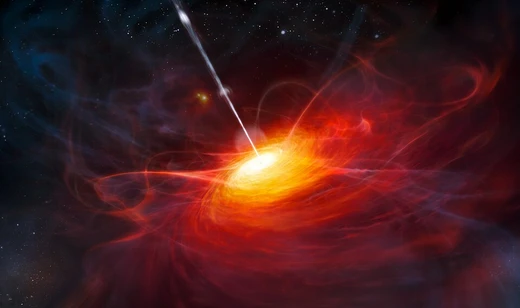
Teacup galaxy
A type 2 quasar with a teacup-shaped ionized gas loop.
The Teacup galaxy, also known as the Teacup AGN or SDSS J1430+1339, is a low redshift type 2 quasar. It features an extended loop of ionized gas that resembles the handle of a teacup. This structure was discovered by volunteers of the Galaxy Zoo project and classified as a Voorwerpje.
Quick Facts
- Constellation
- Boötes
- Names
- FIRST J143029.9+133912
- IRAS F14281+1352
- LEDA 1436754
- NVSS J143030+133912
- SDSS J1430+1339
Facts from the source article.
Did You Know?
- The quasar has dimmed by only a factor of 25 or less over the past 100,000 years.
- VLT/SINFONI observations showed a blueshifted nuclear outflow with a velocity of 1600–1800 km/s.
Galaxy
The Teacup galaxy is bulge-dominated and asymmetric, with a shell-like structure and a tidal tail that indicate a recent merger of two galaxies. Dust lanes suggest a gas-rich merger. Hubble Space Telescope images have identified several candidate star clusters. Observations with the Gran Telescopio Canarias reveal a giant reservoir of ionized gas extending up to 111 kpc, across which optical and radio bubbles appear to be expanding.
Bubbles
Galaxy Zoo volunteers discovered a 5 kpc loop of ionized gas in SDSS images, dominated by emission lines such as hydrogen alpha and doubly ionized oxygen, giving it a purple color. The [O II] emission is extremely strong in the Teacup AGN, and the quasar 3C 48 shows a similar [O II]/Hβ ratio. Follow-up Very Large Array observations revealed two 10–12 kpc bubbles: an eastern bubble consistent with the optical loop and a western bubble visible only in radio. A bright emission northeast of the AGN corresponds to high-velocity ionized gas at -740 km/s. The bubbles may be created by small-scale radio jets or quasar winds. Chandra data show an x-ray loop matching the eastern bubble and evidence for hotter gas inside, suggesting a wind of material blowing away from the black hole, possibly driven by radiation from the quasar. VLT/MUSE observations indicate the jet strongly perturbs the host interstellar medium, with a ≤100–150 Myr young stellar population at the bubble edge, indicating triggered star formation. ALMA observations found that the radio jet compresses and accelerates molecular gas, driving a lateral outflow perpendicular to the jet, based on carbon monoxide (CO) gas observations.
More in Quasars and Galaxy Clusters
Spotted an error? Know more?
Reader corrections go straight into our review queue. Suggest an edit · How this site is sourced