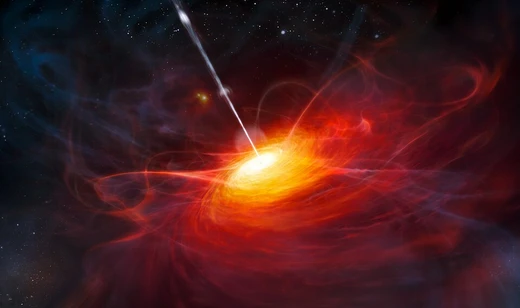
3C 336
A steep-spectrum radio-loud quasar in a rich galaxy cluster.
3C 336 is a powerful Fanaroff-Riley type 2 quasar in the constellation Hercules, discovered in the Third Cambridge Catalogue of Radio Sources survey in 1962. Its radio source was identified with a quasi-stellar object by 1965. It has a redshift of 0.927.
Quick Facts
- Constellation
- Hercules
- Names
- 4C+23.43
- PKS B1622+238
- LEDA 2817683
- OS +328
- DA 410
- NRAO 0501
- TXS 1622+238
- CoNFIG 248
- SDSS J162439.08+234512.1
Facts from the source article.
Description
3C 336 is a steep radio spectrum radio-loud quasar at the center of a rich galaxy cluster. Its spectrum shows six metal absorption lines at redshifts of 0.472, 0.797, and 0.891, associated with absorbing galaxies including an early-type spiral galaxy and a faint complex galaxy. A damped Lyman-alpha absorber at redshift 0.656 has an H I column density of 2 × 10^20 cm−2. The radio structure is a double source with each component smaller than 7 × 4 arcseconds and no interplanetary scintillations. A total intensity image reveals an asymmetric source spanning 28 milliarcseconds with two radio lobes. A jet composed of bright knots extends southwest, linking a compact component to an elongated recessed feature in the southern lobe. No counterjet is seen, but a conspicuous knot lies on the jet axis, followed by a hook of radio emission curving toward a bright ridge on the eastern side of the northern lobe. The nucleus contains a core component of 12 Jansky at position angle 200°, with a resolved low-surface brightness extension. High-resolution Very Large Array and MERLIN observations show radio emission from the lobes extending back into the core and jet. A compact hotspot in the southern lobe has flux densities of 0.097 ± 0.015 Jy at 1.53 GHz and 0.045 ± 0.007 Jy at 4.89 GHz, with an optical spectrum of 1.5 ± 1.0. At 0.35 arcsecond resolution, the hotspot splits into two compact components, one aligned with the jet and core, the other offset. The emission-line region, observed with Hubble Space Telescope and ground-based imaging, is asymmetric with a low-surface brightness structure northwest perpendicular to the radio axis, though later data indicate emission mainly restricted to the south with a flux of 1.8 ± 0.5 × 10^−16 erg cm−2 s−1. Optical emission extends 5 arcseconds north and 3 arcseconds south from the quasar, with a velocity shear of 600 kilometers per second across the emission.
More in Quasars and Galaxy Clusters
Spotted an error? Know more?
Reader corrections go straight into our review queue. Suggest an edit · How this site is sourced