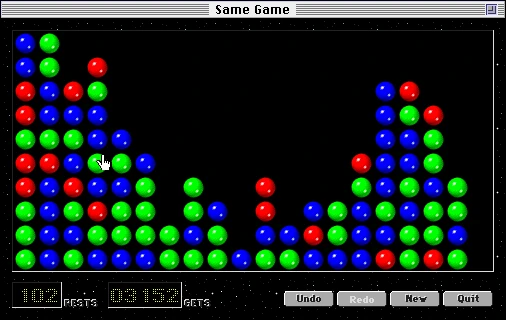
Puzzle video game
Puzzle video games emphasize logic, pattern recognition, and problem-solving.

Mobigame · CC BY-SA 3.0
Puzzle video games are a broad genre of video games that emphasize puzzle solving, testing skills such as logic, pattern recognition, sequence solving, spatial recognition, and word completion. They originated from traditional brain teasers and puzzles, with early computer implementations of games like Nim, Hangman, and Bulls and Cows. The genre was revolutionized by Tetris (1985) and popularized further by titles like Lemmings (1991), and it continues to evolve with modern match-three games and physics-based logic puzzles.
- earliest_known_example
- Early computer implementations of Nim, Hangman, and Bulls and Cows
- modern_mechanic_origin
- SameGame (1985) featured similar swap mechanics
Lore & Background
Puzzle video games owe their origins to brain teasers and puzzles throughout human history. The mathematical strategy game Nim, and other traditional thinking games such as Hangman and Bulls and Cows (commercialized as Mastermind), were popular targets for computer implementation. In Universal Entertainment's Space Panic, released in arcades in 1980, the player digs holes in platforms to trap creatures, a precursor to puzzle-platform games such as Lode Runner (1983), Door Door (1983), and Doki Doki Penguin Land (1985). Blockbuster (1981) was a computerized version of the Rubik's Cube puzzle, and Snark Hunt (1982) was a clone of the 1970s Black Box board game. Elements of Konami's tile-sliding Guttang Gottong (1982) were later seen in Pipe Mania (1989). Boulder Dash (1984) involved collecting diamonds while avoiding falling rocks. Chain Shot! (1985) introduced removing groups of same-color tiles on a grid, causing remaining tiles to fall into the gap. Uncle Henry's Nuclear Waste Dump (1986) involved dropping colored shapes into a pit, aiming to keep same-color tiles from touching.
Reader's Guide
Tetris (1985), created by Soviet game designer Alexey Pajitnov for the Electronika 60, revolutionized and popularized the puzzle game genre. Pajitnov was inspired by the traditional puzzle game Pentominos, in which players arrange blocks into lines without gaps. Tetris was released by Spectrum Holobyte for MS-DOS in 1987, by Atari Games in arcades in 1988, and sold 30 million copies for Game Boy. Lemmings (1991) introduced a gameplay where a player assigns jobs to lemmings to guide them to safety. The 1994 MS-DOS game Shariki, by Eugene Alemzhin, introduced the mechanic of swapping adjacent elements to tile-matching games, which later had major influence. In 2000, PopCap Games released Bejeweled, a direct clone of Shariki with improved visuals, sparking interest in the match-three mechanic that became the foundation for games like Puzzle Quest: Challenge of the Warlords (2007), Candy Crush Saga (2012), and Puzzle & Dragons (2012). After Portal (2007), physics-based logic puzzle games rose in popularity. The genre includes subgenres such as physics games (e.g., The Incredible Machine, Angry Birds), programming games (e.g., Rocky's Boots, SpaceChem), exploration games (e.g., Myst, Limbo), Sokoban games (e.g., Baba is You), hidden object games, and tile-matching games (e.g., Zuma).
Did You Know?
- Tetris was inspired by the traditional puzzle game Pentominos, in which players arrange blocks into lines without gaps.
- The 1994 game Shariki popularized swapping adjacent elements in tile-matching games, but earlier games like SameGame (1985) already featured similar mechanics.
- Space Panic (1980) is considered a precursor to puzzle-platform games such as Lode Runner and Door Door.
- Chain Shot! (1985) introduced the mechanic of removing groups of same-color tiles on a grid, causing remaining tiles to fall.
Cooperative Design and Asymmetrical Gameplay
Orbitals is a two-player cooperative puzzle-adventure built around asymmetrical roles. Players follow Maki and Omura, two space explorers racing to save a station from a deadly storm. Rather than mirroring each other's actions, the two players take on distinct responsibilities, using different tools and gadgets to open pathways and solve puzzles together. This design philosophy traces back to Hazelight Studios' approach in titles like A Way Out and It Takes Two, where asymmetry forces genuine collaboration. The game leans more heavily into puzzle-solving than platforming, and the team deliberately kept difficulty accessible—game director Jakob Lundgren described the experience as "never too difficult." The goal was a short, satisfying arc that players would actually finish, prioritizing completion over endless challenge. The third-person perspective and the emphasis on synergizing with a partner make Orbitals a game about connection as much as problem-solving.
Development Team and Creative Direction
Shapefarm, a Tokyo-based studio, developed Orbitals with Marcos Ramos as creative director and Jakob Lundgren as game director. Lundgren brought a wealth of experience from Hazelight Studios, where he served as a designer on A Way Out, It Takes Two, and Split Fiction. That background clearly shaped the project's DNA: the asymmetrical co-op structure, the emphasis on player interaction, and the deliberate accessibility all echo Hazelight's signature approach. Yet the team wanted Orbitals to carve its own identity. They chose to make the game a shorter experience, prioritizing the feeling of seeing a story through to its conclusion. Puzzle-solving was elevated above platforming as the primary mechanical focus. The result is a game that feels like a natural evolution of the cooperative design language Lundgren helped pioneer, filtered through a new studio's creative lens and a distinctly Japanese production sensibility.
Art Direction and Anime Influences
While the gameplay mechanics share DNA with Hazelight's titles, Shapefarm deliberately set Orbitals apart through its visual identity. The studio partnered with Studio Massket, the anime production house behind Lycoris Recoil, to create the game's cutscenes. The broader visual palette drew inspiration from a constellation of iconic anime works: the space-western aesthetic of Cowboy Bebop, the dynamic energy of Dragon Ball, and the mechanical intensity of Neon Genesis Evangelion. The two protagonists, Maki and Omura, were specifically inspired by Sailor Moon and Ranma, giving them a visual personality rooted in classic shōjo and action anime. The narrative itself carried the emotional weight and storytelling sensibility of Studio Ghibli films. This layered approach to visual and narrative inspiration gives Orbitals a distinctly Japanese artistic fingerprint, distinguishing it from Western co-op titles while remaining accessible to a global audience.
Platform, Release, and Critical Response
Orbitals launched exclusively for the Nintendo Switch 2 on September 3, 2026, published by Kepler Interactive, a company in which Shapefarm holds a founding member position. The game made its public debut at The Game Awards in December 2025, generating early anticipation for the new hardware. A notable platform feature is the Switch 2's GameShare functionality, which lets the purchasing player invite a friend to join the cooperative experience at no additional cost, effectively removing the financial barrier to the two-player format. Critically, the game landed in solid territory: Metacritic classified the reviews as "generally favorable," while OpenCritic reported that 93% of critics recommended it. For a debut title from a relatively new studio, those numbers signal a well-received entry into the cooperative puzzle-adventure space, validating both the design philosophy and the artistic choices that set Orbitals apart from its inspirations.
Gallery



Frequently Asked Questions
What defines a puzzle video game as a genre?
Puzzle video games are a category built around structured problem-solving, where players lean on logic, pattern recognition, spatial reasoning, and word completion to advance. The genre grew out of traditional brain teasers adapted into digital form.
What are the earliest known examples of puzzle video games?
The earliest digital puzzle games were computer adaptations of classic brain teasers such as Nim, Hangman, and Bulls and Cows. These titles represent the first structured implementations of puzzle mechanics in software.
Which title is credited with transforming the puzzle genre into a mainstream phenomenon?
Tetris, released in 1985, is widely recognized as the game that elevated puzzle video games from a niche hobby into a global mainstream category. It set a lasting template for spatial and sequence-based challenge design.
What role did SameGame play in shaping modern puzzle mechanics?
SameGame (1985) is identified as an early origin point for the adjacent-swap mechanics that later defined the match-three genre. It showed that rearranging neighboring elements could serve as the core loop of a puzzle experience.
Why do puzzle video games hold a significant place in gaming history?
They demonstrated that players value mental challenge and skill mastery just as much as action or narrative. From early logic tests to today's physics-based and match-three titles, the genre has kept evolving while remaining a cornerstone of the medium.
More in Puzzle video games 1-24
Spotted an error? Know more?
This is a living reference — every entry is fact-audited, and reader corrections feed straight into our audit queue. Suggest an edit · See this site's audit record