3 in Three
A 1989 metapuzzle game set inside a computer.

August Macke · Public domain
3 in Three is a 1989 metapuzzle video game designed by Cliff Johnson and published by Cinemaware. The game is about a number 3, lost in the innards of a computer by a power surge, who attempts to repair the damage and return to a spreadsheet. It was released only for the Macintosh and is now freeware.
- Publisher
- Cinemaware
Lore & Background
3 in Three was designed by Cliff Johnson as a follow-up to his earlier game The Fool's Errand. While bearing some similarities, 3 in Three took place inside a computer, with the protagonist being a number 3 lost due to a power surge. The game consists of many separate sections, each containing one puzzle, but unlike The Fool's Errand, sections may need to be visited multiple times as they carry story elements when not containing a puzzle. Completing each puzzle places one letter in the Letter Legislature; when all letters are in place, hints from earlier puzzles are used to arrange the letters into a phrase, completing the meta-puzzle.
Reader's Guide
3 in Three is significant as a pioneering metapuzzle game that evolved puzzle design from paper-and-pencil adaptations to computer-native designs. Its puzzles, such as lift puzzles, mesh puzzles, trapdoor puzzles, and reordered word puzzles, took advantage of the possibilities of computer games rather than traditional formats like cryptograms. The game received positive reviews from Macworld, MacUser, The Chicago Tribune, and Games magazine, with MacUser naming it Game of the Year in 1991. Despite never being ported beyond the Macintosh, it remains available as freeware and is noted for its intricate, interconnected puzzles and Tron-esque plot.
Did You Know?
- 3 in Three was released only for the Macintosh and never ported to other platforms.
- The game's protagonist is a number 3 lost inside a computer due to a power surge.
- MacUser awarded 3 in Three five out of five mice and named it best game in its 1991 Editors' Choice Awards.
- The game includes a logic puzzle where Roman numerals must be rearranged to meet rules like 'XVI is north of XIV'.
Roots in Ancient Brain Teasers
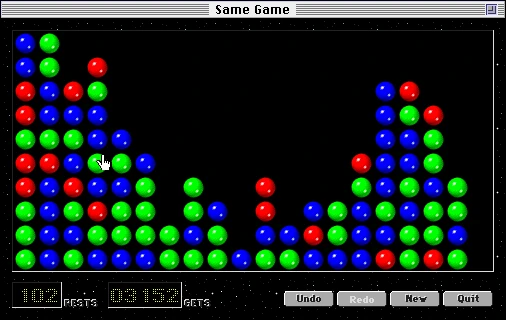
The puzzle video game genre traces its lineage back to brain teasers and thinking challenges that have occupied humanity for centuries. Before any screen existed, games like Nim, Hangman, and Bulls and Cows (later commercialized as Mastermind) served as the intellectual foundation that early programmers would eventually translate into digital form. The arcade era of the early 1980s saw the first dedicated puzzle experiences: Universal Entertainment's Space Panic (1980) asked players to dig holes in platforms to trap creatures, establishing a template that would influence Lode Runner, Door Door, and Doki Doki Penguin Land. Meanwhile, Blockbuster (1981) brought the Rubik's Cube to Atari 8-bit computers, and Snark Hunt (1982) offered logical deduction modeled on the 1970s board game Black Box. Konami's tile-sliding Guttang Gottong (1982) planted seeds that would later sprout into LucasArts' Pipe Mania in 1989. Boulder Dash (1984) added the tension of collecting diamonds while managing cascading rocks, and Chain Shot! (1985) pioneered the concept of clearing same-colored tile groups on a grid. These early experiments collectively built the mechanical vocabulary that the genre still draws from today.
Tetris and the Games That Redefined Thinking
Few titles in gaming history reshaped an entire category as dramatically as Tetris. Soviet designer Alexey Pajitnov created the game in 1985 for the Electronika 60, drawing inspiration from the traditional block-arranging puzzle Pentominos. Its release through Spectrum Holobyte for MS-DOS in 1987, followed by Atari Games' arcade version in 1988, and ultimately the sale of 30 million copies on Game Boy, cemented puzzle games as a mainstream force. The real-time pressure of stacking falling blocks demanded quick spatial reasoning and became a cultural touchstone. Around the same period, Lemmings (1991) introduced a different kind of puzzle: guiding a swarm of creatures through deadly terrain by assigning specific jobs to individual members. In 1994, Eugene Alemzhin's MS-DOS title Shariki quietly introduced the mechanic of swapping adjacent tiles to create matches. Though it remained largely obscure at the time, this simple interaction would prove to be one of the most consequential design decisions in puzzle gaming history, laying groundwork for a wave of match-three titles that would follow a decade later. Interest in Japanese Mahjong adaptations also began to grow during that same year, broadening the genre's global appeal.
From Bejeweled to AI: The Match-Three Explosion
The dormant potential of Shariki's swap-and-match mechanic finally erupted in 2000 when PopCap Games released Bejeweled, a visually polished reimagining of the 1994 original. The game ignited a cultural fascination with the match-three formula, and the genre's influence radiated outward with remarkable speed. Puzzle Quest: Challenge of the Warlords arrived in 2007, blending tile-matching with role-playing elements, while 2012 saw both Candy Crush Saga and Puzzle & Dragons bring the mechanic to massive mobile audiences. By the 2020s, Block Blast demonstrated that the block-puzzle and match-three space was still evolving, now alongside the emergence of AI-based solvers and analytical tools capable of automatically optimizing gameplay strategies. In parallel, the release of Portal in 2007 catalyzed a surge in physics-based logic puzzle games, shifting the genre's focus toward environmental interaction and spatial reasoning. Together, these developments illustrate how a single design concept—swapping tiles to create matches—could spawn an entire ecosystem of titles spanning two decades, while a different innovation opened yet another frontier for players to explore.
A Genre of Many Faces: Sub-genres and Diverse Mechanics
Puzzle video games are far from a monolith; they encompass a remarkable range of sub-genres, each demanding a distinct cognitive skill. Physics-based titles like The Incredible Machine, Portal, The Talos Principle, Braid, Fez, World of Goo, and Cut the Rope require players to exploit consistent environmental physics to solve challenges, a category that also includes projectile games such as Angry Birds, Peggle, Monster Strike, and Crush the Castle. Educators have even adopted these games to illustrate physical principles in classroom settings. Programming games take a different approach, asking players to write code—either as text or through visual systems—to solve puzzles, with examples spanning Rocky's Boots (1982), Robot Odyssey (1984), SpaceChem (2011), and Infinifactory (2015). Exploration-focused titles like Myst, Limbo, and The Dig rely on inductive reasoning and experimentation, while escape-room games such as The Room confine that exploration to a single detailed location. Sokoban (1982) and its descendants, including Baba is You and Patrick's Parabox, challenge players to push blocks on grids without trapping themselves. Hidden object games and tile-matching variants, from Zuma to Mahjong Trails, round out an extraordinarily diverse landscape.
Gallery





Frequently Asked Questions
What is 3 in Three?
It is a 1989 metapuzzle video game in which a stray number three, displaced by a power surge, must navigate the internal workings of a computer to fix the damage and find its way back to a spreadsheet. The game was designed by Cliff Johnson and published by Cinemaware.
Who created 3 in Three?
Cliff Johnson is the designer behind the game, and Cinemaware handled its publication in 1989.
What is the story of 3 in Three?
A number three is knocked out of its spreadsheet by a power surge and ends up trapped inside the computer itself, where it must repair the damage it caused and work its way back to its original spreadsheet.
What platform was 3 in Three released on?
The title was made exclusively for the Macintosh and was never ported to any other system.
Can I still play 3 in Three today?
Yes—the game has since been made available as freeware, so it can be downloaded and played at no cost despite being over three decades old.
More in Puzzle video games 1-24
Spotted an error? Know more?
This is a living reference — every entry is fact-audited, and reader corrections feed straight into our audit queue. Suggest an edit · See this site's audit record