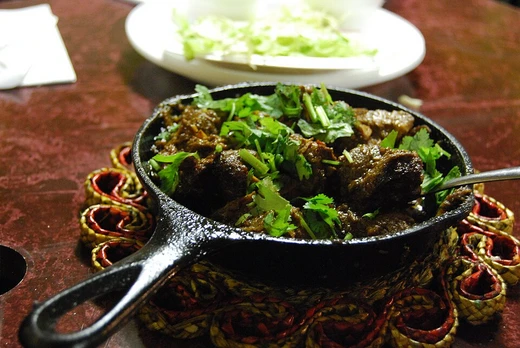
Saag
A leafy vegetable dish from the Indian subcontinent, eaten with bread or rice.
Saag is a leafy vegetable dish from the Indian subcontinent, commonly eaten with bread such as roti or naan, and in some regions with rice. It can be made from mustard greens, collard greens, basella, or finely chopped broccoli, along with spices and sometimes other ingredients like chhena. In the state of Punjab, saag gosht or hariyali maans (spinach and mutton) is a common dish.
Quick Facts
- Region
- Bengal, Bihar, Haryana, Jharkhand, Odisha, Punjab, Sindh, Uttarakhand
- Main ingredients
- Various kinds of edible plants
Facts from the source article.
Variations
In Odisha, sāga is a central part of the local cuisine, with a wide range of plants used as leafy greens. Among the many varieties are kalama sāga, or water spinach; kosalā or khadā sāga, made from amaranth leaves; bajji sāga, from Amaranthus dubius leaves; and leutiā sāga, which uses the leaves and tender stems of Amaranthus viridis. Pālanga sāga is spinach, while sāga chhena combines greens, especially spinach, with cottage cheese. Poi sāga comes from basella leaves and tender stems. Bāramāsi or sajanā sāga is prepared from drumstick tree leaves, often cooked with lentils or alone with fried onions. Other types include sunusuniā sāga from Marsilea polycarpa leaves, pitāgama sāga from Glinus oppositifolius, pidanga sāga, kakhāru sāga from pumpkin plant leaves, and madarangā sāga from Alternanthera sessilis leaves. Sorisa sāga is mustard greens, and methi sāga uses fenugreek leaves cooked with mustard paste. Matara sāga is made from the inner coating of peas. Additional varieties are bahal sāga, kular sāga, bhader sāga, and jhirel dal sāga.
In Bengal, sāg is equally important and a daily staple, with most people eating at least one sāg dish at lunch, typically fried or served with a light gravy and rice. Bengali sāg varieties include kalmi sāg, or water spinach; kosalā or khadā sāg from amaranth leaves; bajji sāg from Amaranthus dubius leaves; and leutiā sāg from Amaranthus viridis leaves and tender stems. Pālong sāg is spinach, and puin sāg comes from basella leaves and tender stems. Bāramāsi or sojnā sāg uses drumstick tree leaves, cooked with lentils or with fried onions. Other types are sunusuniā sāg from Marsilea polycarpa leaves, pitāgama sāg, helencha sāg from Enhydra fluctuans, daata sāg, peyanj sāg from spring onions, mulor sāg, lal sāg from Amaranthus tricolor leaves and tender stems, lau sāg from bottle gourd leaves and stems, kumro sāg from pumpkin plant leaves, and madarangā sāg from Alternanthera sessilis leaves. Sorshe sag is mustard greens, and methi sāg combines fenugreek leaves with mustard paste.
More in Punjabi Cuisine
Spotted an error? Know more?
Reader corrections go straight into our review queue. Suggest an edit · How this site is sourced