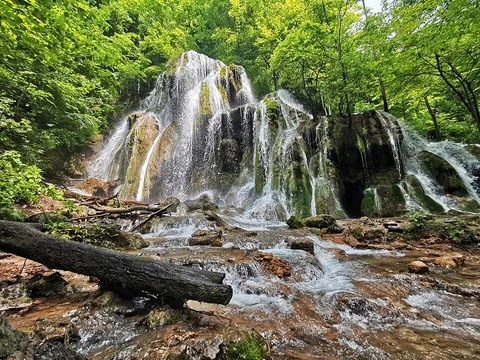
Shebenik National Park
Albanian national park with ancient beech forests and Balkan lynx.
Shebenik National Park is a protected area in eastern Albania, along the border with North Macedonia. It is notable for its mountainous landscape, glacial lakes, and dense forests, and it shelters endangered species such as the Balkan lynx. A portion of the park is included in the UNESCO World Heritage Site of Ancient and Primeval Beech Forests of the Carpathians and Other Regions of Europe.
Quick Facts
- Location
- Elbasan County
- Nearest town
- Librazhd, Prrenjas
- Area
- 34,507.9 ha / 133 sq mi
- Designated
- 21 May 2008
- Governing body
- National Agency of Protected Areas
Facts from the source article.
Geography
The park lies in Elbasan County, mostly between latitudes 41° and 10° N and longitudes 20° and 30° E, covering 339.277 km². It forms part of the Southern European Green Belt, with the nearest significant towns being Librazhd and Prrenjas. The area's geologic history includes deposition from the middle Triassic and Jurassic periods, with mountains formed during the Variscan orogeny predominantly from ultramafic and metamorphic rocks, though calcareous rocks are common in the south and southeast. The bedrock above the forest belt is primarily carbon and karst, dating from the mountain chain's formation. Glacial action from the last ice age shaped the landscape into u-shaped valleys, cirques, and water bodies, and subsequent sediment deposition has contributed to the region's fertility. Under the Köppen climate classification, the park experiences a moderately warm and rainy continental climate with strong Mediterranean influences, with mean annual precipitation between 1300 mm and 1800 mm.
Biodiversity
The park's ecosystems are shaped by topography, climate, hydrology, and geology, creating varied environments that support diverse plant communities and wildlife. The montane ecosystem includes glacial lakes, meadows, and high mountains, with 14 glaciers that were later filled by melt water and rain, providing habitats for shrubs, herbs, grasses, and flowering plants. Forest ecosystems cover large areas, extending to higher elevations and along valleys and streams, and include coniferous, mixed, and deciduous forests, some ancient due to inaccessibility. Deciduous forests, principally of European beech, are present throughout the park, alongside conifers such as European silver fir, Bosnian pine, and Macedonian pine. The fauna is typical of Southern European ecosystems, and the park serves as an ecological corridor for endangered species, though the status of most species is unknown due to incomplete information.
More in Primeval Beech Forests in Europe
Spotted an error? Know more?
Reader corrections go straight into our review queue. Suggest an edit · How this site is sourced