Paklenica
Croatian national park with primeval beech forests and karst canyons.
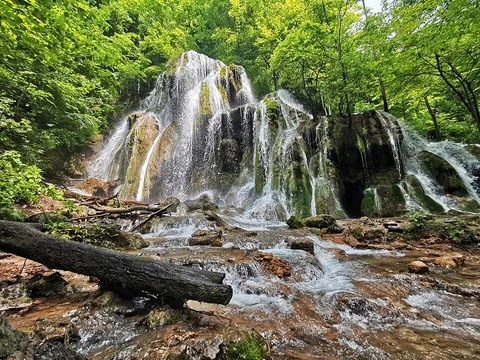
Paklenica is a national park in Croatia, located near Starigrad in northern Dalmatia on the southern slopes of Velebit mountain, not far from Zadar. It encompasses two karst river canyons, Mala (Small) and Velika (Big) Paklenica. The park is notable for its beech forests, which in 2017 were added to the UNESCO World Heritage Site known as Ancient and Primeval Beech Forests of the Carpathians and Other Regions of Europe.
Quick Facts
- Location
- Zadar County
- Area
- 95 km² / 36.7 sq mi
Facts from the source article.
History
The area of South Velebit has been inhabited since prehistoric times. During the last ice age, small groups of Paleolithic hunter-gatherers likely lived there, as elsewhere in the Mediterranean, when sea level was 120 m lower and the Velebit Channel was a valley with a river. Glaciers covered the highest parts of Velebit. As sea level rose in the late ice age, people moved to higher hilly areas. Mesolithic flint tools found in Vaganačka Cave under Veliko Rujno provide the earliest records of humans in Velebit. About eight thousand years ago, the first cattle breeders and farmers arrived, bringing wheat, domestic goats and sheep, and knowledge of breeding. Hunter-gathering declined, and livestock-rearing began. Caves that sheltered people and cattle have yielded bones of domestic animals, tools, and decorated clay tableware. During the last two thousand years BC, in the Bronze Age, Liburian peoples built the first fortifications and stone buildings, which could shelter nearby villagers or serve as permanent settlements for local rulers. These structures oversaw cattle and trade routes to Velebit and Lika via Paklenica or Rujan, and some monitored navigation. They are now destroyed, but ring-shaped mounds (gromile) up to several meters high remain visible. Near the fortifications, casket heaps—deposits of large round stone under which rulers were buried in stone-tablet caskets—have been found, mostly dug out and robbed but still visible, as in the hamlet Ljubotić in Tribanj.
Geological features
The most attractive parts of South Velebit are the canyons of Velika Paklenica and Mala Paklenica. Velika Paklenica canyon is 14 km long and 500–800 m wide; at its narrowest near the Bunkers it is only 50 m wide, with vertical cliffs rising over 700 m on both sides. The most attractive area is around the steep drop downstream from Anića luka, where cliffs rise directly above the stream, forming the narrowest part between Anića luka and the parking lot. Mala Paklenica Canyon is 12 km long and 400–500 m wide, with a narrowest point of only 10 m and surrounding cliffs up to 650 m high. The central park area features the relief complex of Borovnik and Crni vrh, with the valleys of Mala Močila and Velika Močila. Velika Močila is a bowl-shaped valley at 850 m asl, surrounded by Crni vrh (1,110 m asl), Škiljina kosa (1,015 m asl), and Zeleni brig (842 m asl). Borovnik, named after the black pine forest, stretches along the south edge. The east part is geomorphologically differentiated, inaccessible and wild, then transforms into milder forms around Malo Libinje and Veliko Libinje, karstic plateaus with numerous pits. The highest area is the narrow Velebit ridge, 1 to 3 km wide, containing the highest peak Vaganski vrh (1,757 m asl). Paklenica is one of Croatia's most completely explored areas for speleology, with 76 known speleological objects: 39 pits and 37 caves. Notable are Vodarica Pit, the longest cave in Velebit at 300 m, and Precipice on Bunovac (534 m), the deepest object in Central and South Velebit.
Fauna
Diverse habitats and vertical stratification in Paklenica support a varied fauna. Invertebrates are relatively poorly explored, though diurnal butterflies are well studied. Over 40 species of amphibians and reptiles occur, including the endangered Orsini's viper. Birds are the most numerous vertebrate group, with 230 species recorded, including 102 nesting bird species in the broader park area. The nesting community includes 24 species inhabiting rocks and cliffs in the canyons. Endangered and rare bird species include the golden eagle, peregrine falcon, short-toed eagle, and goshawk. Forest areas are rich with woodpeckers, the rarest being the white-backed woodpecker and middle spotted woodpecker. Fifty-three mammal species are present, with roe deer and chamois as highlights; the brown bear is the biggest predator. Caves host underground animals such as crabs, mites, nematodes, aquatic worms, spiders, pseudoscorpions, beetles, and bats.
Tourism
To truly experience Paklenica, you have to hike. The park offers between 150 and 200 kilometers of marked trails, from easy tourist paths that lead to Manita peć cave, Lugarnica forest cottage, and the mountain hut, to challenging mountaineering routes up Velebit’s highest peaks. Paklenica is Croatia’s most popular climbing destination and the largest in Southeast Europe. Its location near the sea gives it a unique appeal, making the Paklenica Riviera perfect for mixing climbing with water sports. There are over 360 equipped climbing routes of varying difficulty and length. The main climbing season lasts from spring through late autumn.
More in Primeval Beech Forests in Europe
Spotted an error? Know more?
Reader corrections go straight into our review queue. Suggest an edit · How this site is sourced