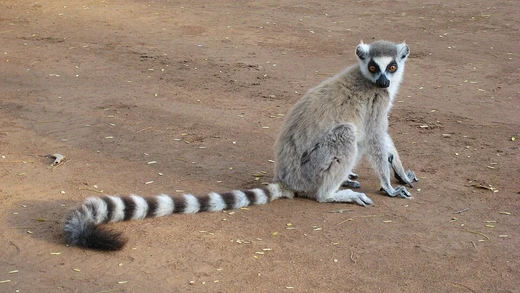
Subfossil lemur
Giant lemurs of Madagascar, now known only from subfossil remains.

Subfossil lemurs are lemurs from Madagascar known from remains dating from the late Pleistocene through the Holocene, roughly from about 26,000 years ago to around 560 years ago. The term often refers to the extinct giant lemurs, though it also includes species still living today. The diversity of these ancient lemur communities was higher than that of modern Madagascar, with up to 20 or more species at a single site, compared to 10 to 12 today. Extinct species ranged in size from slightly over a certain threshold to roughly a maximum weight, and even the subfossil remains of living species are larger and more robust than modern skeletons. Most giant lemurs had wide distributions across the island, but their ranges have contracted significantly since human arrival.
Despite their size, giant lemurs shared many traits with living lemurs, such as rapid development, poor day vision, relatively small brains, and female-dominated social hierarchies. They also had distinct features, including a tendency toward terrestrial locomotion, slow climbing, and suspension rather than leaping, along with a greater reliance on leaf-eating and seed predation. They likely filled ecological niches now vacant, especially seed dispersal for large-seeded plants. Three distinct families existed: Palaeopropithecidae (sloth lemurs), Megaladapidae (koala lemurs), and Archaeolemuridae (monkey lemurs). Two other forms, the giant aye-aye and Pachylemur (giant ruffed lemurs), were more closely related to living lemurs.
Subfossil remains were first discovered in the 1860s, but species were not formally described until the 1890s. Early paleontological interest led to over-naming, misallocated bones, and inaccurate reconstructions. Discoveries waned in the mid-20th century but resumed in the 1980s, yielding new species and a new genus. Recent research has focused on diet, lifestyle, and social behavior. All or most subfossil lemurs date within the last 2,000 years, coinciding with human arrival on Madagascar. Hunting likely contributed to their rapid decline, along with other factors. Oral traditions and recent sightings by Malagasy villagers have been interpreted as possibly indicating lingering populations or very recent extinctions.
- Location
- Madagascar
- Size range
- 10 kg (22 lb) to 160 kg (350 lb)
- Number of extinct species
- 17
- Families
- Palaeopropithecidae, Megaladapidae, Archaeolemuridae
- First discovered
- 1860s
- Formally described
- 1890s
Lore & Background
Subfossil lemurs are known from remains found across Madagascar, dating from the late Pleistocene to the Holocene, roughly 26,000 years ago to about 560 years ago. These remains include both species still alive today and many extinct forms, though the term most often refers to the extinct giant lemurs. The extinct species varied greatly in size, with the smallest being larger than any living lemur and the largest ranking among the biggest primates ever to have existed. Their skeletons are more robust than those of modern lemur species. Despite their size, they shared key traits with living lemurs: rapid tooth development and weaning, relatively small brains, poor day vision due to high sensitivity to low light, and little difference in body or canine size between males and females, suggesting female-dominated social structures. They also had a toothcomb, a specialized grooming feature unique to strepsirrhines. However, they differed in locomotion, relying more on terrestrial movement, slow climbing, and suspension rather than leaping, and their diets emphasized leaves and seeds. Three distinct families of giant lemur existed: the sloth lemurs (Palaeopropithecidae), koala lemurs (Megaladapidae), and monkey lemurs (Archaeolemuridae). Two other forms, the giant aye-aye and Pachylemur (giant ruffed lemurs), were more closely related to living species. Subfossil sites occur across most of the island except the eastern rainforests and the northwest seasonal moist forests, and radiocarbon dates for these remains range from about 26,000 years ago to roughly 500 years ago.
Reader's Guide
The subfossil lemurs are significant because they represent a recent extinction event tied to human arrival on Madagascar around 2,000 years ago. Their remains show that giant lemur communities were more diverse than today's, with up to 20 or more species per location compared to 10 to 12 now. They shared many traits with living lemurs—rapid development, poor day vision, small brains, female-dominated hierarchies—but also had distinct adaptations for terrestrial locomotion, slow climbing, and leaf-eating. Their extinction likely resulted from hunting and other factors, and oral traditions suggest possible very recent survival. Studying them helps understand ecological roles lost, such as seed dispersal for large-seeded plants, and informs hypotheses about lemur evolution, including the energy frugality hypothesis.
Did You Know?
- All 17 extinct subfossil lemurs were larger than any living lemur species.
- The largest subfossil lemur may have weighed as much as 160 kg (350 lb).
- Subfossil lemur remains have been found in most parts of Madagascar except the eastern rainforests and the Sambirano domain.
More in Primates 1-24
Spotted an error? Know more?
This is a living reference — every entry is fact-audited, and reader corrections feed straight into our audit queue. Suggest an edit · See this site's audit record