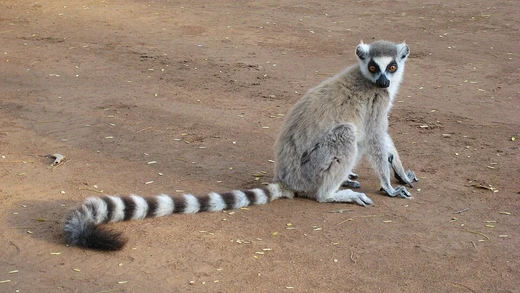
Ruffed lemur
Largest extant lemurs in Lemuridae, endemic to Madagascar's eastern rainforests.

The ruffed lemur genus, *Varecia*, contains the biggest living members of the lemur family. These strepsirrhine primates live only on Madagascar, specifically in the eastern tropical rainforests. What was once thought to be a single species is now recognized as two: the black-and-white ruffed lemur, which has three subspecies, and the red ruffed lemur. More than any other lemur on the island, they rely on fruit for food, and they are extremely sensitive when their forest habitat is disturbed. Their social life is complex and flexible, with groups containing multiple males and females that split and merge in a fission-fusion pattern. They are also very noisy, using loud, harsh calls to communicate.
Their way of having babies is unusual for such large primates. Even though they are the biggest lemurs in their family, they share reproductive traits with much smaller, nocturnal lemurs: a short pregnancy of about 102 days and big litters of two or three infants. Ruffed lemurs are the only primates that build nests for their newborns. They carry the babies in their mouths and practice an absentee parenting style, hiding the young while they go off to find food. The infants are born helpless but grow fast, moving around on their own in the wild by 70 days and reaching full size in six months.
Habitat loss and hunting are pushing ruffed lemurs toward extinction in the wild. However, they breed well in captivity, and since 1997, some have been slowly reintroduced to natural areas. Several groups work to protect them, including the Durrell Wildlife Conservation Trust, the Lemur Conservation Foundation, the Madagascar Fauna Group, Monkeyland Primate Sanctuary in South Africa, Wildlife Trust, and the Duke Lemur Center.
**Evolutionary history** Fossils of lemurs from Madagascar only appear from the Pleistocene and Holocene epochs onward, so very little is known about how ruffed lemurs evolved. Most scientists agree that ancestral lemurs reached the island through a single rafting event about 50 to 80 million years ago, similar to how New World monkeys got to South America. Madagascar had already split from Africa (while still joined to India) around 160 million years ago. Once the lemur ancestors arrived, the founder effect and a lack of strong competition allowed them to spread into many different niches. Today, Madagascar is home to more than three-quarters of all living strepsirrhine primates, a group that was widespread across Laurasia and Africa during the Paleocene and Eocene.
**Taxonomic classification** The genus *Varecia* belongs to the family Lemuridae. An extinct genus, *Pachylemur*, looked very similar to ruffed lemurs but died out after humans arrived. *Varecia* now contains two living species: the red ruffed lemur and the black-and-white ruffed lemur, which itself has three subspecies.
Family Lemuridae: - Genus *Eulemur*: true lemurs - Genus *Hapalemur*: lesser bamboo lemurs - Genus *Lemur*: the ring-tailed lemur - Genus †*Pachylemur* - Genus *Varecia*: ruffed lemurs - Black-and-white ruffed lemur, *Varecia variegata* - Variegated black-and-white ruffed lemur, *Varecia variegata variegata* - Southern black-and-white ruffed lemur, *Varecia variegata editorum* - Northern black-and-white ruffed lemur, *Varecia variegata subcincta* - Red ruffed lemur, *Varecia rubra*
**Changes in taxonomy** Ruffed lemurs and several brown lemur species were once placed in the genus *Lemur*. In 1962, they were moved to *Varecia*, a name taken from the Malagasy word *variky*, first recorded in a 1605 Dutch-Malagasy dictionary by Frederick de Houtman. The red and black-and-white forms were originally considered subspecies of *Varecia variegata*. In 2001, both were raised to full species status, a change later backed by genetic studies. The three subspecies of black-and-white ruffed lemur—*variegata*, *editorum*, and *subcincta*—were recognized decades earlier, though research on them is not entirely conclusive.
Two extinct lemur species were once classified under *Varecia* based on subfossil remains from central and southwestern Madagascar. Named *Varecia insignis* and *V. jullyi*, they resembled modern ruffed lemurs but were more robust and thought to be more terrestrial, making them easier prey for early human settlers. More recent work shows they ate a similar diet and were also tree-dwelling. Enough differences were found to place them in a separate genus, *Pachylemur*, now called *Pachylemur insignis* and *P. jullyi*.
**Anatomy and physiology** Ruffed lemurs are the biggest living members of Lemuridae. Their head and body together measure between a certain length, with a total length from one point to another, and they weigh from a certain range. The thick, furry tail is longer than the body, averaging a particular length, and is mainly used for balance when moving through trees. Ruffed lemurs do not show...
- field
- Primatology
- known_for
- Largest extant lemurs in Lemuridae; only primates that build nests for newborns; highly frugivorous; fission-fusion social structure
- average_litter_size
- 2–3
- head_body_length
- 43–57 cm
- weight_range
- 3.1–4.1 kg
Lore & Background
Ruffed lemurs are diurnal and arboreal quadrupeds, often leaping through the upper canopy of seasonal tropical rainforests in eastern Madagascar. They live in multi-male/multi-female groups with a complex, flexible social structure described as fission-fusion. Highly vocal, they produce loud, raucous calls. Their diet is primarily fruit and nectar, and they are significant pollinators of the traveler's tree (Ravenala madagascariensis), a relationship thought to result from co-evolution. They build nests for newborns, carry infants by mouth, and practice an absentee parental system by stashing young while foraging. Infants are altricial but develop quickly, traveling independently after 70 days and reaching full adult size by six months. Threatened by habitat loss and hunting, ruffed lemurs face extinction in the wild. However, they reproduce readily in captivity and have been gradually reintroduced into the wild since 1997. Conservation organizations involved include the Durrell Wildlife Conservation Trust, the Lemur Conservation Foundation, the Madagascar Fauna Group, Monkeyland Primate Sanctuary, Wildlife Trust, and the Duke Lemur Center.
Reader's Guide
Ruffed lemurs hold significant ecological and evolutionary importance. As the most frugivorous of Malagasy lemurs, they play a key role in seed dispersal and forest regeneration; their feces propagate seeds throughout the rainforest. They are also major pollinators of the traveler's tree, highlighting a co-evolved mutualism. Their reproductive strategy—building nests, carrying infants by mouth, and absentee parenting—is unique among primates and challenges typical patterns seen in lemurids. Extinct relatives, formerly classified as Varecia insignis and V. jullyi, are now placed in the separate genus Pachylemur. Ruffed lemurs are highly sensitive to habitat disturbance and are threatened by deforestation and hunting, but captive breeding and reintroduction programs since 1997 offer hope for their survival. Their fission-fusion social structure and vocal communication further contribute to understanding primate social evolution.
Did You Know?
- Ruffed lemurs are the only primates that build nests for their newborns.
- They are the most frugivorous of all Malagasy lemurs.
- They are significant pollinators of the traveler's tree (Ravenala madagascariensis).
Frequently Asked Questions
Who is Ruffed lemur?
Ruffed lemur refers to two species of large strepsirrhine primates in the genus Varecia, found nowhere else on Earth except Madagascar. They hold the title of the biggest living members of the family Lemuridae.
What makes Ruffed lemur unique among primates?
They are the only primates known to build dedicated nests specifically to house their newborn pups. They also rank as the most fruit-dependent lemurs in all of Madagascar.
Where does Ruffed lemur live?
Both species are restricted to the seasonal tropical rainforests along Madagascar's eastern coast. They are fully endemic to that island and occur nowhere else.
How does Ruffed lemur reproduce and raise its young?
Females typically deliver litters of two to three pups and construct a nest structure to shelter the newborns. Parental investment follows an absentee pattern, so the infants are left largely unattended after birth.
Why is Ruffed lemur important to primatology?
As the largest extant lemurs in Lemuridae, they provide critical data on strepsirrhine body-size evolution and reproductive ecology. Their fission-fusion social dynamics and one-of-a-kind nesting behavior make them a recurring focus in primate research.
More in Primates 1-24
Spotted an error? Know more?
This is a living reference — every entry is fact-audited, and reader corrections feed straight into our audit queue. Suggest an edit · See this site's audit record