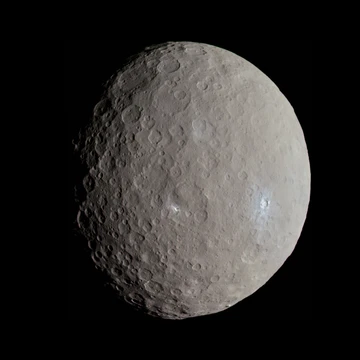
Orcus (dwarf planet)
A Kuiper belt dwarf planet and the 'anti-Pluto'.
Last updated
It is a plutino locked in a 2:3 orbital resonance with Neptune, similar to Pluto but opposite in orbital phase.[1] Orcus has been called the "anti-Pluto" because of these contrasts and its large moon.[2] Located in the Kuiper belt, the dwarf planet Orcus (minor-planet number 90482) has a single large satellite called Vanth, and its estimated diameter ranges from 870 to 960 km, comparable to Ceres.[3]
Key facts and history
Precovery images from Palomar Observatory date back to 8 November 1951.[4] Orcus's moon Vanth was named on 30 March 2010 after an Etruscan underworld entity.[5] The ratio of Vanth's mass to Orcus's mass is 0.16, measured with ALMA.[6] Both bodies have similar densities of about 1.5.[6]
The rotation period of Orcus is uncertain, with estimates ranging from 7 to 21 hours.[7] On 17 February 2004, the object was found by M. E. Brown, C. A. Trujillo, and D. L. Rabinowitz during observations at Palomar.[4][8]
What the cited sources add
The Minor Planet Center record states that Orcus was discovered at Palomar on 2004-02-17 by M. E. Brown, C. A. Trujillo, and D. L. Rabinowitz.[8] Wm. Robert Johnston's archive confirms the discovery date and that the companion was announced on 2007 February 22.[9] Johnston's archive also lists a 2010 Astronomy and Astrophysics paper on the "TNOs are Cool" survey of the trans-Neptunian region.[9] The Minor Planet Electronic Circular for 2004 DW was issued on 20 February 2004.[10]
References
- Wikipedia, "Orcus (dwarf planet)" (CC BY-SA 4.0), which cites: Buie, Marc W., "Orbit Fit and Astrometric record for 90482", SwRI (Space Science Department), 22 December 2007; "MPEC 2004-D15 : 2004 DW", Minor Planet Center, 20 February 2004 (we also read that source) en.wikipedia.org
- Wikipedia, "Orcus (dwarf planet)" (CC BY-SA 4.0), which cites: Michael E. Brown, "S/2005 (90482) 1 needs your help", Mike Brown's Planets (blog), 23 March 2009; Michael E. Brown, "S/2005 (90482) 1 needs your help", Mike Brown's Planets (blog), 23 March 2009 (original not read by us) en.wikipedia.org
- Wikipedia, "Orcus (dwarf planet)" (CC BY-SA 4.0), which cites: Grundy, "Mutual Orbit Orientations of Transneptunian Binaries", Icarus, 2019, p. 62–78 (original not read by us) en.wikipedia.org
- Wikipedia, "Orcus (dwarf planet)" (CC BY-SA 4.0), which cites: "90482 Orcus (2004 DW)", Minor Planet Center (we also read that source) en.wikipedia.org
- Wikipedia, "Orcus (dwarf planet)" (CC BY-SA 4.0), which cites: Wm. Robert Johnston, "(90482) Orcus", Johnston's Archive, 4 March 2007 (original not read by us) en.wikipedia.org
- Wikipedia, "Orcus (dwarf planet)" (CC BY-SA 4.0), which cites: Brown, "Masses and Densities of Dwarf Planet Satellites Measured with ALMA", The Planetary Science Journal, 1 October 2023, p. 193 (original not read by us) en.wikipedia.org
- Wikipedia, "Orcus (dwarf planet)" (CC BY-SA 4.0), which cites: A. Delsanti, "Methane, ammonia, and their irradiation products at the surface of an intermediate-size KBO? A portrait of Plutino (90482) Orcus", Astronomy and Astrophysics, 2010, p. 1057 (original not read by us) en.wikipedia.org
- "90482 Orcus (2004 DW)", Minor Planet Center. facts only, no text reused. minorplanetcenter.net
- Wm. Robert Johnston, "(90482) Orcus", Johnston's Archive, 4 March 2007. facts only, no text reused. johnstonsarchive.net
- "MPEC 2004-D15 : 2004 DW", Minor Planet Center, 20 February 2004. facts only, no text reused. minorplanetcenter.net
Each numbered sentence above was checked against the source it cites before publication. Sentences citing Wikipedia adapt text from the English Wikipedia article Orcus (dwarf planet) (contributors), used under CC BY-SA 4.0; this entry is available under the same licence. Other sources were used for facts only; no text or images are copied from them.
More in Planets and Dwarf Planets
Sources
Compiled from Wikipedia and the sources listed below. Text from Wikipedia is available under CC BY-SA 4.0; this entry is adapted from it.
- Wikipedia: Orcus (dwarf planet) (CC BY-SA 4.0).
Spotted an error? Know more?
Reader corrections go straight into our review queue. Suggest an edit · How this site is sourced