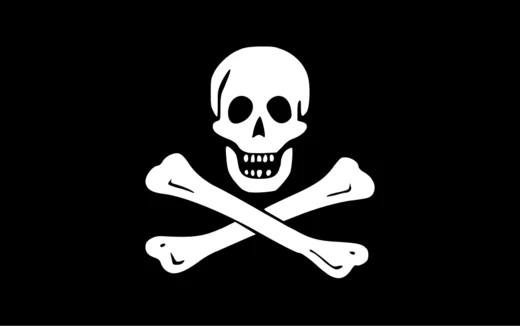
Calico Jack
English pirate known for female crew members Anne Bonny and Mary Read, and a fictional flag.

via Wikipedia: John Rackham · see source
John Rackham, executed on 18 November 1720, was an English pirate who sailed around the Bahamas and Jamaica near the end of the Golden Age of Piracy. Historical records from his own time refer to him only as John Rackham; the nickname "Calico Jack" is almost certainly a later invention. He is chiefly remembered today for having two women—Anne Bonny and Mary Read—among his crew, as well as for a flag that was never actually used by him. Almost nothing is known about Rackham’s life before he turned to piracy. The earliest account of him comes from Captain Charles Johnson’s 1724 book *A General History of the Pyrates*, a notoriously unreliable collection of pirate biographies.
What little can be said about Rackham’s early years is uncertain. The surname Rackham is English, originally from a hamlet of the same name, and many people with that name lived in Norfolk and Suffolk during the 1600s and 1700s. Johnson’s book says Rackham was English, but during his brief fight with Jonathan Barnet, Rackham himself claimed to be “From Cuba”—a statement that could mean he was born there, lived there, visited often, or was simply sailing from that island. Unlike his crewmates Anne Bonny and Mary Read, no trial records describe Rackham’s clothing, physical appearance, age, or nationality. The idea that he wore calico fabric is not supported by any contemporary evidence and cannot be proven. Before August 1720, nothing definite can be said about his life.
According to Johnson’s *General History*, Rackham began his pirate career as a quartermaster on Charles Vane’s brigantine *Ranger*, based out of New Providence in the Bahamas—a haven for pirates led by Benjamin Hornigold since 1713. Vane and his crew robbed ships near New York City, then encountered a large French man-of-war. Vane chose to retreat, citing caution, but Rackham argued they should fight, believing the ship held great riches and could become a valuable prize. Only fifteen of the ninety-one crew members backed Vane; the rest supported Rackham. Despite this, Vane insisted the captain’s decision was final, and they fled. On 24 November 1718, Rackham called a vote, and the crew branded Vane a coward, removing him from command and making Rackham captain. Rackham then gave Vane and his fifteen supporters the other ship in the fleet, plus supplies. Charles Vane’s trial transcript does confirm a crew vote ousted him, but the quartermaster involved is not named, so it is unclear whether Rackham was actually part of Vane’s crew.
In reality, John Rackham does not appear in any records before August 1720. His name is absent from Vincent Pearse’s list of pirates who accepted a pardon, and no newspaper from the time mentions him. It is likely he did not become a pirate until 1720. Johnson’s book, however, claims that in 1719 Rackham sailed into Nassau, took advantage of a general amnesty, and obtained a royal pardon and commission from Governor Woodes Rogers. Johnson also writes that in December of that year, Rackham captured the merchant ship *Kingston*, which carried a rich cargo. But the *Kingston* was taken within sight of Port Royal, prompting merchants to hire bounty hunters. They caught up with Rackham in February 1719 near Cuba’s Isla de los Pinos, but Rackham and most of his men were ashore and escaped into the woods, losing their ship and prize. In truth, the *Kingston* was stolen by Captain Joseph Thompson, not Rackham. Johnson further claims that while refitting a small sloop in a Cuban town, a Spanish warship and a captured English sloop entered the harbour. The warship could not reach the pirates at low tide, so it anchored at the harbour mouth to wait. That night, Rackham and his men rowed to the English sloop, overpowered the Spanish guards, and sailed past the warship at dawn as it fired on their empty old vessel. They then returned to Nassau, told Governor Rogers they had been forced into piracy by Vane, and received a pardon.
- known_for
- Having female crew members Anne Bonny and Mary Read; a fictional flag
Lore & Background
Little is known of Rackham's upbringing or early life. The surname Rackham is English in origin, originating from the hamlet of Rackham. Many Rackhams are recorded in the Norfolk and Suffolk region of England throughout the 17th and 18th century. While A General History claimed that he was English, during his short fight with Jonathan Barnet, Rackham said he was 'From Cuba.' This could mean born in Cuba, lived in Cuba, frequented Cuba, or simply was sailing from Cuba. Unlike his associates Anne Bonny and Mary Read, no descriptions of Rackham's clothing were given during his trial, alongside no physical descriptions nor mention of his age or national origin. Claims of wearing calico clothing is not contemporary and not proveable. Prior to August 1720, it is difficult to say anything definitive about John Rackham's early life. Rackham first appears in records around August 1720 after stealing merchant John Ham's sloop from Nassau harbor on 22 August. After a short two-month run, Rackham was captured by Jonathan Barnet, a former English privateer, on 22 October 1720. Rackham was put on trial by Sir Nicholas Lawes, Governor of Jamaica, and hanged on the 18th of November that year in Port Royal, Jamaica. According to writer James Knight, Rackham was beheaded and his head was gibbeted on a very small cay at the main entrance to Port Royal known as Plumb-Point. By the 1750s, it had become known as Rackham's Cay.
Reader's Guide
John Rackham's significance lies primarily in his association with two of the most famous female pirates, Anne Bonny and Mary Read, and in the enduring legend of his nickname Calico Jack. Despite his brief career—only about two months in 1720—he has become a well-known figure in pirate lore, largely due to Johnson's unreliable biography. The lack of contemporary records before August 1720 makes it difficult to separate fact from fiction. His capture and execution were swift, and his legacy is tied more to the romanticized image of pirates than to any substantial historical achievement. The fictional flag often attributed to him further cements his place in popular culture rather than in documented history.
Did You Know?
- Rackham's nickname 'Calico Jack' is likely fictional and not found in contemporary sources.
- The flag commonly associated with Rackham (white skull above crossed swords on black) was not described at his trial; only a 'white pendant' was noted.
- Rackham said he was 'From Cuba' during his capture, but this could mean born in Cuba, lived there, or simply sailed from there.
- Rackham's head was gibbeted on a cay that by the 1750s became known as Rackham's Cay.
- The Kingston was actually stolen by Captain Joseph Thompson, not John Rackham.
The Elusive Man Behind the Name
John Rackham's personal history remains one of the great gaps in pirate scholarship. No contemporary record describes his appearance, age, or national origin. While the surname Rackham traces back to a hamlet of that name and appears frequently among families in Norfolk and Suffolk during the seventeenth and eighteenth centuries, the man himself defies easy categorization. During his brief confrontation with the privateer Jonathan Barnet, Rackham declared he was "From Cuba," a statement that could indicate birth, residence, regular trade, or simply the port from which he was sailing at the time. Unlike his famous female associates Anne Bonny and Mary Read, whose clothing was noted at trial, no physical or sartorial details of Rackham were recorded. The popular image of a pirate in calico fabric is entirely a later invention, unsupported by any document from his era. Before the summer of 1720, the historical record simply goes silent, leaving scholars with nothing but speculation and the unreliable narratives of a posthumous biographer.
The Ouster of Charles Vane
According to the narrative preserved in Captain Charles Johnson's 1724 compilation, Rackham's path to captaincy was forged in a moment of crew rebellion. While serving as quartermaster aboard Vane's brigantine Ranger, operating out of New Providence in the Bahamas, Rackham found himself in a heated dispute during a pursuit by a French man-of-war roughly twice the size of their vessel. Vane ordered a retreat, citing caution, but Rackham publicly challenged the decision, arguing that the larger warship would carry substantial wealth and that capturing it would give the crew a far more powerful vessel. Of the roughly ninety-one men aboard, only fifteen sided with Vane. The captain insisted his word was final, and the crew fled. On 24 November 1718, Rackham called a formal vote; the men branded Vane a coward and deposed him. Rackham received the captaincy and gave Vane and his small faction the other ship in the fleet with a reasonable supply of ammunition and goods. Vane's own trial transcript confirms a crew vote occurred, though the quartermaster who led it goes unnamed.
A Two-Month Career and a Swift End
The historical record of John Rackham as a pirate is startlingly brief. He first surfaces in documents around August 1720, after seizing merchant John Ham's sloop from the harbor at Nassau on 22 August. His entire career as a captain lasted approximately two months. On 22 October 1720, Jonathan Barnet, a former English privateer, captured Rackham. The confrontation was short enough that Rackham managed to declare his origin as "From Cuba" before being overpowered. He was brought before Sir Nicholas Lawes, Governor of Jamaica, who presided over his trial. On 18 November 1720, Rackham was hanged in Port Royal. Notably, his name does not appear on Vincent Pearse's list of pirates who surrendered under a promised pardon, nor does any contemporary newspaper mention him by name. In all likelihood, Rackham was not engaged in piracy at all before the summer of 1720, making his entire documented career a matter of mere weeks rather than the lengthy career that later biographers attributed to him.
The Making of a Myth
The figure the world knows as Calico Jack is, in large part, a construction of later imagination. Primary sources from his lifetime refer to him only as John Rackham; the colorful nickname and the image of a pirate flying a distinctive flag are almost certainly fictional embellishments. The most detailed account of his life comes from Captain Charles Johnson's A General History of the Pyrates, published in 1724, a work widely regarded as unreliable. Johnson attributed to Rackham a long career under Charles Vane, a daring escape from a Spanish warship near Cuba, and a romantic entanglement with Anne Bonny in Nassau. Yet the Kingston merchant ship Johnson credits to Rackham was actually stolen by a different captain, Joseph Thompson. The relationship between Rackham and Bonny remains unclear, and Bonny was described as a spinster at her trial, complicating the narrative of a shared domestic life. What endures is not the verified man but the legend: a short-lived pirate remembered less for his deeds than for the two women who sailed beside him and the fictional trappings that later storytellers draped over his name.
Common Misconceptions (Editorial)
Many people believe that "Calico Jack" was a historical nickname used during John Rackham’s lifetime, but it is likely fictional and does not appear in contemporary sources. The flag commonly attributed to Rackham—a white skull above crossed swords on a black field—is also widely assumed to be authentic, yet only a "white pendant" was recorded at his trial, with no such design mentioned. Another common misconception is that Rackham stole the *Kingston*; in fact, that ship was taken by Captain Joseph Thompson, not Rackham.
Why It Matters (Editorial)
John Rackham’s legacy endures not because of his brief, unremarkable piracy, but because his crew included Anne Bonny and Mary Read, two of the most famous female pirates in history. Their presence challenges traditional narratives of piracy as an exclusively male domain, making Rackham’s story a lens through which we examine gender, mythmaking, and how popular history often outruns the facts.
Frequently Asked Questions
Who is Calico Jack?
Calico Jack is the confirmed nickname of John Rackham, an English pirate who operated around the Bahamas and Jamaica in the early 1700s. The name appears in actual trial records from the period, so it is not a later legend or invention.
What does Calico Jack's flag look like?
His historically documented flag shows a white skull resting above a pair of crossed swords on a plain black field. It is one of the few early-18th-century pirate flags whose design is verified by period documents rather than storytelling.
Why is Calico Jack's crew notable?
Rackham's ship carried two women, Anne Bonny and Mary Read, who served openly as crew members rather than as hidden passengers. Their presence made his small band one of the most discussed pirate crews of the era.
How does Calico Jack's story end?
His pirate career was shockingly brief, beginning in August 1720 with the theft of John Ham's sloop and ending when he was captured and hanged in Port Royal, Jamaica, on 18 November 1720. From first theft to execution, his time as a free pirate lasted only a few months.
Why is Calico Jack important in pirate history?
He stands out because his nickname, his flag design, and his unusual crew composition are all backed by contemporary written records rather than folklore. That makes him one of the few early-1700s pirates whose details can be cross-checked against primary sources.
More in Pirates 1-21
Spotted an error? Know more?
This is a living reference — every entry is fact-audited, and reader corrections feed straight into our audit queue. Suggest an edit · See this site's audit record