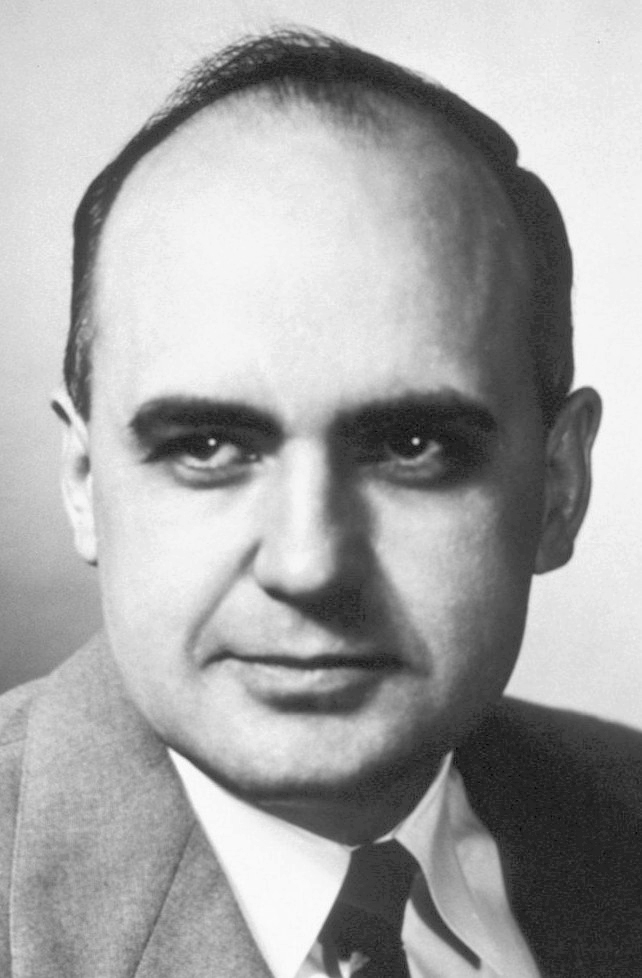
Maurice Hilleman
Developed over 40 vaccines; developed eight of the 14 vaccines routinely recommended in American schedules.

Walter Reed Army Medical Center · Public domain
Maurice Hilleman, a microbiologist from Montana, created more than 40 vaccines. His work is credited with saving roughly eight million lives annually. Some researchers consider him the scientist who saved more lives than any other in the 20th century. He has been called the "father of modern vaccines" and, in the words of Robert Gallo, "the most successful vaccinologist in history."
Of the 14 vaccines routinely recommended in American schedules, Hilleman and his team developed eight: those for measles, mumps, hepatitis A, hepatitis B, chickenpox, *Neisseria meningitidis*, *Streptococcus pneumoniae*, and *Haemophilus influenzae* bacteria. He also played a key role in creating a vaccine for the Hong Kong flu and helped discover antigenic shift and drift, the cold-producing adenoviruses, the hepatitis viruses, and the potentially cancer-causing virus SV40.
Born on a farm near Miles City, Montana, Hilleman was the eighth child of Anna and Gustav Hillemann. His twin sister and mother died shortly after his birth. He was raised by his uncle Bob and worked on the family farm, crediting his boyhood experience with chickens—fertile eggs were later used to grow viruses for vaccines. Raised in the Lutheran Church–Missouri Synod, he discovered Charles Darwin in eighth grade and was caught reading *On the Origin of Species* in church; he later rejected religion. With help from his eldest brother, scholarships, and family, he graduated first in his class from Montana State University in 1941. He earned a doctorate in microbiology from the University of Chicago in 1944, with a thesis showing that chlamydia infections, then thought viral, were actually caused by the bacterium *Chlamydia trachomatis*.
At E.R. Squibb & Sons, he developed a vaccine against Japanese B encephalitis for American troops in World War II. As chief of the Department of Respiratory Diseases at the Army Medical Center (1948–1957), he discovered antigenic shift and drift in the influenza virus, theorizing that yearly flu shots would be needed. In 1957, he joined Merck & Co., where he developed most of his forty vaccines, working at the bench and providing leadership. He served on many advisory boards, including the NIH's Office of AIDS Research Program Evaluation and the Advisory Committee on Immunization Practices.
During the 1957 Asian flu pandemic, Hilleman recognized the Hong Kong outbreak as a potential killer. After nine 14-hour days, he and a colleague identified it as a new strain. Forty million vaccine doses were prepared and distributed; though 69,000 Americans died, many more deaths were prevented. He received the Distinguished Service Medal for this work. In 1968, during the Hong Kong flu pandemic, his team made nine million doses available in four months.
Hilleman warned early about simian virus contamination in vaccines, notably SV40, which contaminated some polio vaccines from 1955–1963. In 1963, his daughter Jeryl Lynn got mumps; he cultivated material from her to create a mumps vaccine. The Jeryl Lynn strain is still used in the MMR vaccine he also developed, the first approved vaccine combining multiple live virus strains. Like many vaccines of that era, it was tested in children with intellectual disabilities living in group homes, who faced higher infectious disease risk due to poor hygiene and cramped conditions.
For hepatitis B, Hilleman and his group invented a vaccine by treating blood serum with pepsin, urea, and formaldehyde. Licensed in 1981, it was withdrawn in the U.S. in 1986 and replaced by a yeast-produced version still in use. By 2003, 150 countries were using that vaccine, and the incidence of the disease dropped dramatically.
- known_for
- Developing over 40 vaccines, including eight in routine American schedules; disc
Lore & Background
His twin sister was stillborn, and his mother died two days after childbirth. He was raised by his uncle Bob Hilleman and worked on the family farm. After joining E.R. Squibb & Sons, he developed a vaccine against Japanese encephalitis for troops in World War II. He and his group invented a hepatitis B vaccine using treated blood serum, licensed in 1981, which he considered his greatest achievement.
Reader's Guide
Maurice Hilleman's significance lies in his development of over 40 vaccines. His work directly contributed to eight of the 14 vaccines routinely recommended in American schedules, covering measles, mumps, hepatitis A and B, chickenpox, and several bacterial diseases. His discovery of antigenic shift and drift established the need for yearly influenza vaccinations. The mumps vaccine derived from his daughter's infection remains in use, and his hepatitis B vaccine, though later replaced by a yeast-based version, dramatically reduced disease incidence.
Did You Know?
- Hilleman's twin sister was stillborn, and his mother died two days after his birth.
- He was caught reading On the Origin of Species in church and later rejected religion.
- He discovered that chlamydia infections were caused by a bacterium, not a virus, for his doctorate.
- He used material from his daughter Jeryl Lynn, who had mumps, to create the mumps vaccine strain still used today.
- He considered his hepatitis B vaccine, licensed in 1981, his greatest achievement.
Gallery
Frequently Asked Questions
Who is Maurice Hilleman?
Maurice Ralph Hilleman (1919–2005) was an American microbiologist who dedicated his career to vaccine research at Merck. He is most often remembered as the most prolific vaccine developer in modern history, earning the nickname 'father of modern vaccines.'
How many vaccines did Maurice Hilleman create?
Hilleman and his team produced more than 40 vaccines over his career, a record no other researcher has matched. Eight of those appear on the standard U.S. childhood and adult immunization schedule, covering conditions such as measles, mumps, hepatitis A and B, chickenpox, and meningococcal disease.
What did Maurice Hilleman discover about the flu virus?
He identified the mechanisms of antigenic shift and antigenic drift, explaining how influenza strains mutate and jump between species. That understanding allowed his lab to design effective vaccines during both the 1957 Asian flu and the 1968 Hong Kong flu pandemics.
How many lives do Maurice Hilleman's vaccines save annually?
Public-health estimates put the annual death toll prevented by his vaccines at roughly eight million people worldwide. That figure is a key reason he is routinely cited as one of the most consequential figures in twentieth-century medicine.
Why is Maurice Hilleman considered a pioneer in physiology and medicine?
Beyond sheer output, he fundamentally changed how scientists think about viral evolution and immune protection. His combined legacy of dozens of vaccines plus foundational virology discoveries reshaped global infectious-disease prevention strategies.
More in Pioneers In Medicine And Physiology 1-19
Spotted an error? Know more?
This is a living reference — every entry is fact-audited, and reader corrections feed straight into our audit queue. Suggest an edit · See this site's audit record