
The Social Contract

Ambre Troizat · CC BY-SA 4.0
Jean-Jacques Rousseau’s *The Social Contract* asks whether a political community can hold legitimate authority—one that respects individual freedom—while dealing with the problems of commercial society he had earlier explored. The book argued against the divine right of monarchs to make laws. Instead, Rousseau claimed that only the general will of the people has the right to legislate, because only then can people be said to obey themselves and remain free. This general will, though debated by interpreters, appears to involve a legislature made up of all adult members of the community, limited to passing general laws for the common good.
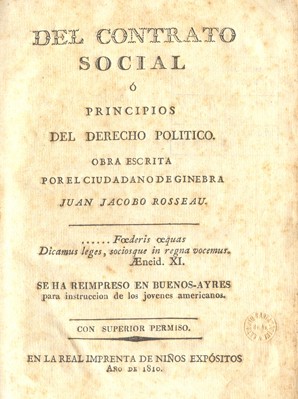
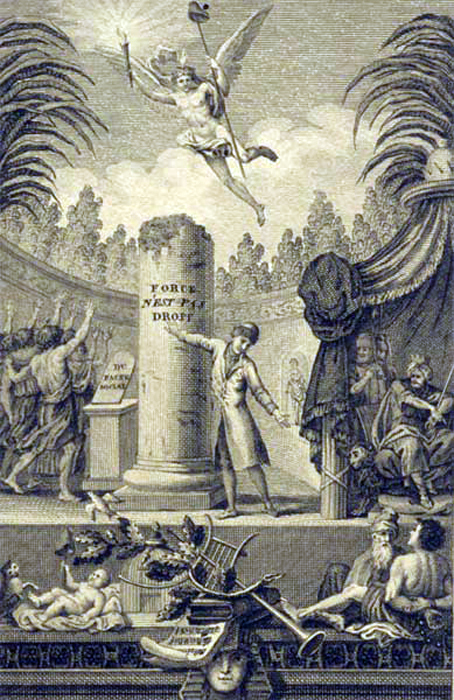
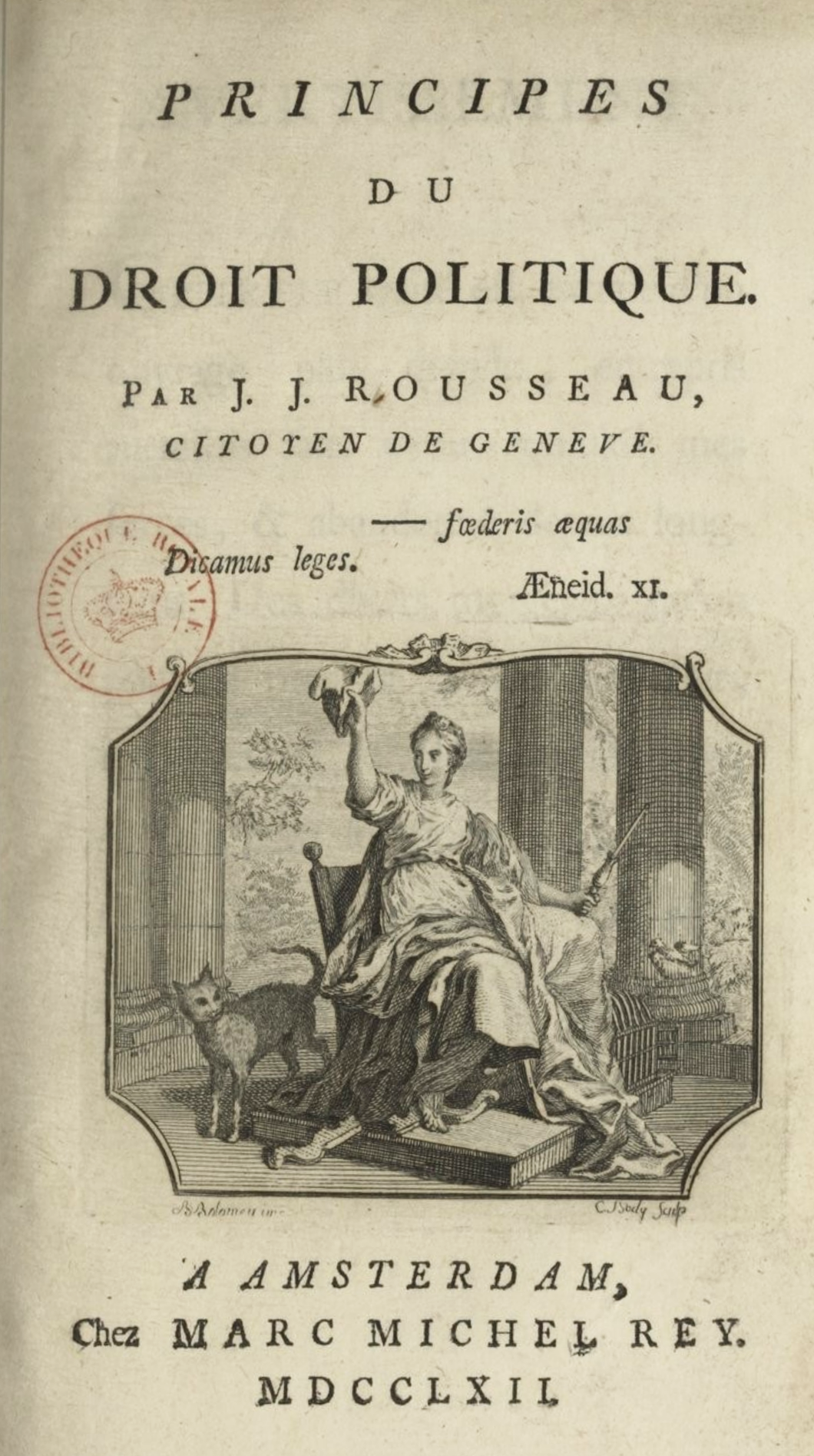
The work opens with a line from Virgil’s *Aeneid*: “Let us set equal terms for the truce.” Its aim is to see if legitimate political authority can exist, since people’s interactions in his time seemed worse than the isolated state of nature. Rousseau concludes that force does not create right—might does not make right—and people are only obliged to obey legitimate powers. A state has no right to enslave a conquered people. Legitimate authority must be consented to, requiring a social contract. But unlike earlier thinkers (Grotius, Hobbes, Pufendorf), Rousseau held that freedom is inalienable, so people cannot hand over their rights to someone else. Transferring rights would mean renouncing freedom and turning natural equality into subjection. The only valid contract is one where the people themselves rule. He calls the united will of the people the general will, which must only make laws that apply equally to all. Collective self-rule increases freedom if those who obey the laws also make them. Rousseau, who opposed extreme wealth inequality, argued that equality is essential for liberty and that legislation should preserve it.
Rousseau separates sovereign power from government (the executive). The sovereign cannot handle particular matters like applying laws, as that would undermine its generality and legitimacy. So government must be a separate institution. If it oversteps the boundaries set by the people, the people should abolish it and start over. The size of a territory often determines the type of government. A government’s strength is fixed, so larger territories require more power over the populace. Monarchy can wield the most power, democracy the least. Larger bureaucracies need more power for discipline, so states are usually aristocracies or monarchies. Rousseau’s terms differ from common usage: “democracy” means the executive is held by half or more of the population, “aristocracy” by between two people and half, and “monarchy” by one person. How executives come to power is irrelevant—hereditary rule is not required. Regardless of the executive type, a state is only legitimate if the people hold legislative power. Rousseau does not mean representative democracy; he insists that the people themselves, not representatives, have supreme power, and everyone’s participation in legislation checks abuse. Small city-states, like his native Geneva, best allow freedom. For such states, an elected aristocracy is preferable; for very large states, a benevolent monarch may work, but even monarchy must be subordinate to the sovereign rule of law.
The book helped inspire political reforms and revolutions in Europe, especially in France.
- author
- Jean-Jacques Rousseau
- original_language
- French
- field
- Political philosophy
- nationality
- Genevan
- known_for
- Theory of the general will and legitimate political authority
Lore & Background
The Social Contract, published in 1762 by the Genevan philosopher Jean-Jacques Rousseau, is a work of political philosophy that seeks to establish a legitimate political authority compatible with individual freedom. Its epigraph, drawn from Virgil’s *Aeneid*, reads “foederis aequas / dicamus leges” (“Let us set equal terms for the truce”). Rousseau opens the book by arguing that force does not create right, and that people are obliged to obey only legitimate powers, rejecting the notion that might makes right. He contends that monarchs are not divinely empowered to legislate; instead, only the general will of the people holds the right to legislate, as this allows individuals to obey only themselves and thus remain free. The general will, to be legitimate, must legislate laws that apply equally to all, and Rousseau emphasizes that equality is essential for liberty. He distinguishes the sovereign power (the people legislating) from the government (the executive), arguing that the sovereign cannot handle particular matters without undermining its generality. Rousseau claims that the size of a territory influences the nature of its government: larger states require stronger governments, with monarchy wielding the most power and democracy the least. He defines democracy as an executive held by half or more of the population, aristocracy as executive power held by a number between two and half the population, and monarchy as executive power held by one individual. For Rousseau, small city-states like his native Geneva are best suited for freedom, with an elected aristocracy preferable for such states, though even a monarch must remain subordinate to the sovereign people.
Reader's Guide
The Social Contract's significance lies in its influence on political reforms and revolutions, particularly in France. Rousseau's concept of the general will—the united will of the people—requires that laws apply equally to all and that the people themselves, not representatives, hold supreme legislative power. The work distinguishes sovereign power from government (executive power), arguing that the government must remain separate and that the people may abolish it if it exceeds its boundaries. Rousseau's ideas on equality and liberty, and his rejection of divine right, shaped later thinkers such as Immanuel Kant, who credited Rousseau with teaching him to honor human beings. The book was banned in France and Geneva and placed on the Church's Index Librorum Prohibitorum, yet it also influenced American political thought through Noah Webster's Sketches of American Policy.
Did You Know?
- The Social Contract was banned in France upon publication, causing Rousseau to flee the country to avoid imprisonment.
- The work's epigraph is from Virgil's Aeneid: 'Let us set equal terms for the truce.'
- Immanuel Kant acknowledged his debt to Rousseau's political philosophy, writing that Rousseau 'set me right' and taught him to honor human beings.
Ancient Roots Before the Enlightenment
The social contract idea is often associated with the Age of Enlightenment, but its intellectual DNA stretches far deeper into human history. Greek and Stoic philosophers, Roman legal traditions, and Canon Law all contain early formulations of the concept. In India, the Arthashastra offers a strikingly realist view of governance: for Chanakya, political authority emerges not from divine mandate or idealism but from the practical vulnerabilities embedded in human nature. His famous observation that without proper enforcement of punishment, the strong devour the weak, echoes the logic that would later animate Hobbes. Similarly, the second-century BC Buddhist text Mahāvastu tells the story of Mahasammata, where humanity descends from an immaterial paradise into a world of scarcity, crime, and social conflict. Faced with theft and murder, the people collectively chose one individual to maintain order in exchange for a share of agricultural produce. This narrative—people voluntarily selecting a ruler to solve a collective problem—captures the essential logic of the social contract millennia before Rousseau gave the concept its most famous name.
The State of Nature as Starting Point
Nearly every major social contract theory begins with the same thought experiment: strip away all political institutions, all laws, all social structures, and ask what remains. Thomas Hobbes labeled this hypothetical condition the state of nature, a realm where human conduct is constrained solely by individual power and personal conscience. In this condition, the working assumption is that nature itself prevents mutually beneficial cooperation. From this shared premise, theorists then argue that rational people would willingly give up their unbounded natural liberty in pursuit of the security and order that political community provides. The central philosophical claim running through all these arguments is that law and political order are not features of the natural world but deliberate human constructions. The social contract and the institutions it produces exist as instruments toward a practical end—the well-being of the individuals who constitute them—and their legitimacy is conditional, lasting only as long as they honor their side of the bargain.
A Constellation of Thinkers, A Spectrum of Answers
The social contract tradition is not a single doctrine but a family of competing responses to the same fundamental question: why should individuals submit to political authority? His solution was stark: free men contract to create civil society and submit to an absolute sovereign, accepting even arbitrary rule as preferable to anarchy. Each theorist approached the relationship between natural and legal rights differently, yet all shared the conviction that political authority requires some form of individual consent, whether explicit or tacit.
The Abstract Model and the Limits of Legitimacy
Beneath the varied rhetoric of Grotius, Hobbes, Locke, Rousseau, and Kant lies a shared structural logic that can be rendered as a general model. In this abstraction, a set of hypothetical choosers operating in an original position or state of nature selects a bundle of rules, principles, or institutions within a particular deliberative setting. The purpose is to give real individuals a reason to endorse and comply with those rules in the actual world, provided the reasoning that guided the original choice is one those real individuals can recognize and share. This model is not itself a theory but a lens for identifying the common factors across competing accounts. Crucially, the framework also encodes a limit on political power. Hobbes maintained that government is not a party to the original contract; it is the product of the agreement among citizens. This means that when a government becomes too weak to suppress factionalism and civil unrest, or when it fails to fulfill its protective role, citizens are not bound to submit. Legitimacy, in this tradition, is never a permanent endowment but a continuing performance.
Gallery



Frequently Asked Questions
Who wrote The Social Contract and what is it?
Jean-Jacques Rousseau, a Genevan political philosopher, composed this treatise in French as a theory of how a community can build legitimate governance. Its core concern is reconciling collective authority with the preservation of individual liberty in an age of commerce and private interest.
What is the 'general will' and why does it matter in the book?
Rousseau uses the term to describe the shared public interest that emerges when citizens act as members of the whole rather than as isolated individuals. He treats this general will as the sole source of legitimate law and sovereignty, distinguishing it sharply from mere majorities or the aggregation of private desires.
How did The Social Contract influence real-world politics?
The text became an intellectual catalyst for reform and revolutionary movements across Europe, most visibly in France. By arguing that political power must rest on the consent of the governed rather than on hereditary right or force, it gave radical thinkers a philosophical vocabulary to challenge existing monarchies.
What problem is Rousseau trying to solve in the book?
He is responding to the instability and inequality that commercial society produces, where wealth and private advantage tend to undermine genuine equality among citizens. His proposed solution is a social compact in which each person surrenders some natural freedom in exchange for civil freedom under laws they collectively author.
Why is The Social Contract still widely studied today?
It remains a foundational text in political philosophy because the tension between collective authority and personal liberty it explores has never been resolved. Its arguments about consent, the limits of legitimate power, and the role of the citizen in self-governance continue to frame modern debates about democracy and rights.
More in Philosophy & Theory 1-24
Spotted an error? Know more?
This is a living reference — every entry is fact-audited, and reader corrections feed straight into our audit queue. Suggest an edit · See this site's audit record