
The Protocols of the Elders of Zion
Antisemitic forgery purporting a Jewish plot for world domination.

Wikimedia Commons · Public domain
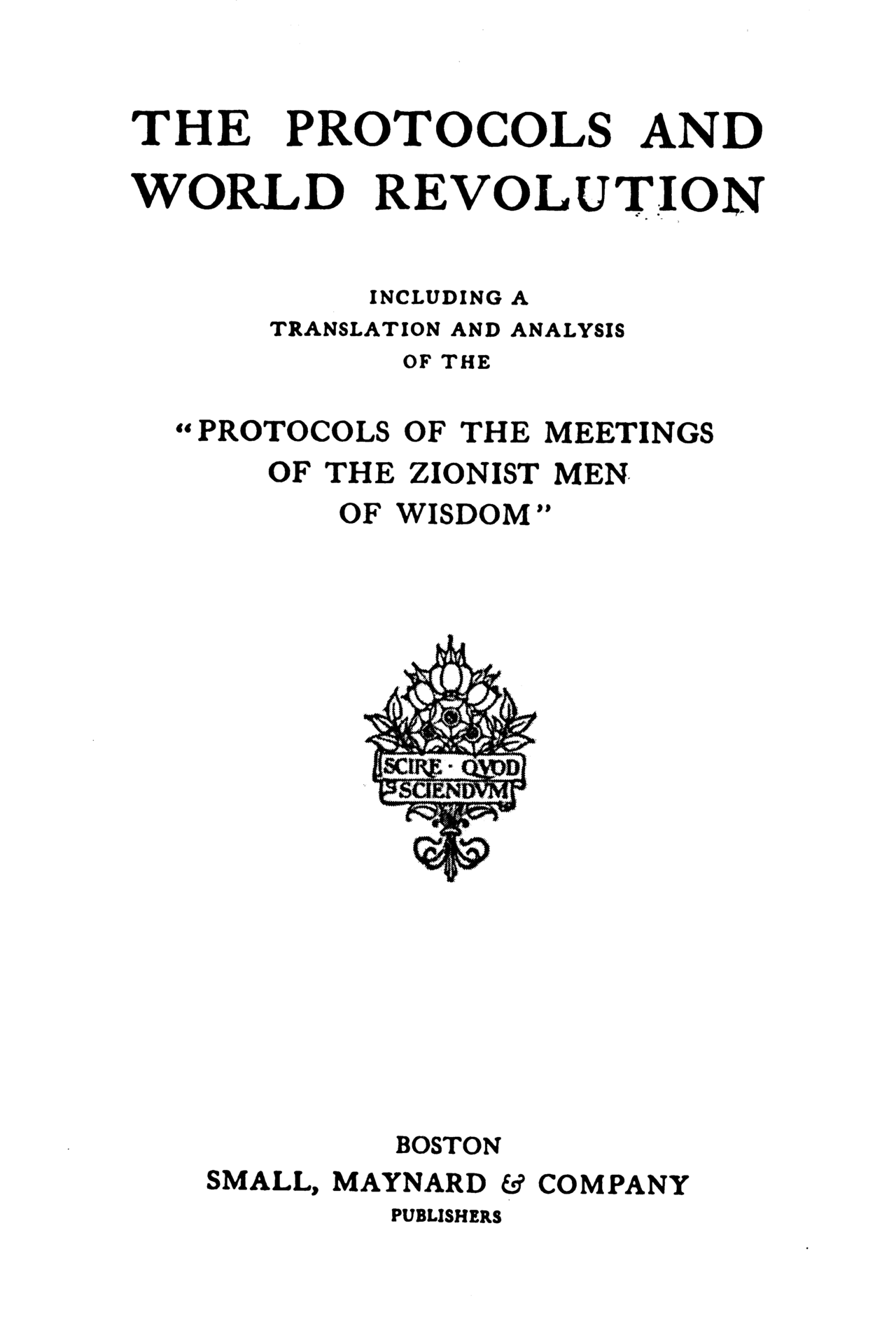
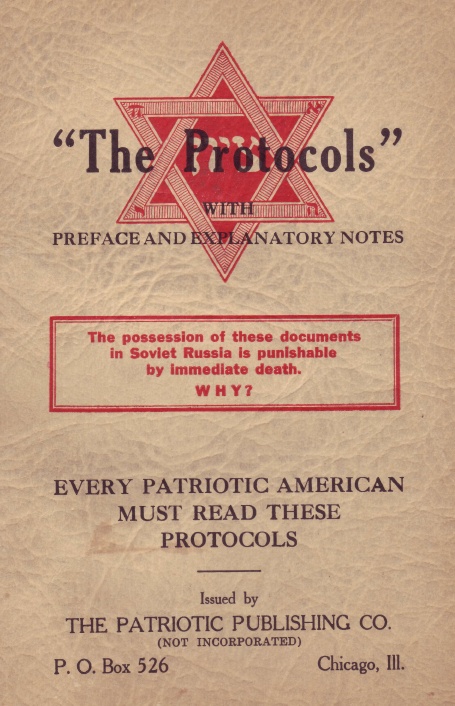
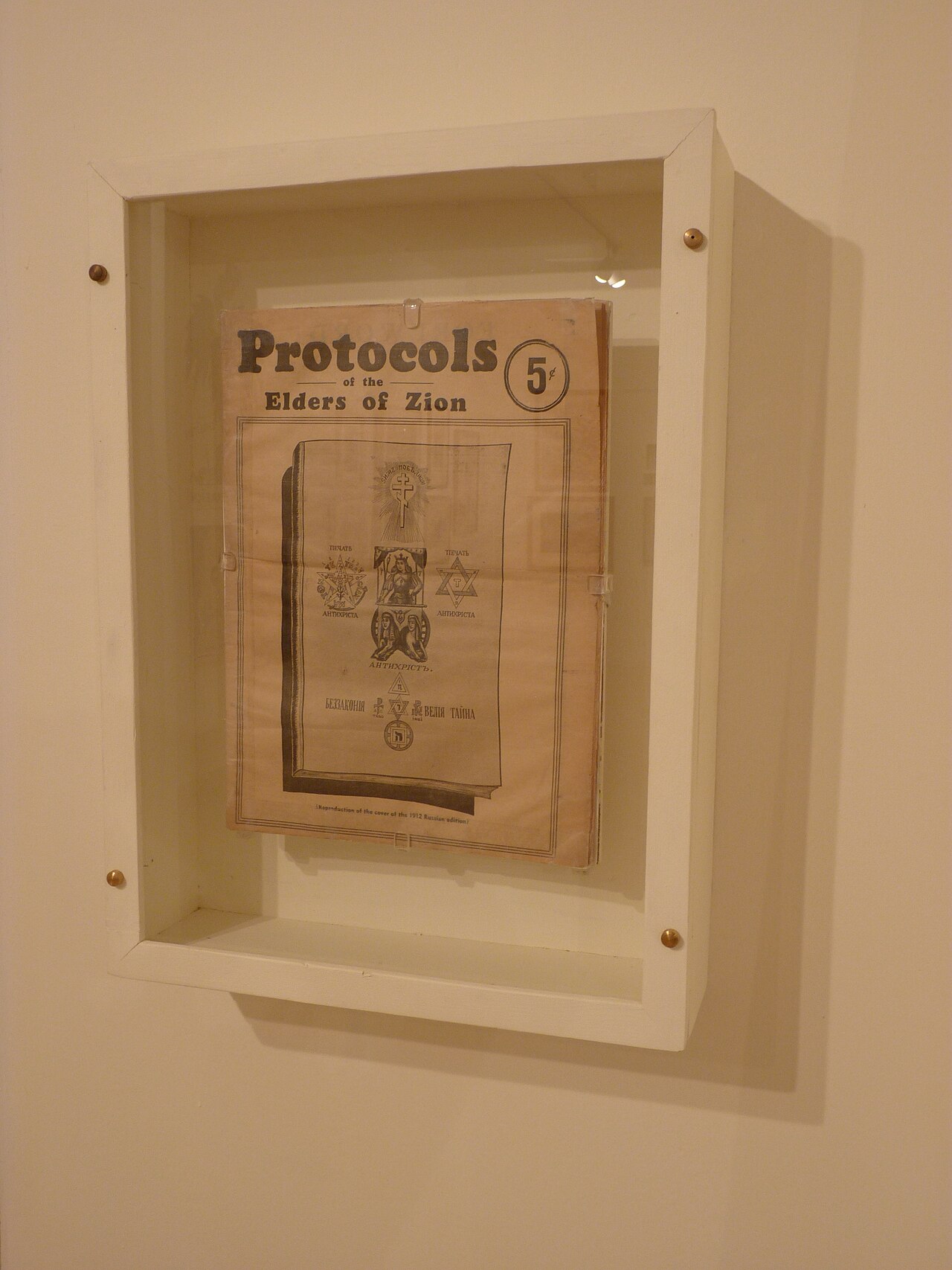
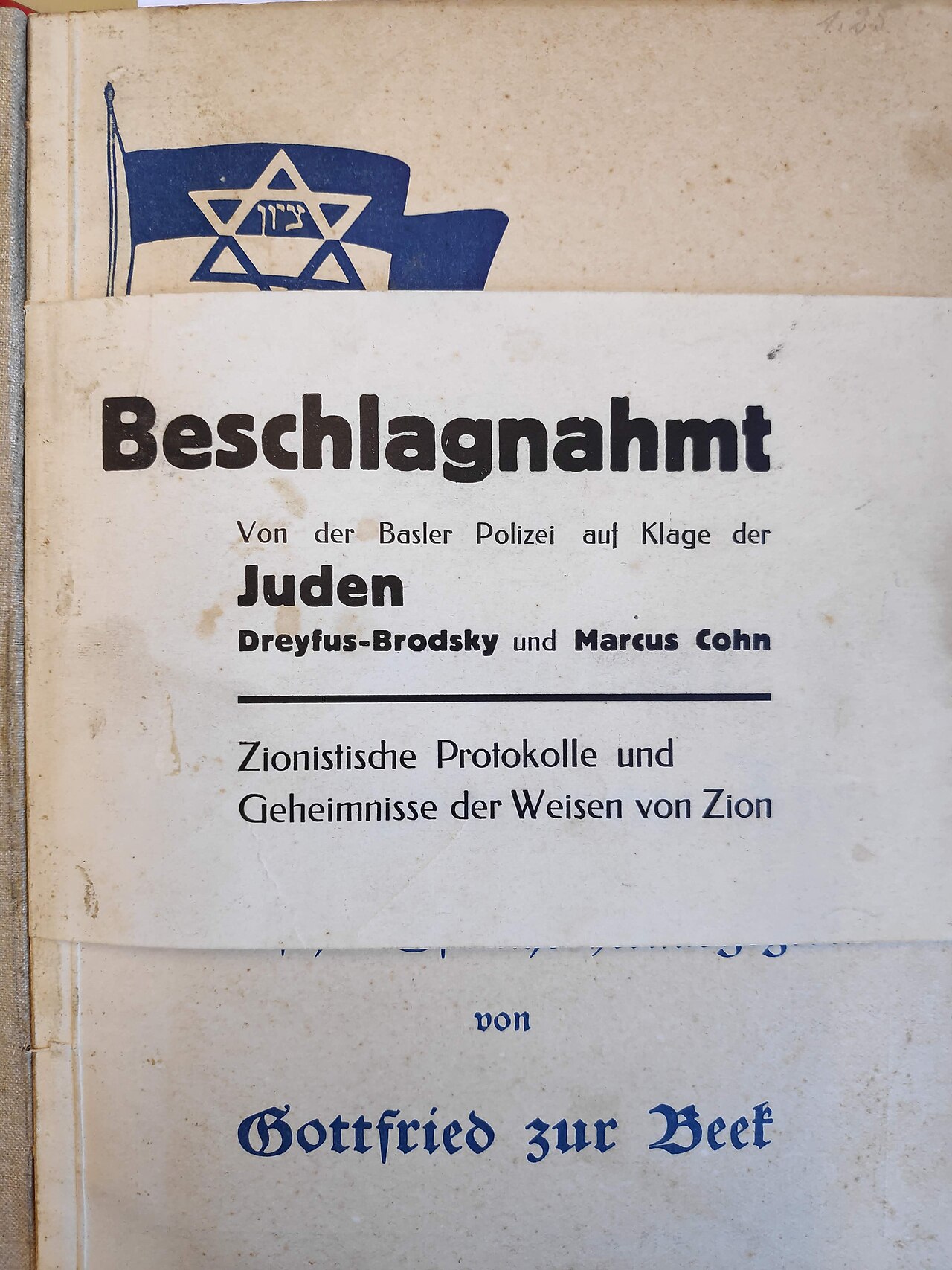
The Protocols of the Elders of Zion is a fabricated antisemitic text that falsely claims to reveal a secret Jewish plan for world control. It was largely copied from earlier works and first appeared in Imperial Russia in 1903, with pamphlets circulating since 1902. Translated into many languages, it spread worldwide in the early 1900s and was instrumental in promoting the idea of a global Jewish conspiracy.
The document was proven to be black propaganda by the British newspaper *The Times* in 1921 and the German *Frankfurter Zeitung* in 1924. Starting in 1933, excerpts were assigned as factual reading to schoolchildren in Nazi Germany. It remains widely available in print and online, still promoted by antisemitic groups as genuine. It has been called "probably the most influential work of antisemitism ever written."
**Creation**
The Protocols is a fake presented as authentic. Textual evidence shows it could not have been written before 1901, as it references the assassinations of King Umberto I (1900) and President William McKinley (1901) as if pre-planned. The first widely distributed edition, by Sergei Nilus, is dated 1902–1903, suggesting it was composed then in Russia. Cesare G. De Michelis argues it was created shortly after a Russian Zionist congress in September 1902, initially as a parody of Jewish idealism for internal antisemitic circles, then cleaned up and published as real. Conflicting testimonies indicate that those involved, including first publisher Pavel Krushevan, deliberately hid its origins and lied about it for decades.
**Political Conspiracy Background**
This forgery is a classic conspiracy theory. After the partitions of Poland in the late 1700s, Russia acquired the world’s largest Jewish population, who lived in shtetls within the Pale of Settlement. Until the 1840s, Jewish affairs were managed by the semi-autonomous *qahal*, which handled taxation and army conscription. As liberalism rose in Europe and Russia, the Tsarist regime hardened its reactionary stance under Nicholas I’s slogan “Orthodoxy, Autocracy, and Nationality.” Non-Orthodox and non-Russian subjects, including Jews, Catholics, and Protestants, were seen as subversives needing forced conversion and assimilation. Even Jews who converted, like composer Maximilian Steinberg, were suspected of being “infiltrators” trying to take over society, while those who kept their religion were resented as aliens.
Resentment existed in Russian society, but the idea of an international Jewish conspiracy for world domination emerged in the 1860s. Jacob Brafman, a Lithuanian Jew from Minsk, fell out with local *qahal* agents, converted to Russian Orthodoxy, and wrote polemics against the Talmud and the *qahal*. In *The Local and Universal Jewish Brotherhoods* (1868) and *The Book of the Kahal* (1869), published in Vilna, he claimed the *qahal* secretly continued, aiming to undermine Orthodox Christian entrepreneurs, seize property, and gain political power. He also alleged it was an international network controlled by the Paris-based Alliance Israélite Universelle, then led by freemason Adolphe Crémieux. Talmudist Jacob Barit tried to refute Brafman’s claims.
Brafman’s work gained international reach when translated into English, French, German, and other languages. The image of the *qahal* as a secret Jewish shadow government was adopted by anti-Jewish publications in Russia and taken seriously by officials like P. A. Cherevin and Nikolay Pavlovich Ignatyev, who in the 1880s urged provincial governors to hunt for the supposed *qahal*. This coincided with the assassination of Tsar Alexander II and subsequent pogroms. In France, Monsignor Ernest Jouin translated it in 1925 and later supported the Protocols. In 1928, far-right geographer Siegfried Passarge, a future Nazi supporter, translated it into German.
Other early writings proposed similar ideas, such as *The Conquest of the World by the Jews* (1873) by Osman Bey (born Frederick van Millingen), a British subject and Ottoman officer who converted to Islam then Russian Orthodoxy. This was followed by Hippolytus Lutostansky’s *The Talmud and the Jews* (1879), which claimed Jews wanted to divide Russia among themselves.
**Sources Employed**
The forgery drew primarily on two works: *Dialogue in Hell Between Machiavelli and Montesquieu* (1864), a political satire by Maurice Joly, and a chapter from *Biar* (the source text cuts off here).
- type
- Forged document
- origin
- Imperial Russia
- known_for
- Antisemitic hoax and forgery
Lore & Background
The Protocols of the Elders of Zion is a fabricated document, an antisemitic hoax and forgery that purports to be a factual record of a Jewish plot for global domination. It was largely plagiarized from several earlier sources and first appeared in Imperial Russia in 1903, having circulated in pamphlet form since 1902. The text was quickly translated into multiple languages and disseminated internationally in the early 20th century, playing a key role in popularizing belief in an international Jewish conspiracy. Its defining characteristic is its fraudulent nature: textual evidence shows it could not have been produced before 1901, as it alludes to assassinations that occurred in 1900 and 1901 as if they were pre-planned. The title of the widely distributed first edition contains the dates 1902–1903, and it was likely written in Russia during that period. One scholar argues it was manufactured after a Russian Zionist congress in September 1902, originally as a parody of Jewish idealism for internal antisemitic circulation, later cleaned up and published as genuine. The forgery was exposed as black propaganda by *The Times* in 1921 and the *Frankfurter Zeitung* in 1924. Beginning in 1933, distillations were assigned as factual reading to German schoolchildren in Nazi Germany. It remains widely available in print and online, presented as genuine by some antisemitic groups, and has been called "probably the most influential work of antisemitism ever written." The individuals involved, including initial publisher Pavel Krushevan, deliberately obscured its origins and lied about it in subsequent decades.
Reader's Guide
The document was first circulated in pamphlet form in Imperial Russia in 1902, with a full edition published in 1903. It purports to be a factual record of a Jewish plot for world domination, but is in fact a fabricated hoax. Textual analysis shows it could not have been written before 1901, as it references assassinations that occurred in 1900 and 1901 as if they were pre-planned. The work was largely plagiarized from earlier sources, including a French political satire. It was likely created in Russia shortly after a Zionist congress in September 1902, possibly as an internal parody among antisemites that was later cleaned up and presented as genuine. The initial publisher and others involved deliberately obscured its origins and lied about its creation. The forgery popularized the belief in an international Jewish conspiracy, a concept that had been developing in Russian society since the 1860s through earlier writings claiming that a secret Jewish shadow government, the qahal, continued to exist and aimed to seize political power. These earlier works, which were translated into multiple languages, influenced Russian officials and later European antisemites. The Protocols was exposed as black propaganda by *The Times* in 1921 and by a German newspaper in 1924. Despite this, from 1933 onward, distillations of the text were assigned as factual reading in German schools under the Nazis. It remains in print and online, still promoted as genuine by antisemitic groups.
Fabrication and Plagiarism
The Protocols was not an authentic document but a deliberate fabrication. Scholar Cesare G. The individuals involved, including initial publisher Pavel Krushevan, later gave contradictory accounts and deliberately concealed the text's true origins.
The Russian Soil of Conspiracy
The forgery grew from deep roots in Russian imperial anti-Jewish sentiment. After the partitions of Poland, the Russian Empire absorbed the world's largest Jewish population, confining them to the Pale of Settlement where local affairs were managed through the qahal, a semi-autonomous Jewish governing body. Under Tsar Nicholas I's doctrine of Orthodoxy, Autocracy, and Nationality, non-Orthodox subjects were treated as subversives. Even assimilated Jews who converted to Orthodoxy, like composer Maximilian Steinberg, were distrusted as potential infiltrators. The specific idea of an international Jewish shadow government crystallized in the 1860s through Jacob Brafman, a Lithuanian Jew who, after a dispute with local qahal agents, converted to Russian Orthodoxy and published polemics claiming the qahal secretly operated as a global conspiratorial network under the Alliance Israélite Universelle in Paris. His works were translated into multiple languages and taken seriously by Russian officials in the 1880s.
Exposure and the Nazi Classroom
Despite its fabricated nature, the Protocols gained enormous international traction in the early twentieth century, translated into numerous languages and circulated widely. Yet the text's destructive power was far from over. This institutional endorsement within the school system gave the forgery an aura of legitimacy it had never possessed. These channels ensured the text reached broad audiences across Europe at precisely the moment political extremism was gaining momentum.
Enduring Influence and Continued Circulation
The Protocols has been characterized as probably the most influential antisemitic text ever produced, a designation that reflects its extraordinary longevity and reach. More than a century after its initial Russian publication, it remains readily accessible in print and across the internet in a wide array of languages. Various antisemitic organizations continue to present it as an authentic historical document, refusing to acknowledge its status as a plagiarized forgery. The text played a central role in embedding the narrative of an international Jewish conspiracy for world domination into popular consciousness, a narrative that transcended national borders and persisted well beyond the fall of the regimes that most aggressively promoted it. The deliberate concealment of its origins by those involved in its creation—including contradictory testimonies from figures like Krushevan—meant that even after its exposure, the question of its authenticity remained contested in certain circles. Its survival as a circulating text, rather than being relegated purely to the historical record, underscores how effectively it was woven into the fabric of modern antisemitic discourse.
Gallery
Frequently Asked Questions
What is The Protocols of the Elders of Zion?
It is a fabricated document produced in Imperial Russia that falsely presents a supposed Jewish conspiracy to seize global power. The text has been conclusively identified as an antisemitic forgery with no basis in reality.
Where and when did The Protocols of the Elders of Zion originate?
The document was assembled in early-20th-century Russia, most likely by agents of the Okhrana secret police. Investigators have traced large stretches of its text to earlier French political pamphlets and a satirical novel, confirming it was pieced together from existing non-Jewish sources.
What role did The Protocols of the Elders of Zion play in history?
It became one of the most widely circulated vehicles for antisemitic conspiracy thinking in the twentieth century. Governments and movements in multiple countries used it to justify discrimination, pogroms, and ultimately genocide against Jewish populations.
How was The Protocols of the Elders of Zion proven to be a forgery?
Legal and academic investigations, including a 1935 Leipzig court ruling, demonstrated that the text was largely plagiarized from a 1884 French political satire and other unrelated works. No independent evidence has ever supported any of the claims the document makes.
Why is The Protocols of the Elders of Zion still discussed in academic and public contexts?
It stands as a textbook case of how a single forged text can seed decades of real-world hatred and violence. Scholars of propaganda, political theory, and the history of antisemitism study it to understand how fabricated narratives gain traction and cause harm.
More in Philosophy & Theory 1-24
Spotted an error? Know more?
This is a living reference — every entry is fact-audited, and reader corrections feed straight into our audit queue. Suggest an edit · See this site's audit record