
Allegory of the cave
Plato's allegory comparing education's effect on human nature.

Gothika · CC BY-SA 4.0
In Book VII of *The Republic*, the Greek philosopher Plato presents an allegory about a cave, using it to explore how education—or its absence—shapes human understanding. The story unfolds as a conversation narrated by Socrates, speaking to Plato’s brother Glaucon. It follows two earlier analogies in the same work: the analogy of the Sun and the analogy of the divided line.
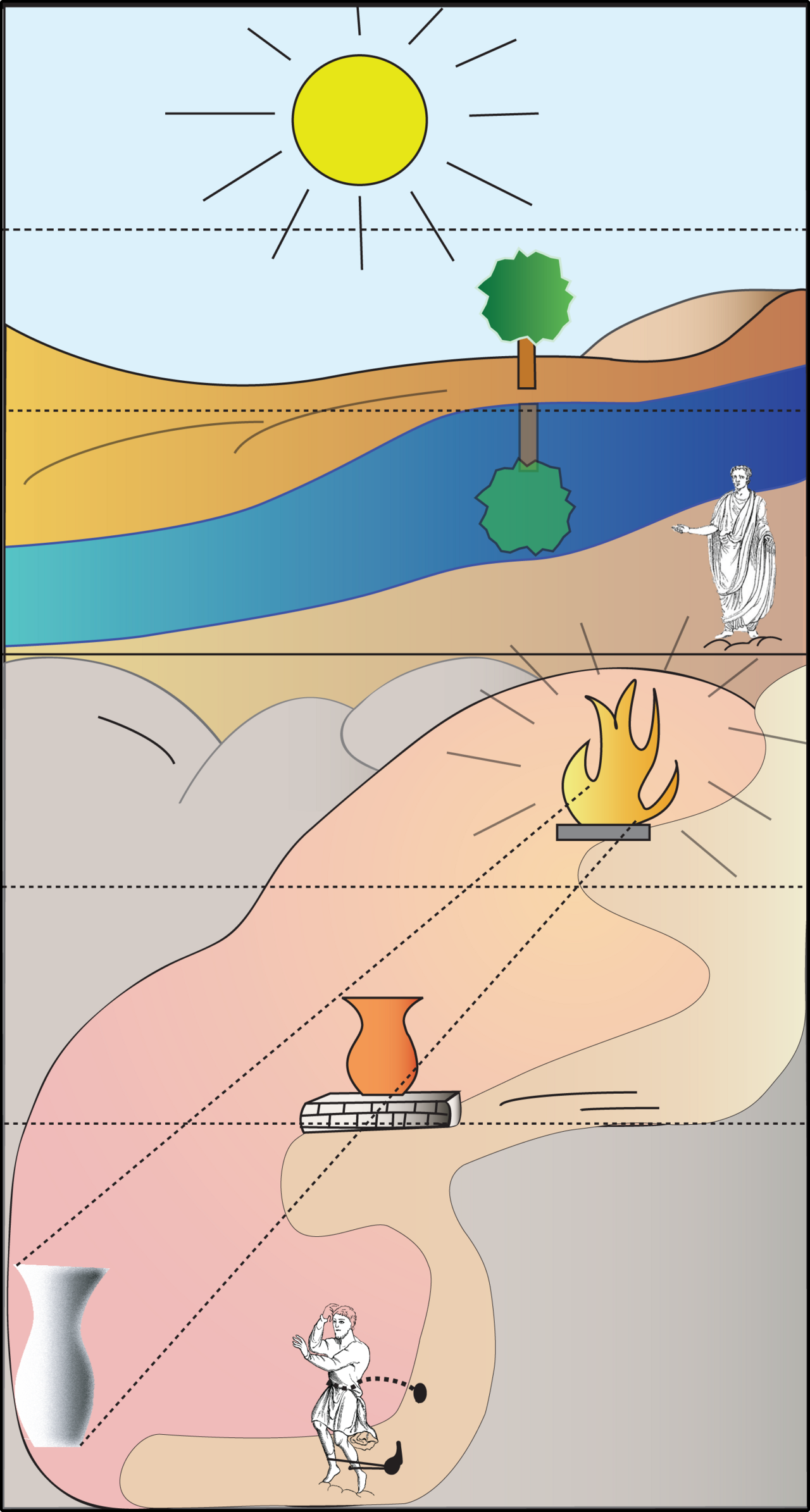
Plato asks us to imagine prisoners who have been chained by the neck and ankles their whole lives inside a cave. They face a blank wall, unable to turn their heads. Behind them, a fire burns, and between the fire and the prisoners runs a low wall. Along this wall, unseen people carry objects—including puppets shaped like men and other living things—so that only the objects cast shadows on the wall the prisoners stare at. The carriers also speak, and their voices echo off the cave walls, making the prisoners believe the sounds come from the shadows themselves. Because the prisoners have never seen anything else, they take these shadows and echoes for reality.
Socrates then imagines one prisoner is freed. Forced to turn around, the prisoner sees the fire and the objects casting the shadows. The light hurts his eyes, and he finds the new sights confusing and painful. He would rather retreat to the familiar shadows. If someone dragged him up the rough, steep path out of the cave into the sunlight, he would resist and feel angry. Once outside, his eyes would slowly adjust: first seeing only shadows, then reflections in water, then people and things themselves, and eventually the stars and moon at night. Finally, he could look directly at the sun and reason about its nature. He would realize that the world outside the cave is far superior to the shadow-world he knew.
The freed prisoner would pity those still chained and want to lead them out. But when he returns to the cave, his eyes, now used to the sun, are blind in the darkness. The remaining prisoners see his blindness and conclude that leaving the cave harmed him. They would not want to follow, and Socrates remarks that if they could, they would kill anyone who tried to drag them out.
The allegory illustrates Plato’s idea that the shadows on the wall are distorted copies of reality, perceived through the senses, while the objects under the sun represent true forms, accessible only through reason. Above the level of shadows and physical objects, three higher realms exist: natural science, deductive mathematics and logic, and finally the theory of forms. The philosopher, like the freed prisoner, aims to grasp these higher levels, but the other inmates, knowing nothing better, have no desire to leave their prison.
- work
- Republic
- section
- 514a–520a, Book VII
- characters
- Socrates, Glaucon
- author
- Plato
- related_analogies
- analogy of the Sun, analogy of the divided line
Lore & Background
In the allegory, Plato describes people who have spent their entire lives chained by their necks and ankles facing the back wall of the cave, where shadows are projected. They observe the shadows cast by objects carried behind them by people who are invisible to the chained 'prisoners' and who walk along a low wall with a fire behind them, creating the shadows on the wall in front of the prisoners. The people carrying the objects pronounce the names of the objects, the sounds of which are reflected near the shadows and are understood by the prisoners as if they were coming from the shadows themselves. Only the shadows and sounds are the prisoners' reality, which are not accurate representations of the real world. The shadows represent distorted and blurred copies of reality we can perceive through our senses, while the objects under the Sun represent the true forms of objects that we can only perceive through reason. Two higher levels exist: dianoia (mathematical reasoning) and noesis (understanding of Forms), while natural science is typically associated with dianoia or pistis depending on interpretation, and placing it exclusively in pistis misrepresents the standard hierarchy.
Reader's Guide
The allegory of the cave is a central metaphor in Plato's Republic, illustrating his theory of Forms and the philosopher's journey from ignorance to knowledge. It contrasts the world perceived through the senses—shadows on a cave wall—with the true reality of Forms accessible only through reason. Scholars debate its interpretation, with Richard Lewis Nettleship viewing it as representing innate intellectual incapacity, while A. S. Ferguson sees it as symbolizing the opposition between the philosopher and political corruption. Martin Heidegger explored the allegory through the lens of human freedom, while Hannah Arendt argued Plato 'wanted to apply his own theory of ideas to politics'. The allegory remains influential in epistemology and political philosophy, highlighting the philosopher's duty to return to the cave and share knowledge, even at personal risk.
Did You Know?
- The allegory is written as a dialogue between Plato's brother Glaucon and his mentor Socrates.
- The prisoners believe the sounds they hear come from the shadows on the wall.
- The freed prisoner would initially be blinded by the sun and prefer the shadows.
- Scholars debate whether the allegory is primarily epistemological or political.
The Narrative and Its Philosophical Core
The Allegory of the Cave occupies a central place in Book VII of Plato's Republic, presenting a vivid scenario in which a group of people have spent their entire existence bound in a subterranean chamber, their faces turned toward a bare wall. Behind them, a fire casts the silhouettes of objects passing by, and the captives, having never seen anything else, attach names and categories to these flickering shapes, constructing an entire language around what they perceive as the world. These shadows represent the nearest approximation to truth available to them. The turning point arrives when a single prisoner manages to break free and emerge into the open, where he encounters the real objects whose outlines he had previously mistaken for reality. Upon returning to share his discovery, he meets not gratitude but disbelief; his fellow captives actively resist his attempts to set them free so they might see for themselves. At its most fundamental level, the allegory dramatizes the philosopher's obligation to transmit hard-won knowledge and the stubborn refusal of those who, convinced of their own education, dismiss such insight as unnecessary.
Allegory as a Spectrum of Meaning
As a literary and artistic device, allegory functions as a narrative or visual representation designed to carry moral, spiritual, or political significance beyond its surface. Writers and speakers across every era and medium have employed this technique to render complex or concealed ideas accessible and striking to audiences. The mechanism typically involves symbolic figures, actions, imagery, or events that collectively encode the deeper meaning an author intends to communicate, and many allegories rely heavily on the personification of abstract concepts. Northrop Frye offered a particularly useful framework by describing what he called a continuum of allegory, a spectrum stretching from what he labeled naive allegory, exemplified by works like The Faerie Queene, toward the more private, layered allegories found in modern paradox literature. In the naive end of this spectrum, characters are deliberately not fully three-dimensional; every facet of their personality and every event that befalls them embodies a specific moral quality or abstraction. The author selects the allegorical structure first, and the narrative details then serve merely to flesh out that pre-determined symbolic architecture.
Etymology and the Classical Debate Over Origins
The English word allegory first appears in written records in 1382, borrowed from the Latin allegoria, which itself is a latinization of the Greek term meaning veiled language or figurative speech. Its literal sense, speaking about something else, derives from allos, meaning another or different, combined with agoreuo, to harangue or to speak in the assembly, a verb rooted in agora, the public gathering place. Tracing the practice itself, scholars note that Homer already employed quasi-allegorical personifications, such as Terror (Deimos) and Fear (Phobos). The title of first allegorist, however, is contested between Theagenes of Rhegium, whom Porphyry explicitly names as such, and Pherecydes of Syros, both presumed active in the sixth century BCE. The difficulty lies in the Greek verb allēgoreīn, which can mean both to speak allegorically and to interpret allegorically. Theagenes is credited with the latter: he proposed that the gods of the Iliad actually symbolized physical elements, with Hephaestus standing for Fire. Pherecydes, meanwhile, is thought to have anticipated this approach through his cosmogonic writings, particularly his early placement of Time (Chronos) in a divine genealogy, reinterpreting the traditional titan Kronos.
Allegory Across Biblical and Medieval Traditions
Allegorical thinking extends far beyond Greek philosophy. In the Hebrew Bible, Psalm 80 employs an extended metaphor of a vine spreading and growing to represent Israel's conquest and settlement of the Promised Land, while Ezekiel chapters sixteen and seventeen use the image of a mighty Eagle capturing that same vine to signify Israel's exile to Babylon. Early Christian scholars continued this tradition of figurative reading; the recently rediscovered Fourth Commentary on the Gospels by Fortunatianus of Aquileia, for instance, relies on a set of concepts tied to key terms to produce what its translator describes as an allegorical decoding of the text. In the medieval period, allegory acquired a distinctive power: it could freeze the temporality of a story while simultaneously infusing it with a spiritual dimension. Medieval thinkers accepted that allegory possessed a reality underlying any rhetorical or fictional surface, treating the allegorical reading as equally true as the facts of appearance. Neoplatonic philosophy further developed allegorical interpretations of both Homer and Plato, a mode of reading that had its roots in the earliest readers of Homer and found fertile ground in Philo's allegorical commentaries on the Bible, ultimately shaping the writings of Proclus in the closing phases of late antique philosophy.
Gallery
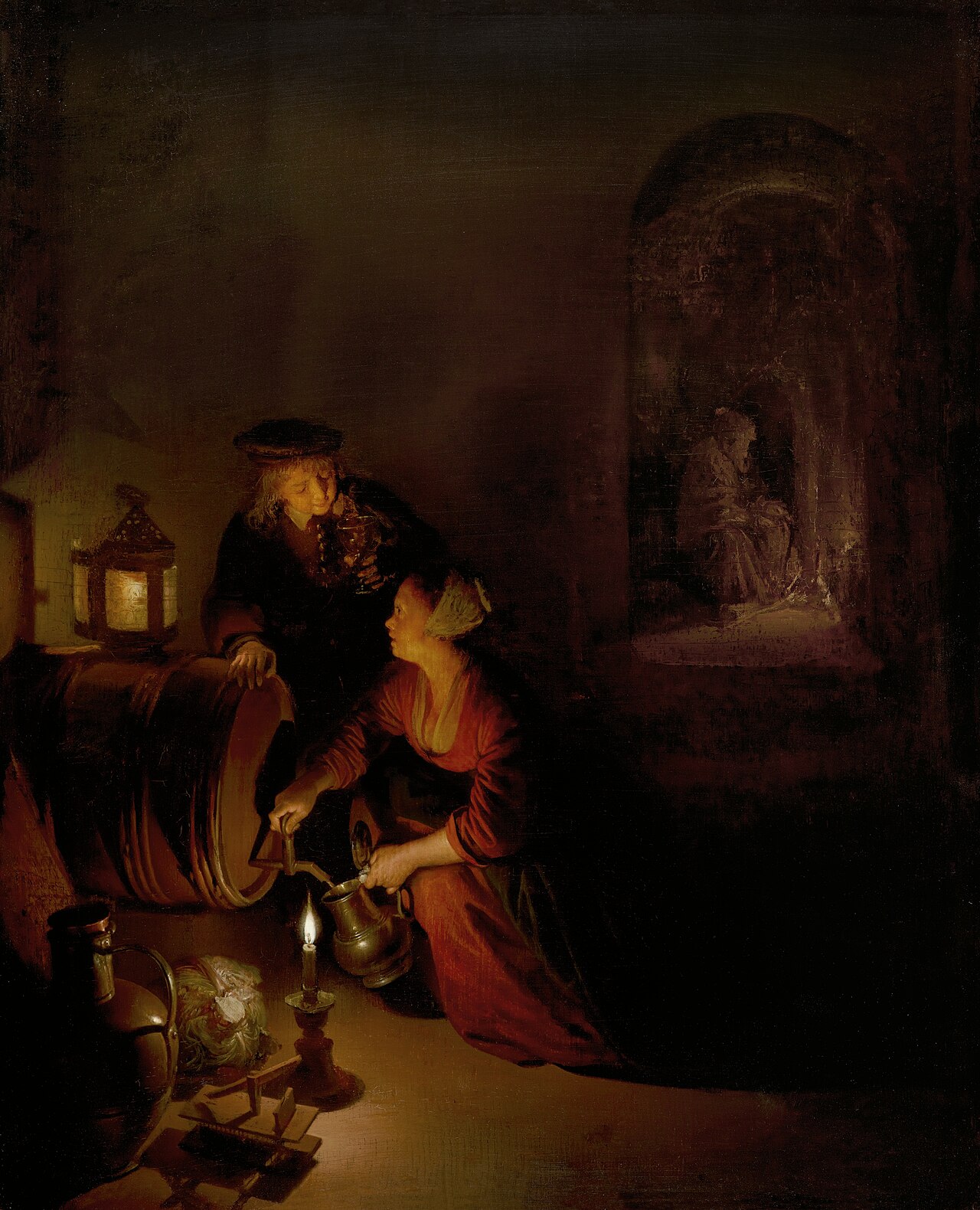
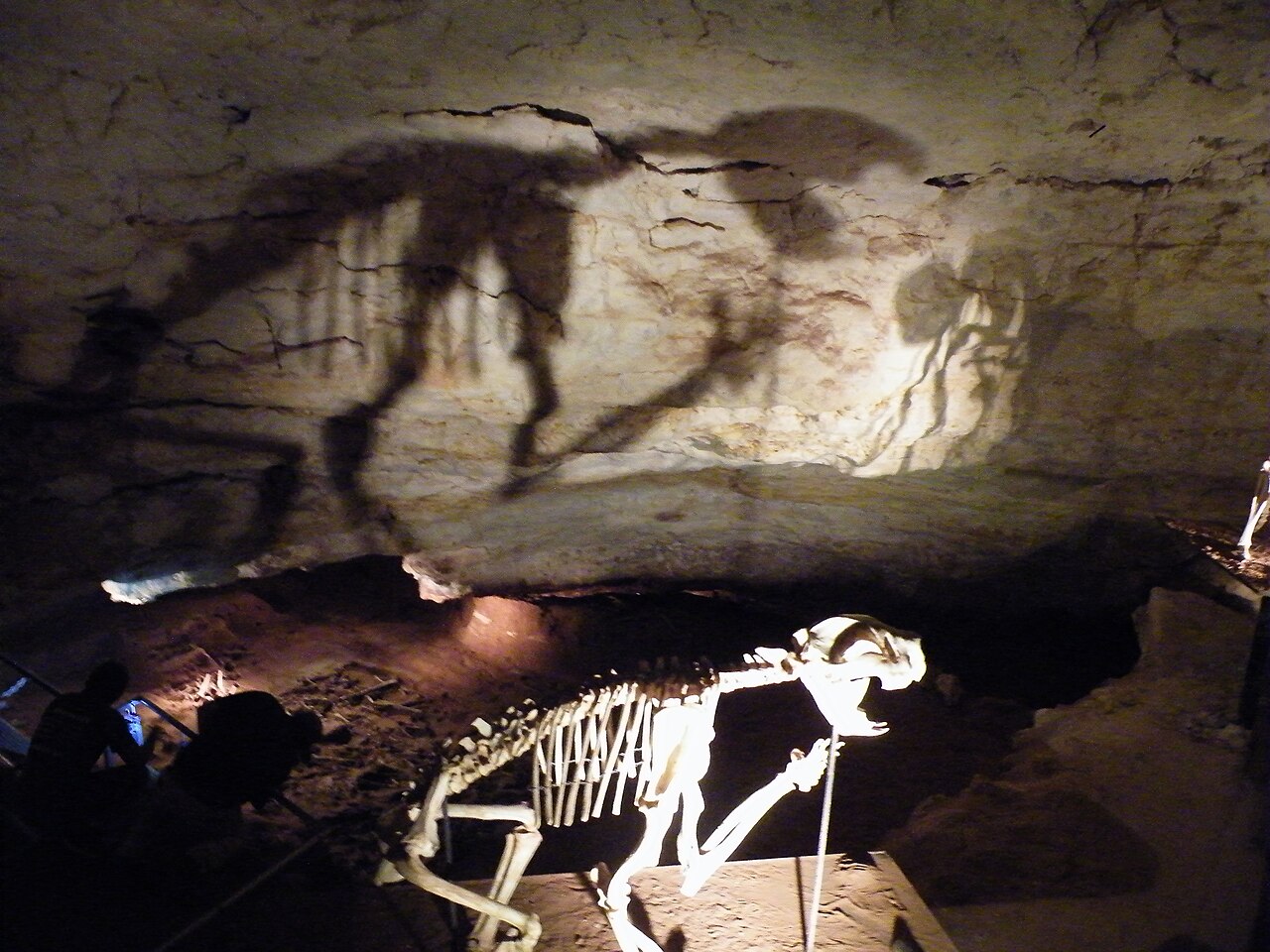
Frequently Asked Questions
Who wrote the Allegory of the Cave?
The Allegory of the Cave was composed by the ancient Greek philosopher Plato as part of his dialogue Republic. It appears in Book VII, specifically in the section spanning 514a to 520a.
What is the Allegory of the Cave about?
It is Plato's extended metaphor illustrating how education transforms human understanding, contrasting the experience of those who have been taught with those who remain in ignorance. The cave represents the uneducated state, while the journey outward symbolizes the process of learning and philosophical enlightenment.
Who tells the story of the cave in the dialogue?
Socrates narrates the allegory to his interlocutor Glaucon, who is Plato's own brother. The exchange takes place as part of a larger discussion about the nature of knowledge and the ideal state.
Where does the Allegory of the Cave fit within the Republic?
It is presented in Book VII of the Republic, following two other key analogies—the analogy of the Sun and the analogy of the divided line. Together, these three passages build a progressive picture of how truth and understanding work.
Why is the Allegory of the Cave important in philosophy?
It remains one of the most widely referenced metaphors in Western thought because it captures the tension between perceived reality and deeper truth. The allegory frames education not as simple information transfer but as a fundamental reorientation of how a person perceives the world.
More in Philosophical Traditions 1-24
Spotted an error? Know more?
This is a living reference — every entry is fact-audited, and reader corrections feed straight into our audit queue. Suggest an edit · See this site's audit record