
Analytic philosophy
A style emphasizing analysis, logic, and the linguistic turn.

Analytic philosophy is a major tradition in contemporary Western philosophy, especially in English-speaking countries. It prioritizes clear writing, careful argumentation, formal logic, mathematics, and the natural sciences over the humanities. A key feature is the "linguistic turn"—a focus on language and meaning. It's often contrasted with "continental philosophy," a label for approaches like existentialism, phenomenology, and Hegelianism. Another way to put it is that analytic philosophy is seen as technical or academic, while continental philosophy is more literary. This school started gaining ground around 1900 and has been the dominant style since the mid-20th century.
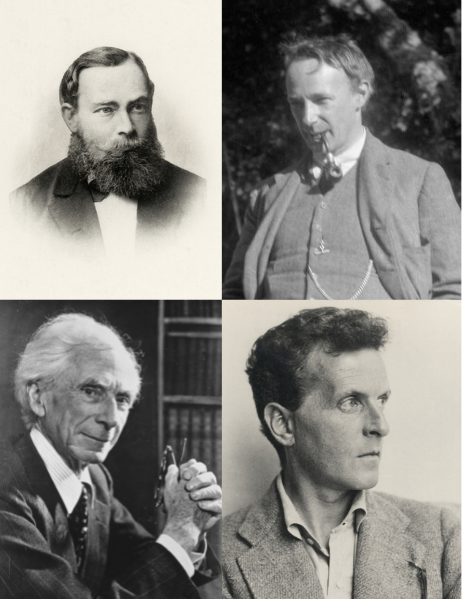
Key early figures include Gottlob Frege, Bertrand Russell, G. E. Moore, and Ludwig Wittgenstein. Others who shaped it are Franz Brentano, the logical positivists (especially Rudolf Carnap), and the ordinary language philosophers. Later, thinkers like Wilfrid Sellars, W. V. O. Quine, Saul Kripke, and David Lewis helped move past logical positivism and revived metaphysics. Analytic philosophy also created new fields, such as the philosophy of language, mathematics, and science, as well as modern predicate and mathematical logic.
The history of analytic philosophy (in its 20th/21st-century sense) typically starts with a rejection of British idealism, a neo-Hegelian movement. Important forerunners include Frege’s work in logic and language, plus the Austrian tradition of Bernard Bolzano, Franz Brentano, Alexius Meinong, and the early Edmund Husserl. In fact, Michael Dummett argued that analytic philosophy is better called Anglo-Austrian than Anglo-American, due to the strong influence of Austrian realism from the former Austria-Hungary.
Franz Brentano, a philosopher and psychologist at the University of Vienna, introduced the concept of intentionality in his 1874 work *Psychology from an Empirical Standpoint*. For him, all mental acts are directed at or "about" something—a real, non-mental intentional object. This "aboutness" is the defining mark of the mental, distinct from intention or intension. He described it as the "intentional inexistence" of an object within a mental phenomenon: in presentation, something is presented; in judgment, affirmed or denied; in love, loved; in hate, hated; and so on. No physical phenomenon has this property.
Brentano’s school included Husserl and Meinong. Meinong, who founded the Graz School, is known for his ontology of real, nonexistent objects—a solution to the problem of empty names. This view, called Meinongianism (or "Meinong's jungle"), holds that objects like flying pigs or golden mountains are real and have being, even though they don't exist. The Polish Lwów–Warsaw school, founded by Kazimierz Twardowski, was also influenced by Brentano. Twardowski emphasized "small philosophy"—the detailed, systematic analysis of specific problems—and was further influenced by the Bohemian logical realist Bernard Bolzano.
Gottlob Frege, a German professor of geometry, logician, and philosopher, is considered the father of analytic philosophy. He advocated logicism—the project of reducing arithmetic to pure logic—supporting Leibniz and opposing Kant in the philosophy of mathematics. In his 1879 book *Begriffsschrift* (Concept-script), Frege developed modern mathematical and predicate logic with quantifiers, unifying Aristotelian and Stoic logic. This allowed a much wider range of sentences to be analyzed logically, solving problems like multiple generality.
In the late 19th century, Neo-Kantianism dominated German philosophy. Husserl’s 1891 *Philosophie der Arithmetik* argued that the concept of a cardinal number comes from mental acts of grouping and counting. Frege opposed this "psychologism" in *The Foundations of Arithmetic* (1884) and *The Basic Laws of Arithmetic* (1893–1903), arguing that mathematics and logic have their own public objects, independent of private judgments. Following Frege, logicists tended toward a kind of mathematical Platonism. The modern study of set theory was started by Richard Dedekind and Georg Cantor, and Giuseppe Peano simplified Dedekind’s work into Peano arithmetic. Frege extended this by trying to reduce arithmetic to logic, developing naive set theory and a set-theoretic definition of natural numbers. Frege also influenced the philosophy of language; Michael Dummett traces the linguistic turn to Frege’s *Foundations of Arithmetic* and its context principle.
- field
- Philosophy
- known_for
- Emphasis on analysis, formal logic, mathematics, natural sciences, and the linguistic turn
- origins
- Turn of the twentieth century, especially in anglophone and Austrian contexts
- central_figures
- Gottlob Frege, Bertrand Russell, G. E. Moore, Ludwig Wittgenstein
- contrasted_with
- Continental philosophy (existentialism, phenomenology, Hegelianism)
Lore & Background
Analytic philosophy was significantly influenced by Austrian realism in the former state of Austria-Hungary, so much so that Michael Dummett remarked it is better characterized as Anglo-Austrian rather than the usual Anglo-American. Important precursors include the work of Gottlob Frege in formal logic and the philosophy of language, as well as the Austrian tradition associated with Bernard Bolzano, Franz Brentano, Alexius Meinong, and the early Edmund Husserl. Brentano gave to philosophy the problem of intentionality, or aboutness, arguing that all mental events have an immanent (mental) intentional object, not necessarily a real, non-mental entity. Meinong founded the Graz School and is known for his ontology of real, nonexistent objects.
Reader's Guide
The history of analytic philosophy is usually thought to begin with the rejection of British idealism, a neo-Hegelian movement. Central figures in its history include Gottlob Frege, Bertrand Russell, G. E. Moore, and Ludwig Wittgenstein. Other important figures include Franz Brentano, the logical positivists (especially Rudolf Carnap), and the ordinary language philosophers. Wilfrid Sellars, W. V. O. Quine, Saul Kripke, David Lewis, and others led a decline of logical positivism and a subsequent revival in metaphysics. Analytic philosophy has also developed several new branches of philosophy and logic, notably philosophy of language, mathematics, and science, and modern predicate and mathematical logic. The distinction has also been drawn between 'analytic' being academic or technical philosophy and 'continental' being literary philosophy.
Did You Know?
- Analytic philosophy is often contrasted with continental philosophy, a catch-all term for methods prominent in continental Europe, most notably existentialism, phenomenology, and Hegelianism.
- Gottlob Frege is understood as the father of analytic philosophy and advocated logicism, the project of reducing arithmetic to pure logic.
- Franz Brentano gave to philosophy the problem of intentionality, or aboutness, calling it 'the mark of the mental.'
- The Polish Lwów–Warsaw school, founded by Kazimierz Twardowski, was influenced by Brentano and emphasized 'small philosophy,' or the detailed, systematic analysis of specific problems.
Gallery
Frequently Asked Questions
Who is Analytic philosophy?
Analytic philosophy is a dominant style of Western thought that crystallized around the early 1900s, mainly in English-speaking and Austrian academic circles. It prioritizes clear argumentation, logical rigor, and close attention to language over broad speculative narratives.
What are Analytic philosophy's powers and role?
Its core toolkit centers on formal logic, mathematical precision, and the so-called linguistic turn—the conviction that many philosophical puzzles dissolve once you carefully examine how words are actually used. It also leans heavily on findings from the natural sciences to ground its claims.
How does Analytic philosophy's story end?
It never truly concludes; instead, it has held the dominant position in anglophone university departments since the mid-twentieth century. Its influence continues to shape how philosophy is taught and practiced, even as it increasingly engages with questions once reserved for its rivals.
Why is Analytic philosophy important?
It reshaped the entire discipline by insisting that philosophical writing be as transparent and testable as a scientific paper, which raised the argumentation bar across the field. Without its emphasis on logic and clarity, modern philosophy departments would look fundamentally different.
Who are Analytic philosophy's central figures?
The founding cast includes Gottlob Frege, Bertrand Russell, G. E. Moore, and Ludwig Wittgenstein, all working in the early 1900s. Their collective push toward formal logic and linguistic analysis set the template that later generations of analytic thinkers followed.
More in Philosophical Concepts 1-24
Spotted an error? Know more?
This is a living reference — every entry is fact-audited, and reader corrections feed straight into our audit queue. Suggest an edit · See this site's audit record