Friedrich Hölderlin
German poet and philosopher of German Romanticism and Idealism.
Last updated

Johannes Baier · CC BY 4.0
He is described as a key figure of German Romanticism and an important thinker in the development of German Idealism.[1] Hölderlin's life was marked by theological training alongside Hegel and Schelling, followed by a period of simultaneous philosophical and poetic activity.[2] Johann Christian Friedrich Hölderlin, a German poet and philosopher, came into the world on 20 March 1770 in Lauffen am Neckar.[3][4]
Life and work
His mother planned for him to join the Lutheran church, and he began formal training for the ministry in 1784 at the Lower Monastery in Denkendorf.[5][6] He found a position as a private tutor and fell passionately in love with his pupils’ mother, Susette Gontard.[2] Hölderlin was accused of high treason but was released on grounds of diminished mental capacity.[2] On 11 September 1806, he was delivered into a clinic in Tübingen run by Dr. Johann Heinrich Ferdinand von Autenrieth.[7]
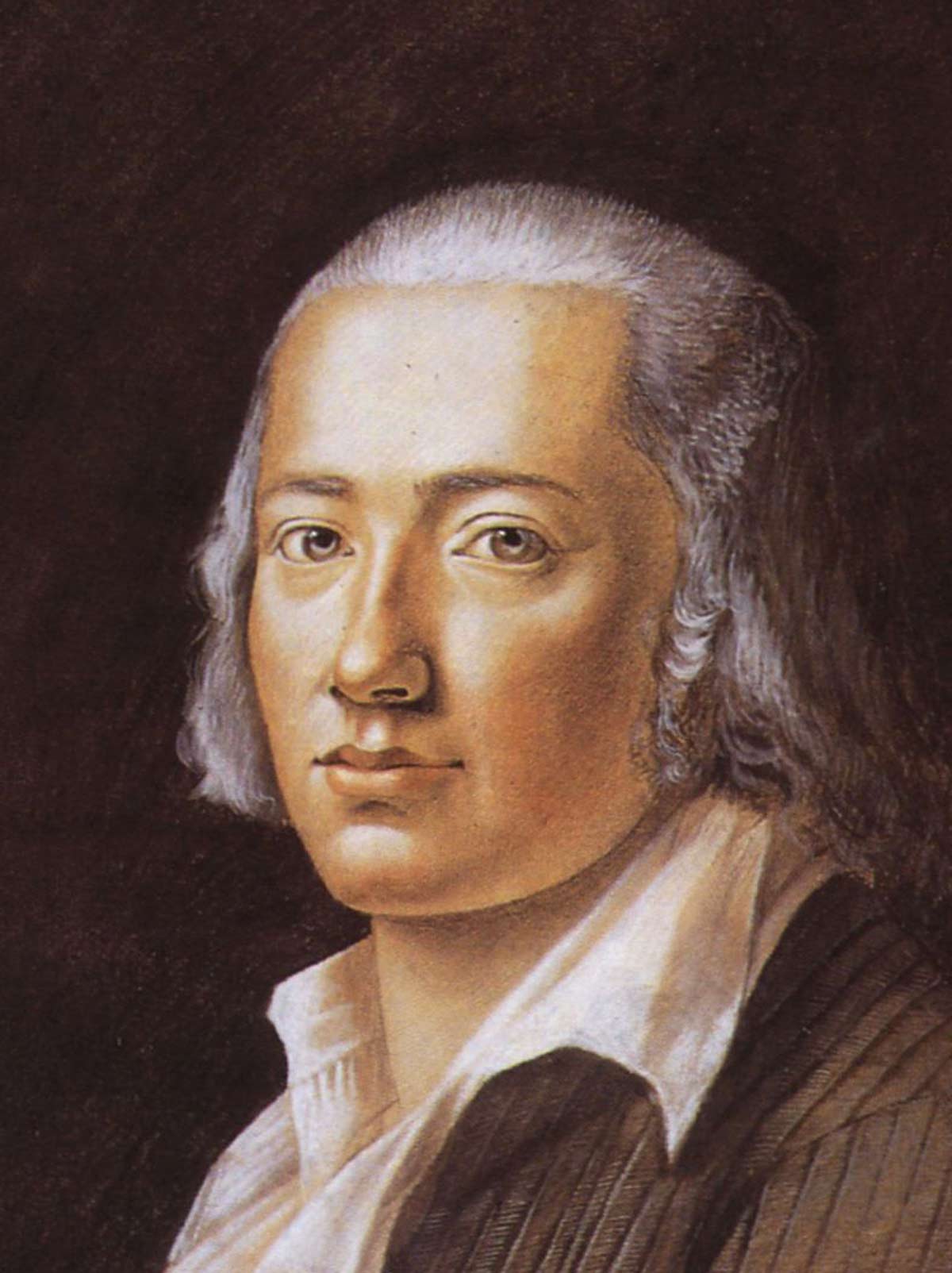
Friedrich was the eldest child of Johanna Christiana Heyn and Heinrich Friedrich Hölderlin; his father, a church estate manager, passed away when Friedrich was two years old.[3] Theological studies at the Tübinger Stift were commenced by Hölderlin in October 1788; among his peers there were Hegel, Schelling, and Isaac von Sinclair.[8] The French Revolution received enthusiastic backing from Hölderlin, Hegel, and Schelling, yet Hölderlin did not support the Reign of Terror.[9] While residing in the tower, Hölderlin produced poetry marked by a simplicity and formality that contrasted sharply with his pre-1805 work.[10]
What the cited sources add
A source on Hölderlin's philosophy states that his key idea is a primordial unity he calls Absolute Being, which grounds the subject-object relation.[2] The same source notes that Hölderlin's ethical views emphasize life as torn between a hankering after original unity and freedom's desire to assert itself.[2] His philosophical text "Über Urtheil und Seyn" was only first published in 1961, and in it he argues that subjectivity cannot provide the first principle of philosophy.[2] The source also reports that Hölderlin's personal acquaintance with Schiller, Novalis, Fichte, Schelling and Hegel ensured the dissemination of his ideas among his contemporaries.[2]
Musical settings of Hölderlin's late poems include Kaija Saariaho's "Tag des Jahrs" (2001) for mixed choir and electronics, which uses four of those poems.[11][12]
References
- Wikipedia, "Friedrich Hölderlin" (CC BY-SA 4.0), which cites: Warminski, "Readings in Interpretation: Hölderlin, Hegel, Heidegger", U of Minnesota Press, 1987, p. 209; "The Cambridge Companion to Hegel", Cambridge University Press, 1993, p. 419; "Because of his small philosophical output, it is important to indicate in what way Hölderlin's ideas have influenced his contemporaries and later thinkers. It ; "Hegel is completely dependent on Hölderlin—on his early efforts to grasp speculatively the course of human life and the unity of its conflicts, on the vividnes; "Indeed, the Pietistic Horizon en.wikipedia.org
- "Because of his small philosophical output, it is important to indicate in what way Hölderlin's ideas have influenced his contemporaries and later thinkers. It . facts only, no text reused. iep.utm.edu
- Wikipedia, "Friedrich Hölderlin" (CC BY-SA 4.0), which cites: Mieth, "Friedrich Hölderlin: Dichter der bürgerlich-demokratischen Revolution", Königshausen & Neumann, 2001, p. 29 (original not read by us) en.wikipedia.org
- Wikipedia, "Friedrich Hölderlin" (CC BY-SA 4.0) en.wikipedia.org
- Wikipedia, "Friedrich Hölderlin" (CC BY-SA 4.0), which cites: Altman, "The Palgrave Handbook of German Idealism", Palgrave Macmillan, 2014, p. 439 (original not read by us) en.wikipedia.org
- Wikipedia, "Friedrich Hölderlin" (CC BY-SA 4.0), which cites: Hölderlin, "Selected Poems and Fragments", Penguin UK, 2007, p. 26 (we also read that source) en.wikipedia.org
- Wikipedia, "Friedrich Hölderlin" (CC BY-SA 4.0), which cites: Constantine (1990), p. 299. (original not read by us) en.wikipedia.org
- Wikipedia, "Friedrich Hölderlin" (CC BY-SA 4.0), which cites: Shelton, "The Young Hölderlin", Peter Lang Publishing, Incorporated, 1973, p. 107; Hölderlin, "Hyperion and Selected Poems", A&C Black, 1990, p. 11 (we also read that source) en.wikipedia.org
- Wikipedia, "Friedrich Hölderlin" (CC BY-SA 4.0), which cites: Good, "A Search for Unity in Diversity: The "permanent Hegelian Deposit" in the Philosophy of John Dewey", Lexington Books, 2006, p. 4; Krell, "Introduction to "The Death of Empedocles"", SUNY Press, 2008, p. 1; Magun, "Negative Revolution: Modern Political Subject and its Fate After the Cold War", Bloomsbury Publishing US, 2013, p. 171 (original not read by us) en.wikipedia.org
- Wikipedia, "Friedrich Hölderlin" (CC BY-SA 4.0), which cites: Constantine (1990), p. 302. (original not read by us) en.wikipedia.org
- Wikipedia, "Friedrich Hölderlin" (CC BY-SA 4.0), which cites: "Tag des Jahrs Kaija Saariaho", www.wisemusicclassical.com; "Überzeugung Kaija Saariaho", www.wisemusicclassical.com; "Die Aussicht Kaija Saariaho", www.wisemusicclassical.com (we also read that source) en.wikipedia.org
- "Tag des Jahrs Kaija Saariaho", www.wisemusicclassical.com. facts only, no text reused. wisemusicclassical.com
Each numbered sentence above was checked against the source it cites before publication. Sentences citing Wikipedia adapt text from the English Wikipedia article Friedrich Hölderlin (contributors), used under CC BY-SA 4.0; this entry is available under the same licence. Other sources were used for facts only; no text or images are copied from them.
More in Philosophers
Related in Philosophers
Links follow this subject's own source article.
Sources
Compiled from Wikipedia and the sources listed below. Text from Wikipedia is available under CC BY-SA 4.0; this entry is adapted from it.
- Wikipedia: Friedrich Hölderlin (CC BY-SA 4.0).
Spotted an error? Know more?
Reader corrections go straight into our review queue. Suggest an edit · How this site is sourced